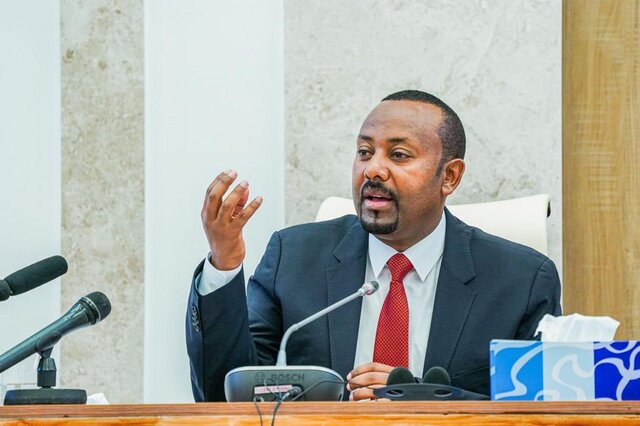
Addis Ababa – Abiy Ahmed took power in Ethiopia in 2018, raising hopes that it would become a more open, democratic country, but his rule has been marked by mounting repression and civil war.
The “Abiymania” of his early months as leader of the Horn of Africa nation saw him feted at home and abroad for releasing political prisoners, loosening the state’s grip on the media, and promising to open up the heavily controlled economy.
He even won the Nobel Peace Prize in 2019 for a rapprochement with neighbouring Eritrea.
“He enjoyed broad popular support at a time when people were hoping for change,” said Roland Marchal, a researcher at the Center for International Studies and Research (CERI) in Paris.
But that soon gave way to the sort of authoritarianism familiar to Ethiopians.
“He is becoming more and more like an imperial leader,” said Cameron Hudson, of the Center for Strategic and International Studies in Washington.
Abiy, 49, looks set to cruise to a new term in elections on Monday expected to deliver a landslide victory for his Prosperity Party — which the committed Pentecostal Protestant named in direct reference to “prosperity theology”, which emerged from the United States and sees wealth and health as a divine blessing.
“Abiy believes he is an agent of God’s will, and that his leadership has a divine purpose,” said Tom Gardner, author of “The Abiy Project: God, Power and War in the New Ethiopia”.
“Such an outlook does not leave much space for dissent. It is not a very democratic mindset,” he added.
– Modest background –
Abiy was born on August 15, 1976, into a modest family in Beshasha in the central Oromia region, to a Muslim father and Orthodox Christian mother, the two main religions of Ethiopia.
He fought the Communist military regime of Mengistu Haile Mariam, which was overthrown in 1991 by rebels from the northern Tigray region, and rose through the army ranks to become a lieutenant colonel, eventually heading the cybersecurity branch of the intelligence service for two years.
In 2010, he traded his fatigues for a suit as a member of parliament, and five years later became minister of science and technology.
Abiy was a relative outsider as an Oromian among a ruling elite dominated by Tigrayans, but was chosen as prime minister in 2018 in a bid to ease violent protests in the country’s heartlands.
He seized the opportunity to introduce popular, liberalising reforms and take over the apparatus of the state.
His rapprochement with Eritrea — formally ending a 1998-2000 war that he himself had fought in, and which he described as “absolute hell” — earned him the Nobel Prize.
But less than a year later, he sent federal troops into Tigray, accusing regional forces of attacking military bases.
The resulting civil war lasted two years, marked by atrocities on all sides and more than 600,000 deaths, according to the African Union.
Abiy’s international reputation was destroyed.
“During the first months in power, he was quite courageous,” Marchal said. “(But) he was blinded by his animosity toward (Tigrayan rivals), and the Nobel Peace Prize was awarded to him far too soon,” said Marchal.
Abiy now gives few interviews, has muzzled the press, and ensured no opposition can emerge to challenge him.
Apart from some limited and tentative steps to liberalise the economy, his main focus has been a tumultuous urban renewal programme, tearing up the capital Addis Ababa for a Dubai-style makeover.
“He truly believes that he is able to undertake transformative projects in the country, but with that comes a certain hubris,” said Hudson, comparing his approach to that of another regional leader criticised as ruthless, Rwanda’s Paul Kagame.
“It looks nice, it’s clean, but it is a brutal regime,” he said.
Follow African Insider on Facebook, X and Instagram
Picture: Twitter/@PMEthiopia
For more African news, visit Africaninsider.com
Source: AFP