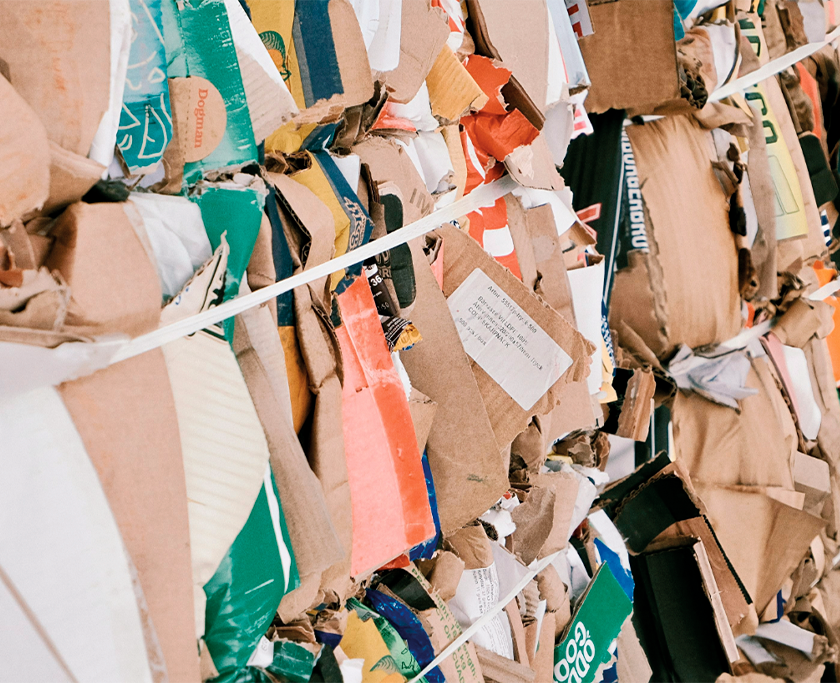
Reduce, Reuse, Recycle. This mantra, with origins linked to the first National Earth Day in the US in 1970, has formed the basis of recycling campaigns worldwide.
Food and beverage corporation Nestlé has created its own mantra – Rethink, Reduce and Repurpose, which guides its recycling efforts. These principles have provided a practical strategy for the company to transform its operations and adopt more sustainable methods of production. These three pillars guarantee that packaging, such as the material used in Nestlé Nespray sachets, can seamlessly enter the recycling process. The company says the adoption of Designed for Recycling (D4R) materials, which has already led to a reduction of 78 tons of packaging waste per year, showcases the substantial influence purposeful design can have. Several of its brands are also now 100% designed for recycling, with KitKat packaging converted from traditional foil and back to flow wrap and the Smarties packaging transitioning to paper.
Nestlé believes that achieving plastic neutrality is attainable if companies prioritise sustainability as a fundamental part of their operations and that it is vital for them to design packaging for a circular economy. ‘Plastic neutrality is not a choice – it is a necessity,’ according to Mark Helfrich, the then packaging engineering manager for Nestlé’s East and Southern African region. ‘We have the opportunity and responsibility to drive lasting change, and each step we take brings us closer to a world where waste is minimised and resources are preserved for future generations.’
The South African Plastic Pact’s 2024 Impact Report reflects that a growing number of companies in the country’s plastics industry have the same commitment to sustainability.
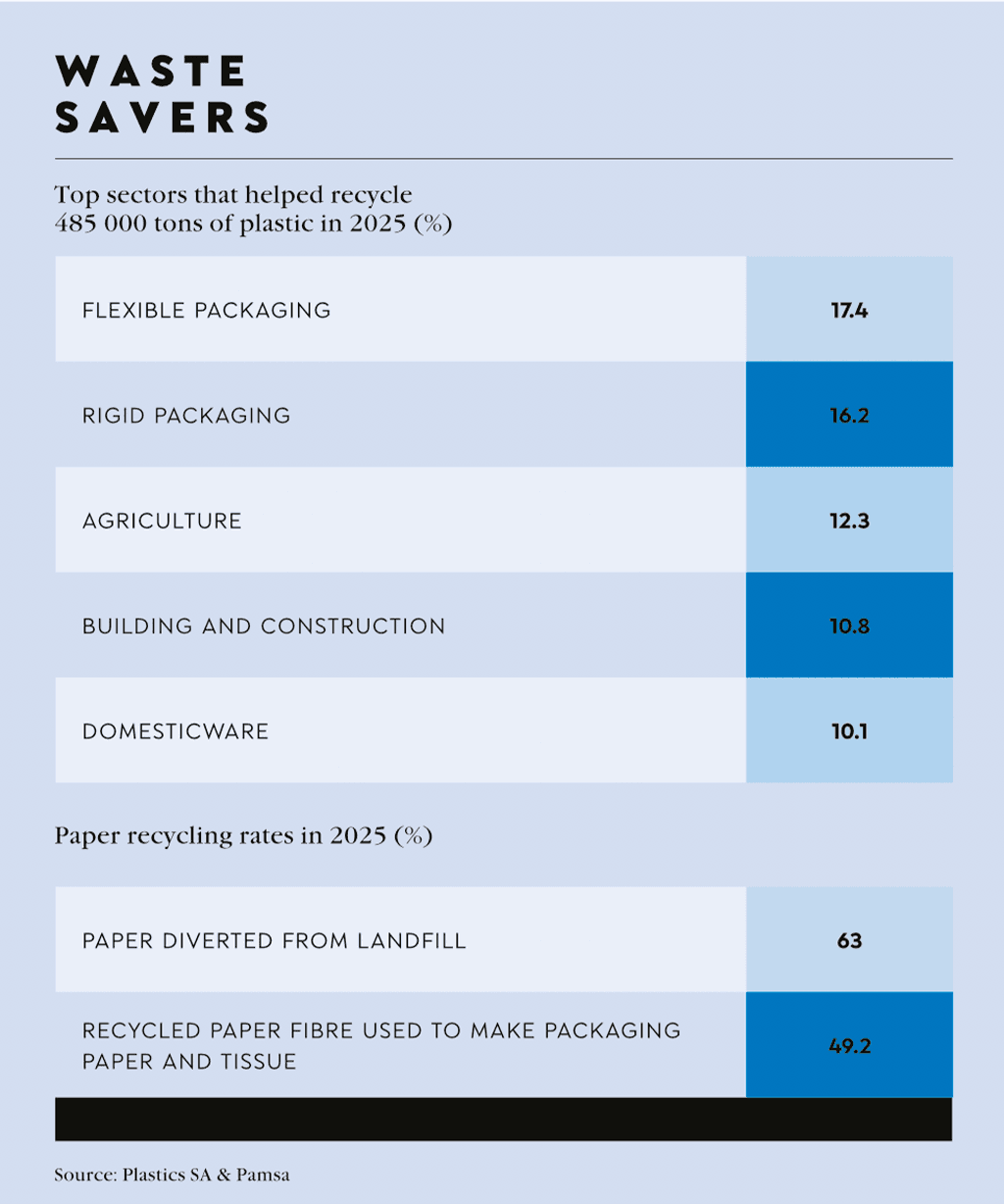
According to the report, member companies, such as Polyco, Petco, Plastics SA and the Consumer Goods Council of South Africa, have made significant strides towards the 2025 circular economy targets for plastics packaging in the country. The report shows that members have invested ZAR4 billion-plus in upstream and midstream circular-economy activities since 2020, helping drive progress towards the targets. Members have reduced problematic and unnecessary plastic items by 35%, or 55 million units; 72% of members’ packaging portfolios are now recyclable, reusable or compostable, and members have increased the amount of recyclable packaging on the market by 28% or 34 000 tons. In terms of ensuring a minimum 30% recycled content, Plastics Pact members achieved an average of 19% recycled content across all plastic packaging.
‘Our work has increasingly focused on practical solutions, including improving packaging design for recyclability, growing demand for locally sourced recycled material, supporting reuse and refill models, and building greater transparency through improved data reporting,’ says South African Plastics Pact chairperson Blain van Wyk, who is also PepsiCo Southern Africa’s public policy and government affairs manager.
The industry has also made a big shift with the implementation of legislation in the country in the past five years. The extended producer responsibility (EPR) regulations, introduced in May 2021, require producers, importers and brand owners to register with the Department of Forestry, Fisheries and the Environment and take financial and operational responsibility for the life cycle of their packaging. Companies must also join an approved producer responsibility organisation, such as industry bodies Petco (plastics/PET), Fibre Circle (paper) and Polyco (polyolefins), or set up an independent EPR scheme to manage collection and recycling.
But regulation alone can’t solve the country’s recycling challenges. Plastics SA continues pushing design-for-recycling standards, training and circular-economy awareness campaigns. ‘Plastics SA and its industry partners remain committed to driving positive environmental change through a combination of recycling growth, education, innovation and collaboration,’ Plastics SA executive director Anton Hanekom told Business Day Earth. ‘These initiatives are focused on addressing plastic leakage into the environment while strengthening South Africa’s circular economy and supporting the livelihoods that depend on it.’
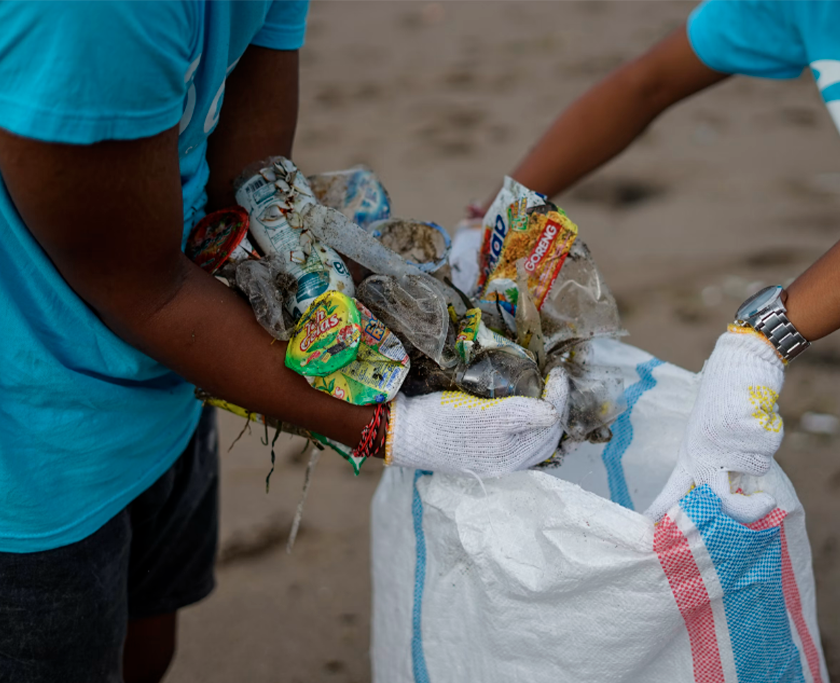
One of those initiatives is Innovative Solutions for Waste. ‘Through collaboration with a range of stakeholders, Plastics SA is working on developing a blueprint for long-term strategies to strengthen waste infrastructure, improve sorting and collection efficiencies, and unlock economic opportunities within the waste-management sector,’ adds Hanekom.
Food processing and packaging solutions company Tetra Pak also supports several initiatives around the country that are making an impact in the recycling sector. When Jocelyn van der Ross joined the company’s enterprise and supplier development programme, it enabled her to expand her Franschhoek-based business, Green Spot Trading.
Towards the end of last year, Eikestad Nuus reported that this modest waste-collection operation had evolved into a thriving enterprise employing 44 people and partnering with municipalities in the area. Van der Ross says that after Tetra Pak’s investment, Green Spot Trading could purchase vehicles, containers, uniforms and essential safety gear and was able to brand its fleet and launch a website. ‘It’s empowering to see the team thrive and to know our work is making a real difference,’ she says.
Tetra Pak, which typically supports businesses for at least three years before introducing new small businesses into its programme, says it has seen how supporting women recyclers can create a positive ripple effect for companies and local communities. ‘Mature programmes show that when large companies back women-led SMMEs, they don’t just help them survive,’ says Klaus Plenge, MD for Tetra Pak South Africa. ‘They give them the tools to thrive, innovate and lead change in their industries.’
In addition, Tetra Pak has commissioned a new PolyAl processing plant in Germiston, Gauteng – a ZAR19 million investment that will help convert used beverage cartons into new industrial products. According to Engineering News, it aims to ramp up South Africa’s carton recycling rate to 40% by 2030. The plant separates the layer of polyethylene and aluminium, known as PolyAl, from used beverage cartons once manufacturing partner Mpact has recovered the paper fibre for papermaking at its mill. The recovered PolyAl is processed into pellets, which Timber Plastics converts into finished products, including outdoor furniture and pipes.
The Council for Scientific and Industrial Research (CSIR) has supported product development, helping validate applications such as pipes being developed as an alternative to conventional high-density polyethylene piping.
‘We’ve worked quite hard with a variety of partners, the CSIR being one of them, whereby we develop applications that are suitable to the South African market and make sure we continue to drive innovation,’ says Tetra Pak Southern Africa sustainability head Masale Monoko. He adds that the investment builds on several years of progress in the country’s carton recycling rate, which has grown from 8% in 2023 to 33%. Tetra Pak has supported this with targeted infrastructure investment, including a monitoring system giving real-time visibility of collection points and buyback centres across the country and a team of graduates deployed across all nine provinces to work directly with buyback centres and collectors, resolving on-the-ground challenges every two weeks. Petco works with waste reclaimers, buyback centres and municipalities to channel cartons into the recycling system.
Manoko emphasises that waste pickers who collect and sort cartons remain essential to the process. ‘This whole process that you see here involves partners in each and every stage. We cannot do it alone.’
A concerted group effort is also ensuring that South Africa’s packaging lifecycle is becoming increasingly circular.
This is vital as recycling is no longer simply about what happens to packaging after it is discarded – it starts with how it is designed and produced.
By Philippa Byron
Image: Gallo/Getty Images