You know a technology has gone mainstream when even the tax man is using it. Since 2021, the South African Revenue Service (SARS) has reported using algorithms, machine learning and other advanced technologies to ensure taxpayer compliance. In September 2026, former SARS commissioner Edward Kieswetter told a webinar sponsored by Ninety One that the service had ‘used AI [artificial intelligence] modelling to make tax filing for 6 million taxpayers unnecessary’.
‘Last year we paid out over ZAR450 billion of refunds, most of it in under 72 hours,’ he said. ‘The same suite of technologies has in it fraud risk detection methodology. In seven years – the number is astounding – SARS has prevented the outflow of ZAR672 billion of impermissible refunds. That’s a refund that we would have paid out if we had not used the AI technology available to us.’
SARS isn’t the only organisation squeezing benefits out of AI. In May, South African insurance platform Naked claimed a world first when it developed and deployed a native app in ChatGPT that provided a final, binding car insurance quote. The insurer hailed it as an early step towards a future where consumers use AI assistants to understand, compare and manage financial products on their behalf.
‘Our app and website are still the best way to use Naked today,’ said Alex Thomson, co-founder of Naked Insurance. ‘But we believe AI assistants will, in time, become one of the primary ways people interact with financial products, and we want to be ready for that next industry shift. This signals our readiness to keep making our offering easier, more convenient and more personalised as technology evolves. We are not waiting for AI interfaces to go mainstream. We are making sure our technology is ready when our customers are.’
Many of those customers are ready already. They use AI at home to plan holidays, write school projects and find their next streaming series, and they’re likely using it to get work done, faster and more accurately, at the office too.

‘Across critical business functions like finance, HR, procurement, sales and service, and marketing, embedded AI is driving efficiency, accuracy and smarter decisions at scale,’ says Nazia Pillay, MD at SAP Southern Africa. ‘From automating repetitive processes to delivering real-time insights and predictive recommendations, South African companies are unlocking unprecedented gains in productivity and efficiency.’
Companies in South Africa and around the world are deploying AI-enabled tools to optimise everything from recruitment to inventory management, fraud detection and, most visibly, customer service.
In 2025 Telkom was awarded Project of the Year by the South African Reward Association for developing Polipal, an AI-powered policy bot that gives employees 24/7 access to accurate HR and reward policy information, reducing administrative effort and supporting Telkom’s digital transformation. A month after launch, Polipal had achieved an 85% engagement rate and 82% positive feedback.
And it’s not just large corporates that are seeing the benefits of AI deployment. Lars Gumede, Cape Town-based founder of AI business-in-a-box NowNow, highlights the advantages for SMEs. ‘Advances in AI make it technically possible to do two things,’ he says. ‘Ground AI in locally relevant data to allow it to give accurate answers to legal, tax and other questions, as well as connect AI to [agentic] tools to allow it to do useful tasks in the real world, acting as full-time employees’.
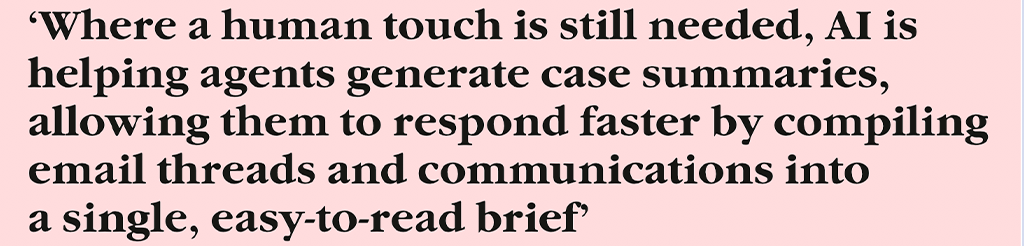
Pillay says tools such as chatbots and virtual assistants now handle routine queries with 24/7 availability, cutting service costs and improving customer satisfaction. ‘Where a human touch is still needed, AI is helping agents generate case summaries, allowing them to respond faster by compiling email threads and communications into a single, easy-to-read brief. This can boost productivity by 25% and improve first-contact resolution by 10%,’ she says.
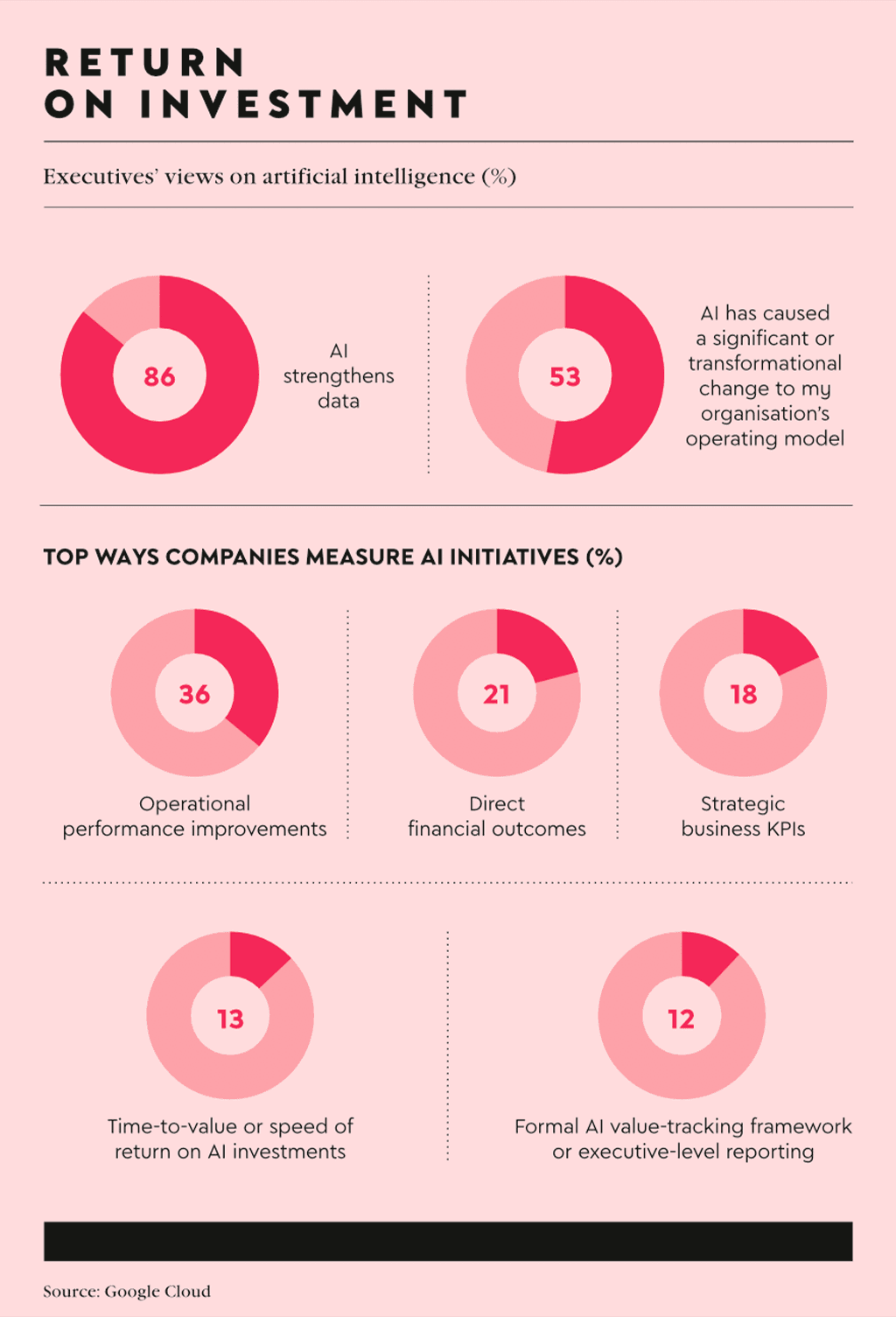
Productivity is usually where businesses first see a return on their AI investment, because it is relatively easy to measure. Routine tasks take less time, employees find information faster, and people feel as though they have an extra set of digital hands. In a McKinsey global survey, 80% of respondents said AI had improved their individual productivity, and 50% said it had helped them make better decisions.
But what about financial returns? Automating processes does cut costs, and at enterprise level the work can be done for the price of a few tokens. About 32% of McKinsey’s respondents said their organisations had decided against buying one or more software products or features and had built them in-house with agentic coding tools instead.
But there is more money to be made. A new report by Google Cloud and the National Research Group surveyed 2 403 executives across industries, geographies, company sizes and stages of AI adoption. It found that 26% of enterprises qualify as AI return-on-investment leaders, with financial returns from their AI initiatives rising year on year. A further 58% of organisations reported steadily increasing returns.
As a generative AI tool would tell you (with its long em-dashes and uncannily inhuman cadence), those numbers matter.
Pillay pointed to a separate McKinsey study suggesting that African countries could unlock as much as US$100 billion in economic value a year through GenAI alone.
‘To unlock this vast economic potential, organisations must integrate AI into core business processes and achieve measurable outcomes for clear use cases,’ she says. ‘A clean core strategy further allows businesses to respond faster to market changes and adopt new technologies like AI and advanced analytics more easily, creating clear pathways to significant ROI and business impact.’ (A ‘clean core’ keeps a company’s core systems standardised so that new technology can plug in easily.)

The real wins, then, come when organisations use AI not only to speed up the work being done, but also to optimise and refine the workflows themselves. McKinsey’s survey offers a useful pointer: companies that attribute at least 5% of their earnings before interest and taxes to AI were also three times more likely to have pursued a broad redesign of their operating model. Layering AI on top of old, inefficient ways of working may deliver an incremental improvement, but it amounts to doing things the wrong way, very quickly. Changing the processes shifts the goal to doing things better, and even faster, with larger gains as a result.
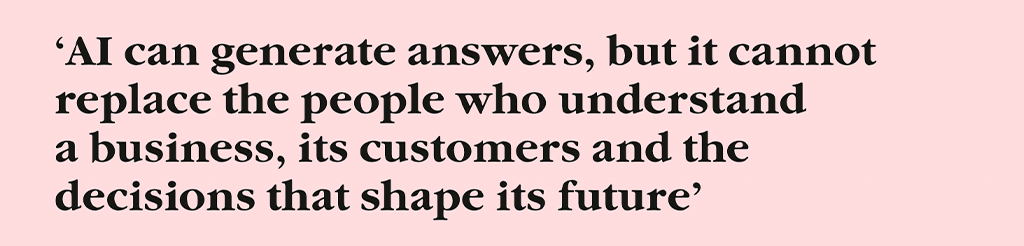
Redesigned processes don’t remove people from the picture. Bryan Harris, chief technology officer at global software company SAS, puts it well: ‘When everyone is one prompt away from the same answers, human judgement becomes the differentiator. AI can generate answers, but it cannot replace the people who understand a business, its customers and the decisions that shape its future. The organisations that gain the most from AI will be the ones that use it to amplify human expertise, not replace it.’
Kobus Vermeulen, direct sales executive of process automation at Schneider Electric, adds nuance. He says that AI, digital twins and industrial internet of things technologies mean that industrial operators no longer need to focus on manually controlling equipment. Instead, they act as supervisors of highly autonomous systems, interpreting the intelligence behind them to make strategic decisions.
‘Instead of monitoring individual process variables, operators are now investigating anomalies, reviewing predictive maintenance alerts, analysing performance trends and so forth,’ he says. ‘They are no longer asking, “How do I keep this machine running?”, but rather, “How do I optimise operations?”.’
AI excels at recognising patterns in complex industrial data, but factories and processing plants seldom operate under perfectly predictable conditions. A seasoned operator may notice unusual sounds or subtle signs of machine failure long before electronic sensors do, says Vermeulen, and these real-world observations provide context that data alone cannot capture. ‘An intelligent system may predict heat exchanger fouling or a looming compressor fault, but it is the experienced operator who verifies those predictions against real plant conditions. This continual feedback builds operational confidence and sharpens future AI models,’ he says.
Human expertise, Vermeulen adds, is the bridge between the digital representation of the plant and its physical reality.
The same applies to many of the business tasks now being enhanced, or performed, by AI. Whether it’s an insurance quote, a tax filing dispute or a customer service query, the organisations that get the most from AI will be those that decide deliberately where people sit in the process.
‘The next generation operator will spend less time controlling equipment and more time interpreting information, validating insights, managing complexity and making decisions that elevate safety, reliability and performance,’ says Vermeulen. ‘And in autonomous industrial environments, human insight may prove to be the most valuable capability of all.’