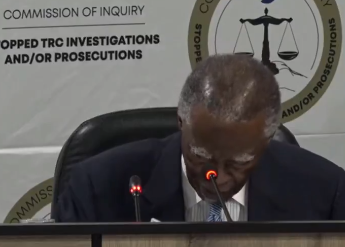
Johannesburg – Former president Thabo Mbeki has rejected allegations that he is trying to prevent the Truth and Reconciliation Commission (TRC) Cases Inquiry from uncovering the truth about the failure to prosecute apartheid-era crimes, insisting that officials responsible for stalled cases must be held accountable.
Mbeki was responding to accusations by Lukhanyo Calata, son of murdered anti-apartheid activist Fort Calata, who alleged that Mbeki and former president Jacob Zuma were attempting to conceal their failures to implement the TRC’s recommendations.
Speaking to SABC News, Calata said the legal challenge against Judge Sisi Khampepe’s role in the inquiry raised concerns about whether the two former presidents wanted the commission to reach the truth.
“I think the two former presidents are trying to hide something,” Calata said.
WATCH | Lukhanyo Calata, son of anti-apartheid activist Fort Calata, claims that former presidents Jacob Zuma and Thabo Mbeki are concealing something through their legal fight to have Judge Sisi Khampepe removed from the TRC Cases Inquiry. https://t.co/ftRpNfzbxj
— SABC News (@SABCNews) March 16, 2026
He argued that the inquiry needed to establish why people who were denied amnesty for apartheid-era crimes were not prosecuted, including those implicated in the killing of his father and other political activists.
Calata also accused the former presidents of trying to prevent scrutiny of their administrations’ handling of the TRC’s recommendations.
The Calata family has criticised former President Thabo Mbeki’s testimony at the Khampepe Commission. Mbeki took the stand on Monday before the TRC cases inquiry as it continues its investigation into alleged political interference in the prosecution of apartheid-era crimes. Tune in to #eNCA on #DStv403.
— eNCA (@eNCA) October 19, 2026
Mbeki defends his position on TRC prosecutions
Testifying before the TRC Cases Inquiry in Newtown, Johannesburg, on Monday, Mbeki again denied that his administration had politically interfered with the National Prosecuting Authority (NPA) to prevent prosecutions.
He said Calata’s criticism of his March 2024 statement, which supported Justice Jody Kollapen, was misplaced.
“It is illogical for Mr Calata to characterise my statement supporting Justice (Jody) Kollapen as disrespectful. This could only follow if he sought to shield the prosecutors that Justice Kollapen said had failed in their duties,” Mbeki said.
The former president argued that accountability required prosecutors to explain why cases referred to the NPA were not pursued.
@TRC_inquiry
Former President Mbeki response to the Calata accusation that he is showing “disrespect for the victims’ families.” https://t.co/47Jzxu8WIb— TRC_inquiry (@TRC_inquiry) October 19, 2026
“Accountability requires these prosecutors to explain why they did not prosecute, which cases were affected, whether anyone prevented or attempted to prevent prosecution, how any such interference occurred, who was responsible and why they were not prosecuted,” he said.
Mbeki maintained that investigating the failures would not amount to disrespecting Calata, his father or the families who have waited years for justice.
“Such an inquiry cannot be reasonably regarded, not least by Mr Calata, as disrespectful of him, his father’s memory or the families that have waited so long for accountability,” he said.
More than 300 TRC cases remain under scrutiny
Mbeki suggested that the failure to prosecute more than 300 cases referred to the NPA by the TRC Amnesty Committee could point to problems within the prosecuting authority itself.
He raised questions about whether prosecutors who had served under apartheid were motivated to pursue cases against former colleagues who had participated in defending the apartheid system.
“A decision was therefore taken that the prosecution of these large numbers of former apartheid operatives who had been denied amnesty by the TRC Committee must be avoided at all costs,” Mbeki said.
He said the role of prosecutors inherited from the apartheid era needed to be examined as part of the inquiry into why the cases were not prosecuted.
The investigation includes the 1985 murders of the Cradock Four — Fort Calata, Matthew Goniwe, Sparrow Mkonto and Sicelo Mhlauli — whose killings became emblematic of apartheid-era state violence.
Calata has maintained that the inquiry must establish what the former presidents did, or failed to do, to ensure that those responsible for political killings were brought to justice.
Follow African Insider on Facebook, X and Instagram
Picture: Screengrab
For more African news, visit Africaninsider.com
Compiled by Glaan Sibuyi