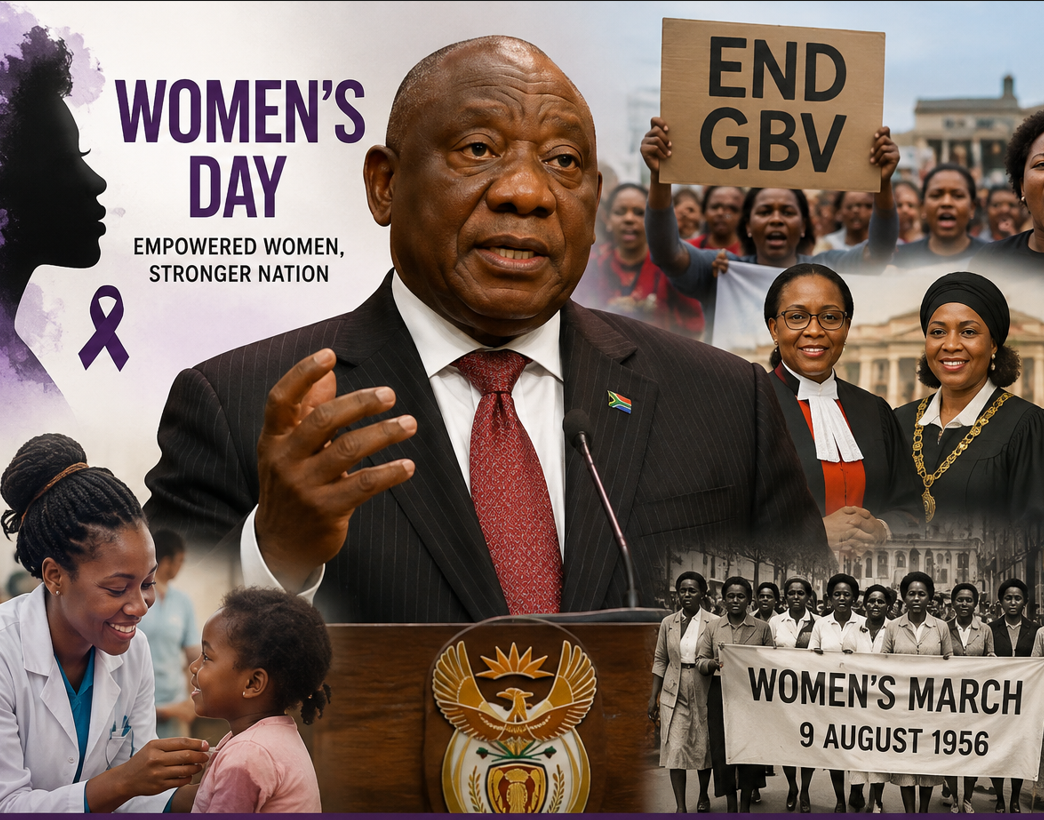
Cape Town – President Cyril Ramaphosa has called for greater investment in women’s health, safety and economic independence, warning that gender-based violence remains a major threat to women across South Africa.
In messages marking Women’s Day on Sunday, Ramaphosa said empowering women was essential to the country’s social and economic progress.
“A woman who is healthy, educated, safe and economically independent is better able to determine the course of her own life,” he said.
“By investing in women’s health, we invest in the health, productivity and future of our nation.”
Ramaphosa also highlighted the continued threat of gender-based violence and femicide, saying women remained fearful both in public spaces and in their homes.
“Today, women live in fear of the gender-based violence that stalks them in the streets, even in their homes,” he said.
He stressed that violence against women and children affected people across racial and socioeconomic lines.
“It affects rich and poor, young and old, black and white,” Ramaphosa said.
A woman who is healthy, educated, safe and economically independent is better able to determine the course of her own life.
By investing in women’s health, we invest in the health, productivity and future of our nation.#WomensDay https://t.co/YNki8gvBKo
— Cyril Ramaphosa 🇿🇦 (@CyrilRamaphosa) August 9, 2026
The president said the government had classified gender-based violence and femicide as a national disaster to mobilise the resources needed to tackle the crisis.
“That is why we classified gender-based violence and femicide as a national disaster. We did so, so that we could harness all the resources and capabilities of the state to end these crimes,” he said.
Ramaphosa also reflected on the progress South African women have made since the struggle against apartheid, noting that women now occupy some of the country’s most senior positions.
Women currently serve as Chief Justice, Speaker of the National Assembly, chairperson of the National Council of Provinces, Public Protector and Auditor-General, while also holding positions as ministers, judges, mayors, diplomats, police officers, soldiers, scientists and academics.
“These gains matter. They were fought for. They must be defended,” he said.
Human rights
Ramaphosa said South Africa had made significant progress in areas including gender parity, education, financial inclusion and political representation.
He also recalled the history of women’s resistance, including the 1956 Women’s March against apartheid pass laws.
“The women of 1956 were protesting against passes, but their message reached far beyond the pass laws,” he said.
“They challenged the idea that women should be confined to the home, silent in public affairs and subordinate to men.”
Ramaphosa said the women of 1956 had demonstrated that the struggle for women’s rights was inseparable from the broader fight for freedom.
“They made clear that no nation can be free while its women are not free,” he said.
He said the country’s commitment to gender equality remained central to building a democratic and prosperous South Africa.
“As a country we have been consistent that there can be no human rights without women’s rights,” Ramaphosa said.
“There can be no progress in society without the empowerment of women. We cannot achieve social justice without gender equality.”
Follow African Insider on Facebook, X and Instagram
Picture: ChatGPT
For more African news, visit Africaninsider.com
Compliled by Betha Madhomu