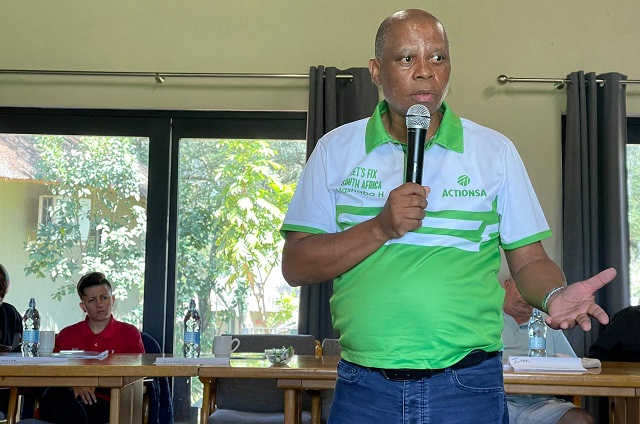
Cape Town – ActionSA leader Herman Mashaba says political tensions between his party and its coalition partners in the City of Tshwane will not undermine stability ahead of the 4 November elections.
Mashaba said in a media statement that the parties may disagree on policy, but some issues require a firm and principled position, particularly whether government should build its own capacity to deliver essential services rather than relying on private contractors.
“There are some policy questions on which political parties can legitimately disagree. There are others where the consequences of getting the answer wrong are so profound that we must be prepared to take a principled and unapologetic position.”
Mashaba said ActionSA believes government should prostop outsourcing functions it is capable of performing itself, particularly where services are permanent, essential and directly affect citizens’ daily lives.
He stressed that the position was not an attack on the private sector, pointing to his background as a businessman and his belief in entrepreneurship, investment and private enterprise as drivers of wealth creation.
Permanent function
However, he said government had a different responsibility from business. Municipalities, he argued, should question why they pay intermediaries to employ workers performing permanent functions that the state requires every day.
Mashaba pointed to his tenure as Johannesburg mayor as an example of ActionSA’s approach, saying his administration directly absorbed thousands of security guards and cleaners into permanent City employment.
“If a worker is permanently required to perform a permanent function, there must be a compelling reason why that worker should not be permanently employed.”
He said the move gave workers who had previously been vulnerable to labour brokers and tenderpreneurs direct employment, proper employment conditions and greater dignity.
Mashaba said his administration had found that tenderpreneurs could be paid substantially more than the workers ultimately performing the work, which he described as exploitation rather than empowerment.
🗣️🚨 THE ROOM SPOKE, LOUD AND CLEAR!!
After our closing 30-second remarks on why South Africans should vote for our respective parties, Cathy put the question to the floor: Had anyone had a change of heart about who they would vote for on 4 November?
The response filled the… https://t.co/1krhyJ9nhn pic.twitter.com/gTOaJapm17
— Herman Mashaba (@HermanMashaba) August 15, 2026
He pointed to ongoing protests by casual workers at Pikitup’s Randburg depot as an example. According to Mashaba, more than 300 casual workers contracted through Pikitup’s fleet ad-hoc service providers embarked on protest action in July 2026, demanding permanent employment directly from Pikitup.
For Mashaba, the nature of refuse collection illustrates why municipalities need to rethink their approach to outsourcing. Johannesburg, he said, would continue to require refuse collection for years to come, raising questions about why workers performing the service should remain temporary.
He said municipalities should first consider whether they can develop the capacity to provide essential services themselves rather than automatically issuing another tender.
ActionSA wants government to invest in institutional knowledge and skills, including training artisans and developing engineers, technicians, electricians, plumbers, mechanics, environmental specialists, project managers and administrators within public institutions.
Mashaba cited countries such as China as an example of the importance of building state capacity, while stressing that he was not suggesting South Africa copy China’s political system.
Basic responsibilities
“A government that cannot fix, maintain, manage or operate anything without hiring an outside company becomes dependent on contractors for its most basic responsibilities. That is not state capacity. That is state dependency.”
He said Tshwane was demonstrating what could be achieved through strengthening internal capacity and praised Executive Mayor Dr Nasiphi Moya for the City’s efforts.
According to Mashaba, Tshwane has been filling critical vacancies, investing in skills development and artisan training, and pursuing insourcing initiatives, including the employment of contract cleaners.
He said municipalities should first ask whether they have the skills to perform a function themselves and, if not, whether those skills could be developed before deciding to outsource.
Outsourcing, he said, should only become the preferred option when there is a genuine case that government cannot or should not perform a function internally.
Mashaba also criticised Helen Zille’s position on the role of the private sector in rebuilding Johannesburg. He acknowledged her right to advocate for greater private-sector involvement but said he disagreed when partnerships with business became a substitute for developing government’s own capacity.
Economic policy
The private sector, Mashaba argued, has a legitimate responsibility to pursue a return on investment, while government’s primary obligation is to protect the public interest and deliver services efficiently, sustainably and equitably.
He said outsourcing did not eliminate costs, as taxpayers ultimately paid for contractors’ employees, overheads, management costs and profit margins.
However, Mashaba stressed that ActionSA was not advocating an ideological ban on outsourcing or private-sector participation. Where government genuinely lacked capacity and outsourcing offered better value for citizens, he said, it should remain an option.
“Tenderpreneurs cannot be the economic policy of South Africa.”
Mashaba said South Africa also needed to confront its “tender economy”, arguing that issuing tenders should not automatically be equated with economic empowerment.
He questioned whether a procurement model could be considered socially just if an intermediary became wealthy while the worker performing the service remained poorly paid, insecure and without benefits.
Professionalisation of the public service
For ActionSA, the debate over insourcing extends beyond municipal administration. Mashaba said it was ultimately about dignity, economic participation, skills development and building capable public institutions.
He said the party had consistently supported the professionalisation of the public service and insourcing where it was feasible, financially responsible and in the public interest.
In 2022, Mashaba called for legislation requiring municipalities to conduct feasibility and financial-impact assessments before outsourcing core functions. He said ActionSA’s position had not changed.
The party, he said, would support training South Africans where skills were needed, building municipal capacity where it was lacking and removing exploitation where workers were being disadvantaged by intermediaries.
At the same time, he said ActionSA would work with business where private-sector participation was genuinely necessary.
Mashaba said Johannesburg needed a government capable of delivering services and political leadership willing to put ordinary citizens ahead of self-interest.
He maintained that ActionSA would continue pursuing insourcing wherever it governed, arguing that the purpose of government was not to create opportunities for tenderpreneurs but to create opportunity, dignity and prosperity for citizens.
Follow African Insider on Facebook, X and Instagram
Picture: X /@Action4SA
For more African news, visit Africaninsider.com
Compiled by Glaan Sibuyi