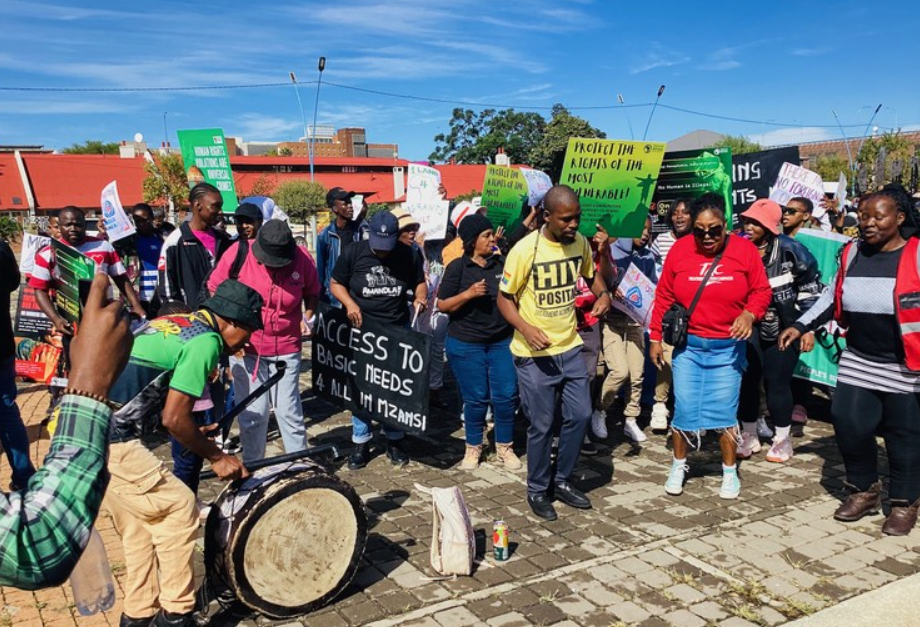
Over 150 protesters sang, drummed and danced to mark Freedom Month before marching to Constitution Hill in Braamfontein. They called for an end to xenophobia. Photo: Kimberly Mutandiro
By Kimberly Mutandi
More than 150 people gathered at Mary Fitzgerald Square in Newtown, Johannesburg, on Saturday to protest against xenophobia and the ill treatment of immigrants in South Africa.
Holding placards reading “No person is illegal”, “Blaming migrants is not the answer”, and “Africa for Africans”, protesters sang, drummed and danced to mark Freedom Month before marching to Constitution Hill in Braamfontein.
The march was organised by Kopanang Africa Against Xenophobia (KAAX) with immigrant-led organisations. The marchers called for an end to xenophobia, corruption and the scapegoating of immigrants.
The march follows anti-immigrant protests Durban over the past week.
Activists urged the government to promote equality, justice and human dignity, and to address the challenges faced daily by immigrants.
Sharon Ekambaram of Lawyers for Human Rights said that rights should apply equally regardless of nationality.
In a circular, KAAX expressed concern over political leaders and state institutions that blame immigrants for South Africa’s social and economic problems instead of addressing the underlying causes such as unemployment and failing public services.
“The real crisis lies in systemic corruption, failing governance and an inhumane capitalist system that prioritises profit over people,” KAAX stated.
The organisation condemned “vigilante brutality, thuggish violence, and sensationalist media narratives”.
KAAX also condemned the solicitation of bribes by police officers in central Johannesburg and by officials at Home Affairs.
“This march is a declaration that no one is illegal and that our future is bound together as one human race,” stated KAAX.
Thifulufheli Sinthumule, from the Consortium for Refugees and Migrants in South Africa, said immigrants are often denied access to education and healthcare.
“The government should enforce the laws for us,” he said.
Isabel Moyo, from Zimbabwe, said immigrants in her community in central Johannesburg struggle to access vital medication at clinics and hospitals. She said immigrants are not in South Africa to take jobs from locals but to start businesses that provide services to the community.
“We want to be given an opportunity to work together with locals and to live in peace and harmony,” Moyo said.
Vanessa Mbenje, from Malawi, said she has been struggling to be documented. Theodora Faith Kaisi, also from Malawi, said, “Employers take advantage of our desperation to overwork and underpay us due to lack of proper documents. We plead with the South African government to give us documents.”
© 2026 GroundUp. This article is published under the GroundUp Republication Licence Version 1.0. Email [email protected] to request permission to republish.
Follow African Insider on Facebook, X and Instagram
Picture: GroundUp
For more African news, visit Africaninsider.com