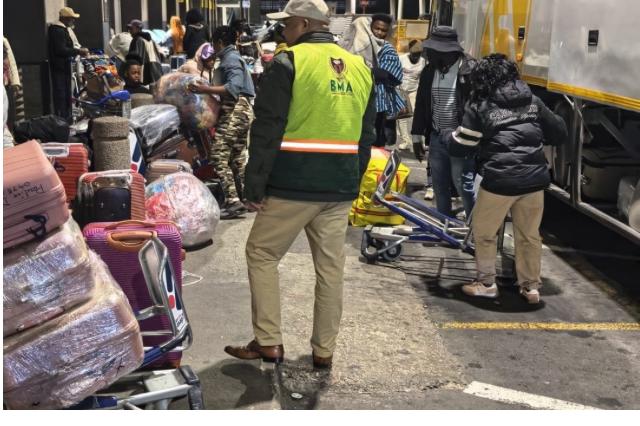
Cape Town – The Border Management Authority (BMA) has confirmed that 663 Ghanaian nationals were processed for repatriation from South Africa to Ghana through OR Tambo International Airport over the weekend, although nine passengers were ultimately prevented from boarding after being declared medically unfit to travel.
In a media statement, BMA spokesperson Mmemme Mogotsi said a group of 300 travellers underwent immigration processing, with 25 arriving from the Lindela Repatriation Centre under the supervision of the Department of Home Affairs’ Immigration Inspectorate. The remaining 275 were brought to the airport by the Ghanaian High Commission.
Following an extensive check-in process, immigration officials found that approximately 90% of the travellers were undocumented. As a result, the Ghanaian Embassy had to issue Emergency Travel Certificates, which are one-way travel documents that allow citizens to return to their country of origin.
According to the BMA, most of the travellers had overstayed their visas by more than 30 days, while some had remained in South Africa unlawfully for more than a year. They were consequently declared undesirable in terms of Section 30 of the Immigration Act.
📰 BMA processes 663 Ghanaian nationals for repatriation
The Commissioner of the Border Management Authority (BMA), Dr Michael Masiapato, has confirmed that the BMA has successfully processed 663 Ghanaian nationals for repatriation from South Africa to Ghana through OR Tambo… pic.twitter.com/6gll78uybX
— South African Government (@GovernmentZA) June 8, 2026
Several passengers were also prevented from departing the country due to immigration and documentation concerns.
One traveller was found to hold a valid asylum seeker permit and could not be allowed to leave South Africa without first cancelling his application for protection. The BMA explained that allowing him to return to the country from which he had sought refuge without withdrawing his application would amount to refoulement.
Another passenger was denied departure because he only possessed an expired passport and had not been issued with an Emergency Travel Certificate by the Ghanaian Embassy.
On Sunday, 7 June 2026, a further group of 331 Ghanaian nationals was brought to OR Tambo International Airport by the Ghanaian High Commission for repatriation. Following check-in procedures, the travellers proceeded to BMA Immigration for processing.
Among those processed, 117… pic.twitter.com/pUiAyTmkNe
— The Border Management Authority SA (@TheBMA_SA) June 8, 2026
A woman travelling with two minor children was also stopped after failing to provide proof of her relationship to the children or the legally required consent documentation from their mother, who was said to be her sister.
The repatriation operation was facilitated by the Ghanaian government through its High Commission in Pretoria using a chartered aircraft.
“This decisive action underscores the BMA’s uncompromising implementation of the South African legislative framework in its facilitation and management of people and goods movement in and out of the country,” BMA Commissioner Michael Masiapato said.
Repatriation follows renewed anti-immigration protests
According to The Citizen, the Ghanaian government announced last month that it would assist its citizens wishing to return home following renewed anti-immigration protests in South Africa.
Groups such as March and March and Operation Dudula have staged demonstrations calling for the deportation of undocumented foreign nationals. The organisations have set a deadline of 30 June for undocumented migrants to leave the country and have threatened a national shutdown if their demands are not met.
In response, the Ghanaian government launched a repatriation programme for its citizens living in South Africa.
THE BMA SUCCESSFULLY PROCESSES ANOTHER GROUP OF 663 GHANAIAN NATIONALS ON REPATRIATION THROUGH OR TAMBO INTERNATIONAL AIRPORT
The Commissioner of the Border Management Authority (BMA), Dr Michael Masiapato, has confirmed that the BMA successfully processed 663 Ghanaian nationals… pic.twitter.com/BcESy5POZE
— The Border Management Authority SA (@TheBMA_SA) June 8, 2026
Ghana’s High Commissioner to South Africa, Benjamin Anani Quashie, previously said there were close to 16,000 Ghanaians residing in the country.
The first group of returnees departed on 27 May after delays caused by verification processes. Immigration inspections reportedly revealed that only 10 of the 300 individuals on the initial repatriation list were legally residing in South Africa, with the remainder either undocumented or in violation of immigration regulations through visa overstays.
Diplomatic tensions emerge
The repatriation process has also led to diplomatic tensions between South Africa and Ghana.
On 6 June, Minister of International Relations and Cooperation Ronald Lamola rejected claims by the Ghanaian government that its citizens had been residing legally in South Africa and warned against any potential legal action against the South African government.
“Let there be no misunderstanding: we will vigorously defend any frivolous or baseless lawsuit emanating from Ghana against South Africa,” Lamola said in a statement.
He said South Africa had initially sought to assist Ghana in repatriating its citizens in a humane and cordial manner but believed that this approach had not been reciprocated.
“We will not continue to tolerate these public spectacles, characterised by incomplete information and outright misinformation, devoid of any diplomatic decorum,” he said.
Lamola added that South Africa remained open to discussing migration issues through bilateral engagements, the African Union and other multilateral platforms, but stressed the need for factual and constructive engagement.
Ramaphosa outlines government’s migration strategy
On Sunday evening, President Cyril Ramaphosa addressed the nation on the government’s response to illegal migration amid growing protests directed at foreign nationals.
According to IOL, Ramaphosa outlined five key measures aimed at strengthening immigration management and enforcement.
These include intensifying arrests, inspections, prosecutions and deportations of undocumented migrants while increasing penalties for employers who hire them unlawfully.
“No other person is allowed for example to confront someone in the street to demand proof of identit,y we know that South Africans are not xenophobic” President Cyril Ramaphosa
“As communities and as a society we must not be tempted to join those who want us to turn against… pic.twitter.com/zuJyClaBqS
— News Live SA (@newslivesa) June 7, 2026
The government also plans to strengthen border security through improved technology, infrastructure and personnel, as well as relocating refugee reception centres closer to border posts.
Other measures include combating corruption, introducing biometric-based digital identification systems, phasing out green barcoded identity documents and tightening identity verification processes.
Ramaphosa further announced plans to reform immigration and labour legislation, introduce quotas for foreign workers and strengthen regulation of businesses and informal traders.
Finally, he said South Africa would continue working with African countries and regional bodies to address the root causes of migration, including poverty, conflict and limited economic opportunities.
Follow African Insider on Facebook, X and Instagram
Picture: X/@TheBMA_SA
For more African news, visit Africaninsider.com
Compiled by Glaan Sibuyi