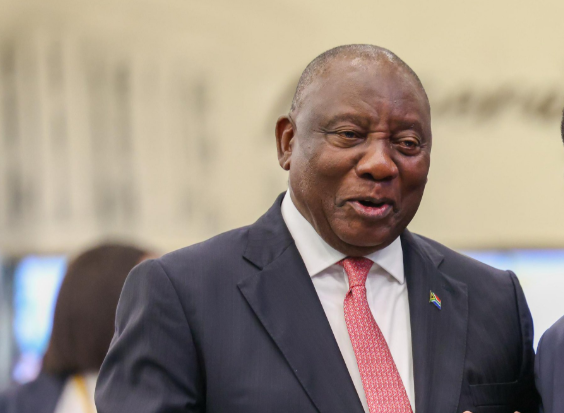
Cape Town – President Cyril Ramaphosa faced a wide-ranging and tense oral question session in the National Assembly on Thursday, addressing issues ranging from investment-led job creation and youth unemployment to crime operations, student debt, and allegations of misconduct within his Cabinet.
Responding to questions on the impact of the 2026 South Africa Investment Conference, Ramaphosa said the initiative had secured “a total of R890 billion in investment commitments,” with “approximately 230,000 direct permanent jobs” projected from private sector participation.
However, he cautioned that job creation would vary across sectors.
“Not all investment capital creates employment at the same rate,” he told MPs, noting that labour-intensive industries generate significantly more jobs than capital-heavy sectors such as renewable energy and data centres.
📰 SPEECH | President Cyril Ramaphosa responds to questions for oral Reply in the National Assembly
…Investments facing implementation blockages are referred for active resolution, with escalation to ministerial level where required. Declared employment figures will be… pic.twitter.com/eKzrTunKMr
— South African Government (@GovernmentZA) May 14, 2026
Ramaphosa added that “the structural unemployment problem is rooted in skills mismatches, spatial economic concentration, slow growth of the formal private sector and barriers to small business formation,” stressing that investment alone is insufficient to resolve unemployment.
He said government is pursuing a broader growth strategy, including infrastructure expansion and industrial policy reforms, and set an ambitious target of “R3 trillion in new investment over five years.”
On youth unemployment, Ramaphosa outlined a range of state-led programmes, including learnerships, internships, and military-linked training initiatives. He highlighted that the South African National Defence Force supports programmes such as NARYSEC and the South African National Service Institute, which combine training and workplace exposure.
“In the course of 2025, 584 matriculants trained in a character-building programme,” he said, adding that “200 are currently on an artisans programme sponsored by MERSETA.”
Turning to security, the President reported progress under Operation Prosper, saying joint SAPS and SANDF deployments had resulted in “more than 1,000 arrests” and “over 38,000 coordinated actions,” including roadblocks and targeted operations against organised crime.
On Cabinet accountability, Ramaphosa confirmed the dismissal of Minister of Social Development Sisisi Tolashe. “I have decided to remove Minister Tolashe from the position of Minister of Social Development in terms of section 91(2) of the Constitution,” he said.
The President also addressed student debt concerns, noting that outstanding university debt stands at “approximately R23 billion in the 2024 academic year,” although it is held by institutions rather than government.
“We will continue work on a comprehensive student funding model,” he said, adding that efforts are underway to regulate tuition fees and improve access to financial aid.
Ramaphosa further confirmed that a ministerial task team is working on long-term reforms to address gaps in funding for so-called “missing middle” students.
The session underscored both the scale of South Africa’s socioeconomic challenges and the government’s reliance on investment-led growth and structural reforms as its central policy response.
Follow African Insider on Facebook, X and Instagram
For more African news, visit Africaninsider.com
Compiled by Betha Madhomu