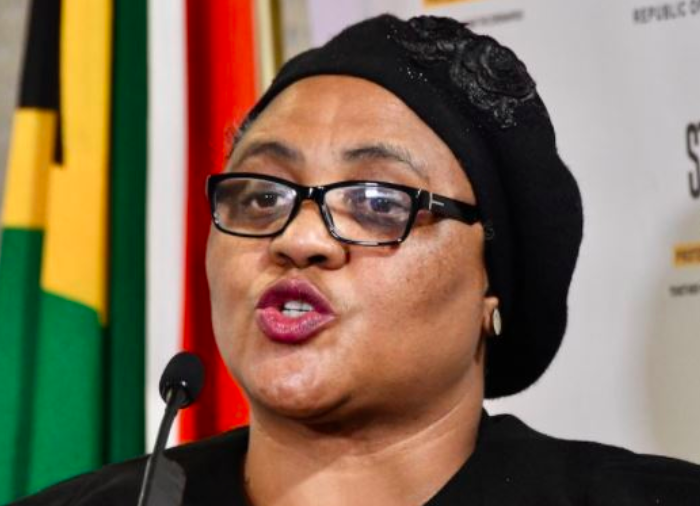
Cape Town – National Assembly Speaker Thoko Didiza has survived an Economic Freedom Fighters (EFF) bid to remove her from office after most parties in the Government of National Unity (GNU) rejected allegations that she had failed to defend Parliament in President Cyril Ramaphosa’s Phala Phala impeachment proceedings.
Didiza defeated the motion of no confidence on Wednesday after 282 MPs voted against her removal, while 101 supported the motion.
The motion, tabled by EFF leader Julius Malema, centred on Didiza’s decision not to oppose Ramaphosa’s court application seeking to interdict Parliament’s Section 89 impeachment proceedings.
The EFF accused Didiza of failing to protect Parliament, disregarding legal advice and placing party political considerations above her constitutional responsibilities as Speaker.
Malema argued that Didiza had effectively sided with Ramaphosa instead of defending Parliament’s oversight role.
Economic Freedom Fighters (EFF) leader Julius Malema says National Assembly Speaker Thoko Didiza has failed to show impartiality towards Parliament and chose her political party’s interests when President Cyril Ramaphosa interdicted the impeachment committee.… pic.twitter.com/wXGmcTyBxG
— SABC News (@SABCNews) August 26, 2026
“She did not want accountability then, and she does not want accountability now,” Malema said during the debate.
He also accused Didiza of failing to act independently and impartially, saying the Speaker’s constitutional responsibility was to Parliament and the public rather than the political party that deployed her.
“To be Speaker of the National Assembly is a role that comes with a great responsibility,” Malema said, arguing that the position required Didiza to distinguish between serving the ANC and serving the Constitution.
However, the EFF failed to secure the support needed to remove Didiza, with most GNU parties voting against the motion.
The ANC defended the Speaker’s decision, arguing that she had acted within the law and had not interfered with the work of the Section 89 impeachment committee.
ANC chief whip Mdumiseni Ntuli said Didiza had allowed the committee to conduct its own proceedings and had not attempted to prevent it from opposing Ramaphosa’s legal challenge.
Strange way of thinking
“We cannot allow the EFF’s strange way of thinking to prevail,” Ntuli said.
The Democratic Alliance (DA), which has repeatedly clashed with the ANC over Ramaphosa’s accountability, also rejected the EFF’s attempt to remove Didiza.
DA chief whip Glynnis Breytenbach said the party did not believe Didiza’s decision met the threshold for removal and warned against using a no-confidence motion as a political weapon against a Speaker whose ruling a party disagreed with.
Other GNU parties, including the IFP, Patriotic Alliance, Rise Mzansi, Freedom Front Plus and Good Party, also voted against the motion.
IFP MP Nhlanhla Hadebe said there was insufficient evidence to show that Didiza had abandoned Parliament or protected Ramaphosa from parliamentary scrutiny.
“The evidence does not establish that the speaker abandoned the impeachment process, protected the president from parliamentary scrutiny, or failed to implement the constitutional court’s judgment,” Hadebe said.
Justice Minister Mmamoloko Kubayi also described the EFF’s motion as unnecessary and frivolous.
The EFF’s position was supported by the MK Party, African Christian Democratic Party, African Transformation Movement, National Coloured Congress and United Africans Transformation.
First motion of no confidence
The vote followed a lengthy debate in Parliament, with tensions rising between MPs from opposing parties.
Deputy Speaker Annelie Lotriet eventually announced the result after the virtual sitting, declaring: “Those in favour of the motion, 101. Those against the motion, 282. The motion is, therefore, not agreed to.”
The defeat is a setback for the EFF’s attempt to use the Speaker’s handling of the Phala Phala impeachment process to force a change in Parliament’s leadership.
It also highlights the difficulty of securing cross-party support for removing a Speaker, even where parties disagree with decisions made by the holder of the office.
The vote was the first motion of no confidence against Didiza since she became Speaker and the first such motion against a National Assembly Speaker to be debated since 2014, when then-Speaker Baleka Mbete faced a similar challenge.
The dispute over Ramaphosa’s impeachment process is, however, far from over, with the president expected to return to court next week in his latest legal challenge concerning the parliamentary impeachment report.
Follow African Insider on Facebook, X and Instagram
Picture: X/@SAgovnews
For more African news, visit Africaninsider.com
Compiled by Betha Madhomu