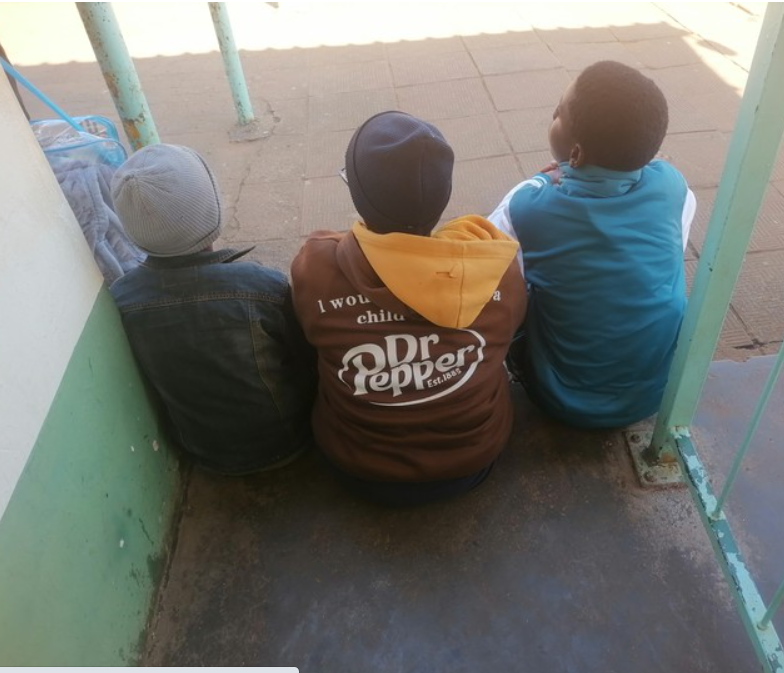
Children of immigrants at the repatriation centre set up at the Makhado showgrounds in Louis Trichardt. Photo: Bernard Chiguvare
By Thembi Siaga and Bernard Chiguvare
“All my dreams are shattered,” Quincy Nemhara told GroundUp on the phone while on his way to Zimbabwe with his mother.
“The situation in South Africa is no longer bearable for me. I was the only Zimbabwean in Grade 12 at this school, so when the campaign against immigrants started, I was harassed. They called me names.”
Nemhara is one of hundreds, possibly thousands, of learners whose schooling has been disrupted by the recent wave of anti-immigrant action. More than 50,000 immigrants are estimated to have left in recent weeks.
Nicolate Hotera is going back to Zimbabwe with her children after living in Tshiozwi, a village outside Louis Trichardt, for 11 years. Her husband has a Zimbabwe Exemption Permit (ZEP), but she and her children are undocumented.
We spoke to Hotera as she was being processed for repatriation at a pop-up centre set up at the Makhado showgrounds in Louis Trichardt.
She hopes her children, who are in grades 8 and 5, may one day return to South Africa to complete their education. They do not have birth certificates, neither South African nor Zimbabwean.
Hotera worries they will struggle because they grew up speaking Venda and have never been to Zimbabwe before.
Jestina Mbofana, from the ZEP Coordinating Committee, said they have tried to set up online classes for learners to continue their studies.
Joseph Maphosa, leader and coordinator of the ZEP Emigrants and Refugee Network, said that many learners are going back to Zimbabwe without transfer letters or any proof of their schooling in South Africa.
“We found families who had been told to leave their homes,” said Tafazwa Muranganani, chairman of Zimbabwe Diaspora 4ED. “Some had been assaulted and robbed. Many left with only the clothes they were wearing.”
A child being repatriated, told us, “They called us kwerekwere, telling us to go back to our country. They came to our home and threatened to burn our house.”
Muranganani said that Zimbabwe Diaspora 4ED has been working with the Zimbabwean embassy and consulate to identify people seeking repatriation and to transport them to collection points before buses take them to Musina.
Many Zimbabweans have had to spend hours, and sometimes the night, outside police stations because they have nowhere else to stay while waiting for transport.
“We had to hire mobile toilets because there were no sanitation facilities,” said Murangani. Mothers with babies, elderly people and children were among those waiting.
Muranganani alleged that some immigrants travelling to collection points have been arrested before boarding buses.
Home Affairs spokesperson Ndileka Cola did not respond to this allegation.
Gift of the Givers says it has assisted about 32,000 people at the temporary repatriation centre in Musina, serving more than 115,000 hot meals. The organisation’s community liaison officer, Cliffort Mabe, said they have provided three hot meals a day, water, baby formula, nappies, hygiene packs and blankets.
Published with the Limpopo Mirror
© 2026 GroundUp. This article is published under the GroundUp Republication Licence Version 1.0. Email [email protected] to request permission to republish.
Follow African Insider on Facebook, X and Instagram
Picture: GroundUp
For more African news, visit Africaninsider.com