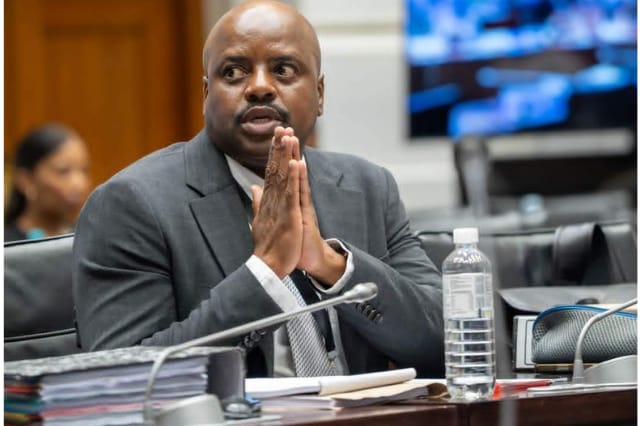
Johannesburg – The defence of suspended Ekurhuleni Metropolitan Police Department (EMPD) deputy chief Julius Mkhwanazi has challenged the State’s case against him in the murder of businessman Emmanuel Mbense, arguing that the evidence points, at most, to him being an accessory after the fact.
Mkhwanazi and five co-accused are appearing in the Brakpan Magistrates’ Court in connection with the April 2022 murder of Mbense, whose body was allegedly dumped at Spaarwater Dam after he was assaulted and tortured.
Mkhwanazi’s lawyer, Advocate Peter Wilkins, argued that his client was not present when Mbense was allegedly assaulted and killed and therefore could not have shared a common purpose with those responsible for the murder.
The argument centres on when Mkhwanazi allegedly arrived at the scene and whether Mbense was already dead by then.
During cross-examination, Independent Police Investigative Directorate (IPID) lead investigator Nomsa Masuku conceded that Mkhwanazi was not part of the alleged meetings where the other accused allegedly planned the crime.
Watch the proceedings live below (Courtesy of SABC News)
However, Masuku rejected the defence’s contention that Mbense was already dead when Mkhwanazi arrived.
“I cannot agree to say when he joined, the deceased was already dead because we don’t have certification of death from the house,” Masuku told the court.
She said the available death certification only recorded Mbense’s death on the afternoon of 15 April 2022, the day after the alleged attack.
The defence has also questioned the State’s reliance on an alleged “prior agreement” to rob, assault and kill Mbense, arguing that this is not contained in the charge sheet.
Wilkins put it to Masuku that the State had no evidence of such an agreement, saying: “the reason why the State does not mention a prior meeting at which this was agreed upon is because there is no such evidence in your docket.”
The State, however, maintains that Mkhwanazi can be held criminally liable through the common-purpose doctrine.
Stringent bail requirements
Prosecutor Advocate Nceba Ntelwa previously argued that Mkhwanazi was aware of what was happening and participated in the broader criminal conduct. “Accused number 5 is charged, like other accused, that he acted in common purpose,” Ntelwa said.I
Investigators allege Mkhwanazi became part of the unlawful conduct by allegedly making suggestions about how Mbense’s body should be disposed of. Masuku maintained that such involvement could still implicate him beyond being merely an accessory after the fact.
The issue is significant because the State is pursuing Schedule 6 murder charges, which carry stringent bail requirements. In earlier proceedings, Mkhwanazi’s defence argued that, based on the State’s own version, he could “at best be an accessory after the fact of the murder”.
The case forms part of a wider investigation into Mbense’s killing that has also featured prominently before the Madlanga Commission of Inquiry, where testimony implicated Mkhwanazi in the alleged disposal of Mbense’s body.
Mkhwanazi and his co-accused remain in custody as their bail proceedings continue. They have not been convicted of any offence and are presumed innocent until proven guilty.
Follow African Insider on Facebook, X and Instagram
Picture: Screengrab
For more African news, visit Africaninsider.com
Compiled by Betha Madhomu