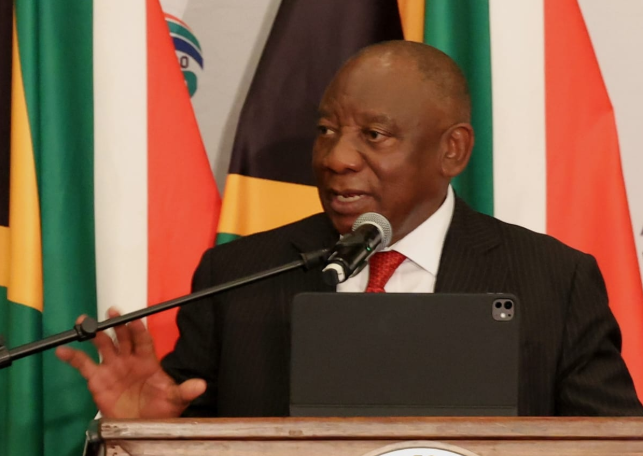
Durban – President Cyril Ramaphosa has called for deeper economic integration among Southern African Development Community (SADC) countries, saying the region must make better use of its natural resources, infrastructure and youthful population to create jobs and reduce dependence on imports.
Ramaphosa made the call in his weekly newsletter as South Africa prepares to assume the SADC chairship and host the 46th SADC Summit in eThekwini.
He said South Africa’s SADC chairship would focus on practical measures to strengthen regional economic integration and develop a larger regional market.
“Our membership of SADC is not just a matter of foreign policy. It is about the creation of jobs and improving the quality of life of South Africans,” Ramaphosa said.
Dear Fellow South African,
This week, South Africa has the honour, as the incoming chair, of hosting the 46th
Summit of the Southern African Development Community (SADC) in eThekwini.As it starts its SADC chairship, South Africa’s focus is on the practical steps needed to… pic.twitter.com/4PS1QLtjlp
— Cyril Ramaphosa 🇿🇦 (@CyrilRamaphosa) August 17, 2026
“It is about the growth of our industries, the development of our infrastructure and the health and well-being of our people.”
SADC comprises 16 countries with a combined population of nearly 400 million people. However, Ramaphosa said trade between member states remained relatively low, accounting for only about 20% of the region’s combined total trade.
He said the region had significant energy resources, minerals, land, skills, technology, industrial capacity and financial institutions but continued to rely heavily on imports from outside the continent.
“For example, our region holds much of the world’s critical minerals, yet we export the ore and import the battery,” he said.
“We are supplying an industrial revolution taking place elsewhere and buying back its products at a price set by others.”
Ramaphosa said stronger regional integration had become increasingly important as global conflicts and economic disruptions continue to affect the prices and availability of fuel, grain and fertiliser.
“That is why we need a dynamic common market in which we trade with each other,” he said.
Regional infrastructure push
Ramaphosa said no individual country could independently develop the infrastructure and systems needed to support the region’s long-term economic growth.
“No country in this region can, on its own, build an integrated power system, develop cross-border corridors, manage shared water resources or withstand the full force of climate change,” he said.
He pointed to the Maputo, North-South, Trans-Kalahari, Beira and Lobito corridors as key infrastructure projects that could strengthen regional trade.
“We need to link our economies through corridors of goods, services and industry,” he said.
On this SADC Day 2026, I extend warm greetings to the people of Southern Africa.
I invite you all to celebrate this important moment of commemoration – a moment that belongs to us all, united by a shared history, common aspirations and a collective commitment to a better… pic.twitter.com/s33I63vAKP
— Cyril Ramaphosa 🇿🇦 (@CyrilRamaphosa) August 17, 2026
Ramaphosa said the corridors needed to become “living arteries of commerce”, carrying freight, electricity, data and people across borders.
He also called for greater use of the Southern African Power Pool to improve energy security across the region.
“Our task now is to widen that pool to ensure that all parts of Southern Africa have a reliable supply of affordable energy,” he said.
From exporting minerals to making products
The president said SADC countries should move beyond simply trading with each other and instead develop integrated regional production chains.
“Our ambition must not be limited to more trade with each other. We must produce goods and services together,” he said.
He gave the example of vehicles being assembled in one SADC country using components manufactured in another and materials produced in a third.
Ramaphosa said such an approach could help the region capture more value from its natural resources while creating jobs and strengthening local industries.
Youth at centre of regional development
The president also highlighted the region’s young population, with more than half of SADC’s population under the age of 30.
“To realise this demographic dividend, we must ensure that every young person is given the best foundation for success in life,” he said.
He called for greater regional cooperation in food and water security, healthcare, early childhood development, education and skills development.
The region, he said, needed to invest in “our schools, universities, technical and vocational colleges and research institutions”.
Ramaphosa said these issues would form part of discussions around SADC’s Vision 2050, which seeks to build a more integrated and prosperous region.
As South Africa takes over the regional bloc’s chairship, Ramaphosa said the country’s economic future was closely tied to that of its neighbours.
“As South Africa takes up the chairship of SADC, we do so in the knowledge that our own prosperity is bound up with that of our neighbours,” he said.
He also called for practical measures to reduce the costs of doing business across borders, including cheaper phone calls and money transfers, shorter border waiting times and harmonised customs procedures.
“We need to remove the costs that we have imposed on ourselves,” Ramaphosa said.