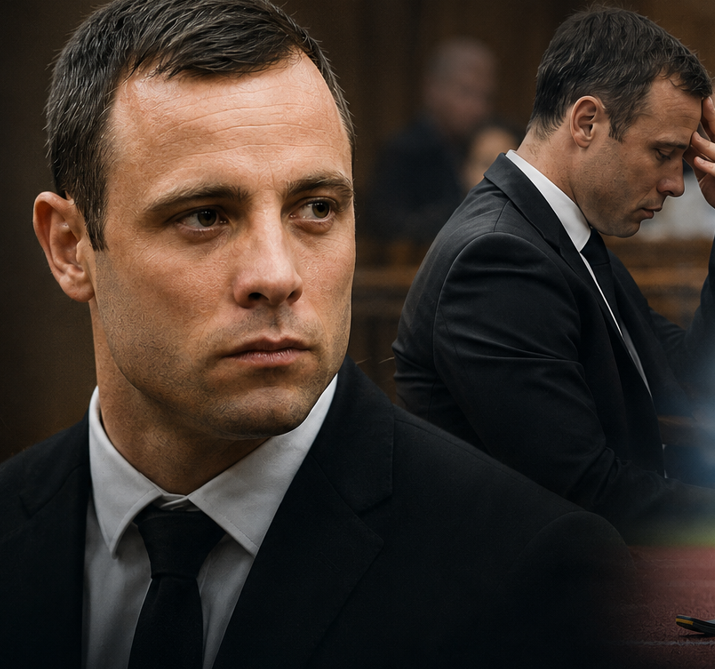
From the 2013 shooting that shocked South Africa to his conviction, imprisonment and parole, here is a complete timeline of the Oscar Pistorius case.
The Oscar Pistorius case remains one of the most closely followed criminal cases in South African history.
Pistorius, a celebrated Paralympic athlete who became an international sporting star, was convicted of murdering his girlfriend, model and law graduate Reeva Steenkamp, after shooting her through a toilet door at his home in Pretoria on 14 February 2013.
The case went through several stages, with Pistorius initially convicted of culpable homicide before the conviction was changed to murder on appeal. His sentence was also increased following a further appeal by the State.
Pistorius was eventually sentenced to 13 years and five months in prison and was released on parole in January 2024.
Here is a timeline of the key events in the case.
Who is Oscar Pistorius?
Oscar Pistorius was born in Johannesburg in 1986 and became one of the world’s best-known Paralympic athletes.
Both of his legs were amputated below the knee when he was a baby because of a congenital condition. He later competed internationally using prosthetic blades and became known as the “Blade Runner”.
Pistorius won multiple Paralympic gold medals and became a global sporting figure. In 2012, he made history by competing against able-bodied athletes at the London Olympics.
His international fame made the events that followed the death of Reeva Steenkamp a major global news story.
Who was Reeva Steenkamp?
Reeva Steenkamp was a South African model, television personality and law graduate.
She was born in Cape Town in 1983 and later built a career in modelling and television. She was also studying law and had spoken publicly about issues including women’s safety and domestic violence.
Steenkamp was 29 when she was killed.
14 February 2013: Reeva Steenkamp is killed
In the early hours of Valentine’s Day, 14 February 2013, Pistorius shot four times through the closed door of a toilet in his home at Silver Woods Country Estate in Pretoria.
Steenkamp was behind the door and was fatally wounded.
Pistorius later told police and the court that he believed an intruder had entered his home and that he had fired because he feared for his safety.
The Supreme Court of Appeal later recorded that Pistorius had heard a sound from the bathroom, retrieved his 9mm pistol and fired four shots through the toilet door. He then discovered that Steenkamp was inside.
The shooting immediately triggered a nationwide investigation and intense international media interest.
15 February 2013: Pistorius is arrested
Pistorius was arrested and charged with Steenkamp’s murder.
The prosecution argued that he had intentionally killed her, while Pistorius maintained that he had mistaken her for an intruder.
The case quickly became one of the biggest criminal stories in South Africa.
February 2013: Bail hearing
Pistorius’s bail application attracted enormous international attention.
The court eventually granted him bail while the investigation and preparation for trial continued.
The central question that would dominate the eventual trial was whether Pistorius believed he was shooting at an intruder and, if so, whether his actions amounted to murder or another offence.
3 March 2014: Murder trial begins
Pistorius’s trial began in the Gauteng High Court in Pretoria on 3 March 2014.
He faced a murder charge as well as charges relating to firearms.
The proceedings were unprecedented in South Africa because parts of the trial were broadcast and audio from the proceedings was made available to the public.
The court had previously considered the tension between the accused’s right to a fair trial, media freedom and the principle of open justice before allowing certain forms of broadcast coverage.
The trial attracted journalists and viewers from around the world.
March 2014: Pistorius gives his account
Pistorius maintained that he believed there was an intruder in his home.
He said he had acted out of fear and had not intended to shoot Steenkamp.
The prosecution challenged his version of events and sought to establish that he knew Steenkamp was behind the door when he fired.
The evidence surrounding the bathroom, the position of Steenkamp’s body, the gunshots and Pistorius’s actions before and after the shooting became central to the case.
12 September 2014: Pistorius found guilty of culpable homicide
Judge Thokozile Masipa found Pistorius not guilty of murder but convicted him of culpable homicide.
The court accepted that the prosecution had not proved beyond reasonable doubt that Pistorius had intended to kill Steenkamp.
However, the court found him criminally responsible for her death.
He was also convicted on certain firearms-related charges.
21 October 2014: Pistorius sentenced to five years in prison
Pistorius was sentenced to five years’ imprisonment for culpable homicide.
The sentence meant he would serve part of his punishment in prison and potentially serve the remainder under correctional supervision.
The sentence immediately became controversial, with the prosecution indicating that it would challenge the outcome.
2015: First parole controversy
Pistorius’s potential release under correctional supervision became another major public controversy.
In October 2015, the Department of Correctional Services announced that he would be placed under correctional supervision from 20 October.
However, the decision was subsequently reviewed after the Parole Review Board found that the earlier decision had been prematurely made.
The parole board later approved his placement under correctional supervision, subject to conditions.
3 December 2015: Murder conviction replaces culpable homicide
A major turning point came when the Supreme Court of Appeal overturned Pistorius’s culpable homicide conviction and found him guilty of murder.
The State had appealed the original verdict, arguing that the evidence supported a murder conviction.
The Supreme Court of Appeal accepted that Pistorius’s conduct amounted to murder under the legal principle of dolus eventualis — broadly, that a person foresees the possibility of death resulting from their actions but proceeds regardless.
The court’s judgment noted that Pistorius fired four shots through the closed toilet door, knowing that a person could be behind it.
This changed the case dramatically.
Pistorius was no longer serving a sentence for culpable homicide; he was now a convicted murderer.
6 July 2016: Pistorius is sentenced to six years for murder
Following the murder conviction, Pistorius was sentenced to six years in prison.
The sentence was criticised by the prosecution, which argued that it was too lenient.
The State appealed the sentence.
November 2016: Pistorius transferred to Atteridgeville Correctional Centre
Pistorius was transferred to Atteridgeville Correctional Centre, where authorities said he could participate in rehabilitation and development programmes.
Correctional Services said the facility was used for offenders serving sentences of between zero and six years and that the transfer took into account Pistorius’s disability and correctional needs.
2017: The State appeals the six-year sentence
The prosecution returned to the Supreme Court of Appeal, arguing that Pistorius’s six-year sentence for murder was inadequate.
The appeal focused on the severity of the sentence rather than whether Pistorius was guilty of murder.
24 November 2017: Sentence increased to 13 years and five months
The Supreme Court of Appeal upheld the State’s appeal and replaced Pistorius’s six-year sentence with 13 years and five months’ imprisonment.
The court held that the original sentence was inappropriate.
The judgment formally recorded the sentence as 13 years and five months.
This became the sentence that ultimately governed Pistorius’s imprisonment.
2021–2023: Parole calculations become complicated
Pistorius’s eventual parole eligibility became the subject of further legal and administrative disputes.
Correctional authorities had to consider different court orders concerning when his sentence was deemed to have begun and how much time he had already served.
In September 2023, the Department of Correctional Services said it had taken court orders into account when calculating the minimum period before parole consideration.
The issue demonstrated why parole eligibility is not necessarily determined simply by counting the years from the date a person is first imprisoned.
March 2023: Parole consideration delayed
In March 2023, Correctional Services announced that Pistorius had not completed the minimum detention period applicable under the relevant court ruling.
The Correctional Supervision and Parole Board therefore granted a further profile for consideration in August 2024.
The matter changed again later that year.
November 2023: Pistorius granted parole
On 24 November 2023, the Department of Correctional Services confirmed that Pistorius had been placed on parole.
His parole was scheduled to take effect on 5 January 2024.
The department said the decision had been made by the Correctional Supervision and Parole Board after considering his profile and other relevant material.
Pistorius was classified as a first-time offender, and his parole formed part of the rehabilitation and reintegration process.
5 January 2024: Pistorius is released on parole
Pistorius officially became a parolee on 5 January 2024.
The Department of Correctional Services confirmed that he had been admitted into the community corrections system and was at home.
He remained subject to parole conditions and supervision.
The department said he would remain under supervision until the expiry of his sentence.
What happened to Oscar Pistorius after prison?
Pistorius’s release did not erase the conditions attached to his parole.
His life after prison has continued to attract public and media interest, particularly because of his status as a former international sporting star and the enduring public interest in Steenkamp’s death.
Any future developments involving Pistorius — including changes to his parole conditions, public appearances, publishing plans or other major developments — can be added to this timeline.
Why did the Oscar Pistorius case attract so much attention?
The case combined several factors that made it unusually prominent.
Pistorius was an internationally recognised athlete who had become a symbol of sporting achievement and disability rights.
Steenkamp was a young model and law graduate with a public profile of her own.
The shooting happened on Valentine’s Day, while the trial was broadcast and followed around the world.
The case also raised difficult questions about:
domestic violence and gender-based violence;
gun ownership and firearm safety;
self-defence;
criminal intent;
South Africa’s sentencing laws;
the treatment of high-profile offenders;
parole and rehabilitation;
the media’s role in criminal trials.
The legal journey was also unusually complex, moving from culpable homicide to murder and then through multiple sentencing stages.
What was Oscar Pistorius convicted of?
Pistorius was initially convicted of culpable homicide in 2014.
That conviction was overturned on appeal in 2015, when the Supreme Court of Appeal found him guilty of murder.
His six-year murder sentence in 2016 was subsequently increased to 13 years and five months by the Supreme Court of Appeal in 2017.
How long was Oscar Pistorius in prison?
The calculation of Pistorius’s effective imprisonment period involved several court orders and legal disputes over when his sentence was deemed to have commenced.
The final sentence imposed by the Supreme Court of Appeal was 13 years and five months.
He was released on parole on 5 January 2024 and placed under community corrections for the remainder of his sentence.
What happened to Reeva Steenkamp’s family?
Steenkamp’s parents, June and Barry Steenkamp, remained prominent figures in the aftermath of her death.
The family’s views on Pistorius’s conviction, sentence, parole and subsequent life have periodically drawn public attention.
For the Steenkamp family, however, the case has always been about more than the legal fate of Pistorius: it concerns the loss of their daughter and the lasting consequences of her death.
The Oscar Pistorius case in brief
14 February 2013: Reeva Steenkamp is shot and killed at Pistorius’s home.
15 February 2013: Pistorius is arrested and charged with murder.
3 March 2014: His murder trial begins.
12 September 2014: Pistorius is convicted of culpable homicide rather than murder.
21 October 2014: He is sentenced to five years in prison.
3 December 2015: The Supreme Court of Appeal changes his conviction to murder.
6 July 2016: Pistorius receives a six-year sentence for murder.
24 November 2017: The Supreme Court of Appeal increases his sentence to 13 years and five months.
24 November 2023: Correctional Services confirms that Pistorius has been granted parole.
5 January 2024: Pistorius is released on parole and placed under community corrections.
The case continues to attract public interest
More than a decade after Steenkamp’s death, the Oscar Pistorius case remains a reference point in discussions about celebrity, criminal justice, sentencing and parole in South Africa.
Its significance also extends beyond the original trial. Every new development involving Pistorius can revive interest in the events of 2013 and prompt a new generation of readers to ask what happened, why the conviction changed and how the former Paralympic champion eventually came to be released from prison.
ALSO READ | Reeva Steenkamp’s family furious over Pistorius’ lucrative book plans – report
Follow African Insider on Facebook, X and Instagram
Picture: ChatGPT
For more African news, visit Africaninsider.com
Compiled by Betha Madhomu