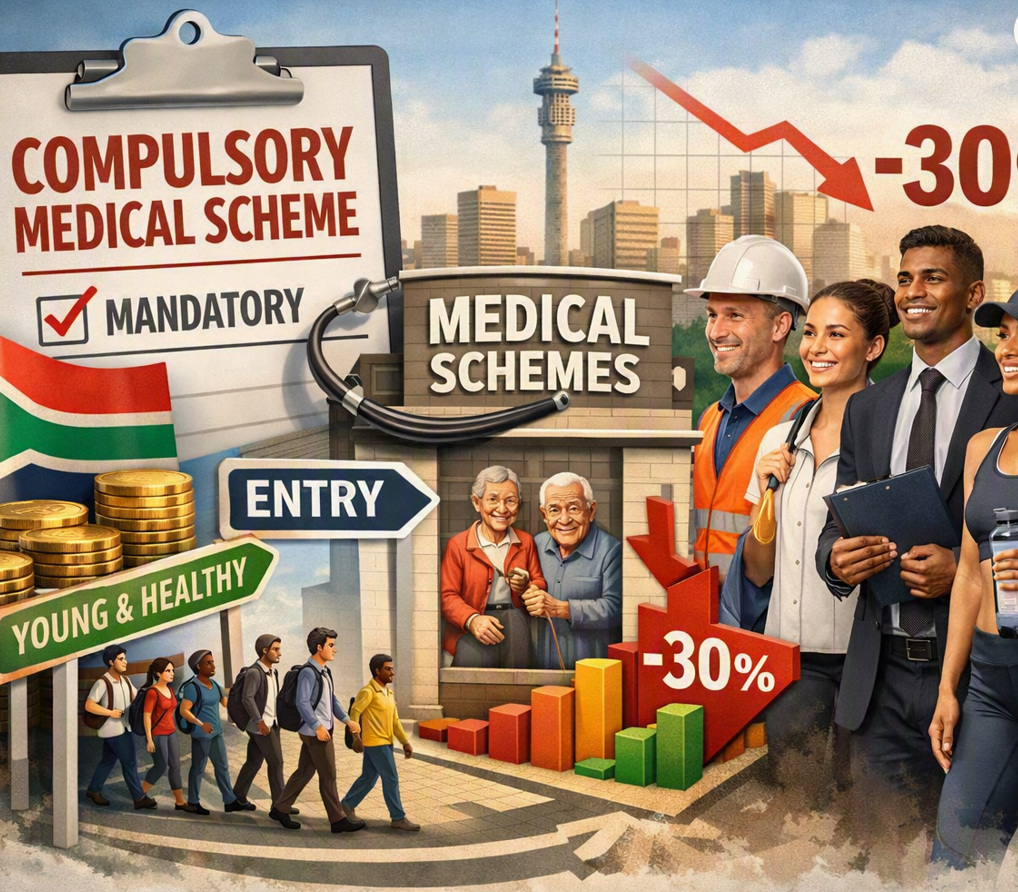
Johannesburg – South Africans earning above the tax threshold could be required to belong to a medical scheme under a proposal that the Health Funders Association (HFA) says could significantly reduce private healthcare costs.
The proposal, highlighted by BusinessTech, forms part of the HFA’s 2026 State of Medical Schemes report and is aimed at bringing more younger and healthier people into the medical scheme risk pool.
The HFA estimates that about 8.7 million currently uninsured taxpayers could potentially be brought into medical schemes if membership were made compulsory for employed people above the relevant income threshold.
According to EWN, HFA CEO Thoneshan Naidoo said expanding the membership base could help spread healthcare costs across a much larger pool.
“It would mean that medical schemes, there’d be an additional 9 million South Africans that would fall into medical schemes.”
Young and healthy
The HFA’s modelling suggests mandatory participation could reduce the average expected cost of prescribed minimum benefits by about 18%, while a separate analysis indicates that broader and more stable participation could potentially reduce contributions by as much as 30%.
However, The Citizen reported that the 30% figure should be regarded as an indicative upper estimate rather than a guaranteed reduction.
Naidoo argues that the current voluntary system encourages younger and healthier people to remain outside medical schemes until they require expensive treatment, leaving schemes with an older and higher-risk membership base.
“If we can solve the problem of the young and healthy staying out of schemes, we would reduce the current contributions by roughly 30%,” Naidoo told Moneyweb.
The proposal would also introduce a risk-equalisation mechanism, under which funds could be redistributed between schemes to account for differences in the health profiles of their members.
Affordability
Sunday Times reported that the HFA’s analysis was based on anonymised data covering about 5.74 million beneficiaries, representing 62% of the medical scheme market at the end of 2025.
Naidoo said medical schemes depend on members pooling money to protect one another against potentially catastrophic healthcare costs.
“None of us knows when we may face cancer, a premature birth, a serious accident or a rare disease,” he said, stressing that risk pooling was central to keeping cover sustainable.
The debate comes as medical scheme membership remains relatively stagnant while the population covered by schemes continues to age. The Citizen reported that the average beneficiary age increased from 31.7 years in 2005 to 34.5 years in 2024, while the proportion of pensioners rose from 6.4% to 10%.
However, affordability remains a major obstacle. Naidoo acknowledged that it would be difficult to impose compulsory membership on lower-income workers who already struggle to meet basic living costs.
“There are certain brackets of income, particularly on the lower end, which is difficult to force medical aid scheme membership because at that end, the bottom end of that, people are considering, they’re on the breadline,” he told EWN.
The proposal therefore does not mean that South Africans earning R60,000 or more are currently legally required to have medical aid. Rather, the figure has been used in reporting around a possible compulsory-membership model, while the HFA’s latest proposal is framed around employed people earning above the tax threshold.
Structural weakness
The HFA says compulsory membership would need to be accompanied by measures to make cover more affordable and accessible. Its broader argument is that a larger, healthier risk pool could reduce the financial pressure currently carried by existing medical scheme members.
Naidoo said the objective was not simply to force people into medical schemes but to address what he described as a structural weakness in the current voluntary system.
“Medical aid schemes are effectively 20% to 30% more expensive because we never made it mandatory for employed people to belong to medical schemes,” he told Moneyweb.
The proposal is part of a wider debate over the future of private healthcare in South Africa as the country grapples with rising medical costs, an ageing medical scheme population and the implementation of the National Health Insurance system.
Follow African Insider on Facebook, X and Instagram
Picture: Copilot
For more African news, visit Africaninsider.com
Compiled by Betha Madhomu