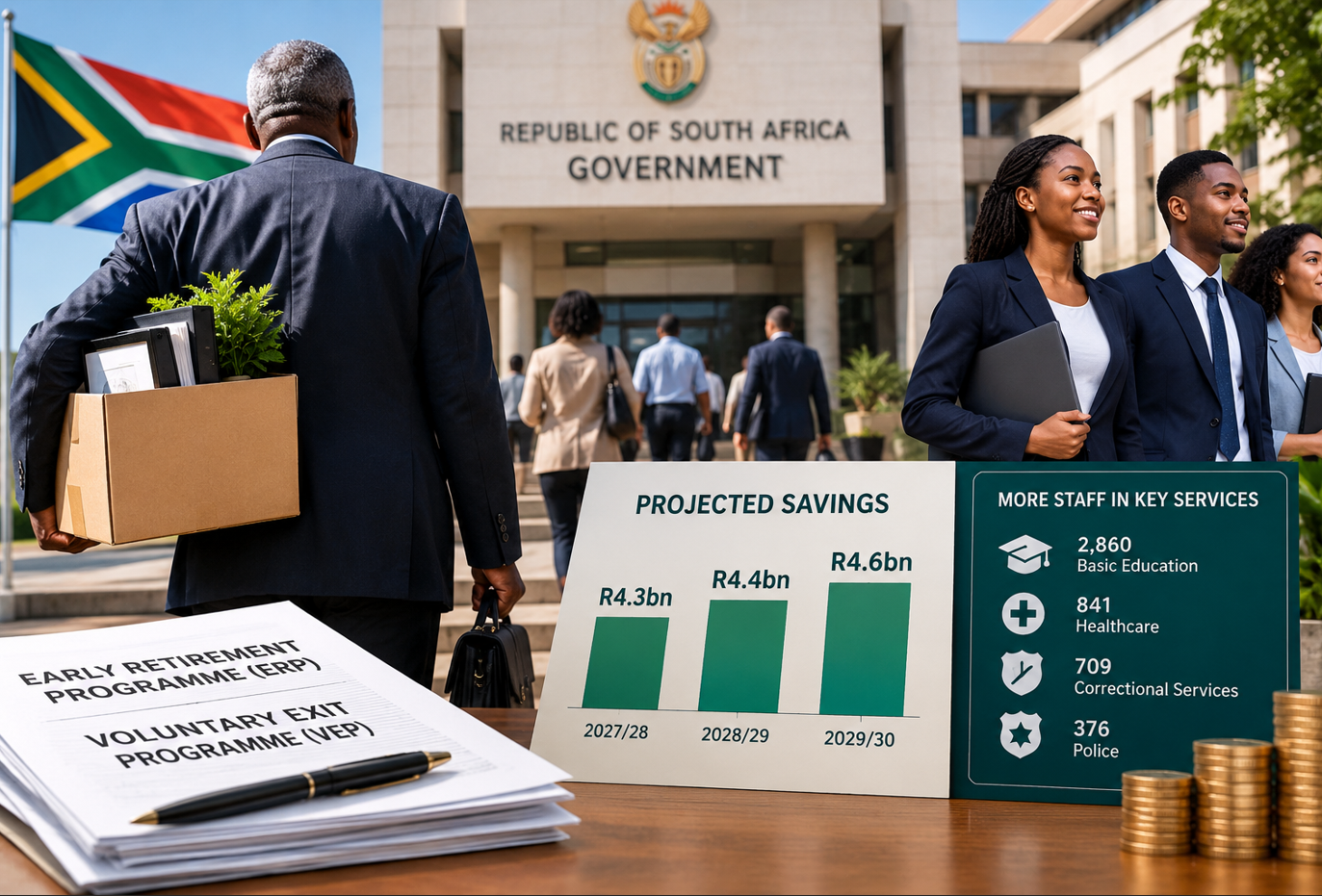
Cape Town – South Africa’s government has approved 27,450 applications under its Early Retirement Programme (ERP) and Voluntary Exit Programme (VEP), as it seeks to contain public sector salary costs, improve workforce efficiency and create room for younger employees.
According to Daily Investor, the programme forms part of National Treasury’s broader efforts to control the public service wage bill while managing the cost of government operations.
The initiative allows eligible public servants to leave government employment before normal retirement age or through voluntary exit arrangements, with the aim of reducing long-term salary costs and renewing the state workforce.
The policy builds on the government’s earlier plan to support the departure of approximately 30,000 employees. In a November 2025 report, Daily Investor said the programme was expected to generate savings of up to R7.1 billion annually, although the final impact would depend on the number and salary levels of employees leaving.
Treasury projects billions in savings
The latest figures indicate that the programme is expected to generate net savings of R4.3 billion in the 2027/28 financial year, rising to R4.4 billion in 2028/29 and R4.6 billion in 2029/30, according to Moneyweb, which reported on the government’s Medium-Term Budget Policy Statement.
Treasury estimates that replacing departing employees with younger recruits at lower salary entry points could save an average of R110,097 annually per employee.
The savings are intended to support recruitment in critical public services. Treasury estimates that the available funding could accommodate an additional 2,860 personnel in basic education, 841 in healthcare, 709 in correctional services and 376 in the police, beyond replacements for employees who leave.
However, the programme also carries upfront costs. The first phase involved R3.87 billion in centrally funded financial incentives, illustrating the initial expense involved in achieving longer-term savings.
Service delivery remains a key consideration
The government has maintained that reducing personnel costs must not undermine essential services.
In a report published in December 2024, Daily Investor quoted Finance Minister Enoch Godongwana as saying the programme would not be a “‘free’ for all employees”, with decisions resting on executive authorities and taking service delivery into account.
This remains a significant consideration because education, healthcare, policing, social development, defence and home affairs accounted for 88.3% of public service personnel in 2025/26, according to figures cited by Moneyweb.
The government’s challenge is therefore to reduce the cost of employment while retaining essential skills and ensuring that departments have enough personnel to meet public needs.
The programme forms part of a broader fiscal strategy aimed at slowing the growth of the public sector wage bill and improving the sustainability of government finances. Its longer-term success will depend on whether the projected savings materialise without weakening the delivery of essential public services.
Follow African Insider on Facebook, X and Instagram
Picture: ChatGPT
For more African news, visit Africaninsider.com
Compiled by Betha Madhomu