In an orchard in Grabouw, a drone rises above the tree line, its multi-spectral cameras capturing details invisible to the naked eye. The images are fed into software that uses artificial intelligence (AI) to assess tree health, identify potential irrigation problems and flag areas that warrant closer inspection. For the farmer, the result is a remarkably detailed picture of what is happening across the orchard, without having to inspect every tree individually.
Aerobotics, the Cape Town-founded company behind the tech, is expanding its operations in the Elgin Valley, bringing the future of farming into the present in one of South Africa’s most important fruit-growing regions.
These developments are unfolding against a backdrop of growing global investment in agricultural technology. According to the Economist, US$9 billion flowed to ‘snazzy new ideas of boosting yields in 2025, up from US$2.5 billion in 2016’. In South Africa, the agriculture internet of things (IoT) market was valued at US$115.4 million in 2025 and was projected to reach to US$142.4 million by 2030.
For farmers facing rising input costs, water scarcity and unpredictable weather, precision farming – the use of data-driven tools such as GPS, sensors, yield monitors and remote sensing to manage crops and inputs more precisely – provides the infrastructure on which the next generation of AI-enabled agriculture can build: precision farming generates the data; AI can analyse it at scale, identify patterns and turn it into predictions or recommendations.
The technology, however, is not being adopted evenly. South Africa’s agricultural sector contains some highly digitised commercial operations alongside farms where basic data collection is still largely manual.‘South Africa is really two farming economies, and the data story follows that divide,’ says Mike van der Laan, associate professor of agronomy and soil science at the University of Pretoria. ‘While we have world-class pockets, we’re not yet a data-driven sector.’
He points out that many of South Africa’s large commercial grain, sugar and export-fruit producers are highly mechanised and leading adopters of precision and digital farming technologies on the continent. ‘GPS auto-steer, yield monitors, satellite imagery and soil-moisture-based irrigation scheduling are fairly routine for them,’ he says. ‘Export industries like citrus have strong incentives to digitise because of strict traceability and audit requirements across the entire supply chain. At that end, we are not far behind the US, Europe or Australia in the tools themselves. But most of the country’s smallholder and emerging farmers have barely started.’
The divide is also visible in livestock farming. Chris van Dyk, project manager at agritech and data-consulting firm Agri Insight, says many South African livestock operations are still working towards integrating digital tools into their day-to-day operations. ‘When considering the industrial movement, South African livestock farming is still in the digitisation phase – Industry 3.0 – and struggling to progress to digitalisation – Industry 4.0,’ he says. ‘This can be due to cost, infrastructure, workforce skill level or organisational culture.’
Globally, some pig farms are nearly fully automated, or at the very least are digitalised, he says. ‘Moreover, they are streamlining data with farm operations and enabling the farmer, or farm manager, to remotely view production from a dashboard. Conversely, South African farmers use a form of pig management software where data is captured on paper, and re-captured on their computer for storage and reporting.’
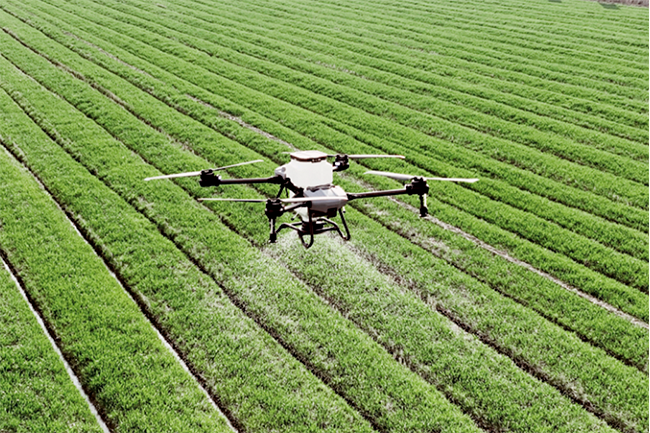
For farmers already making the transition, adoption – unsurprisingly – tends to start with technologies that solve an immediate problem. ‘Adoption is highest for the cheapest and most practical tools: satellite-based crop monitoring, GPS guidance on tractors, weather data and mobile apps,’ says Van der Laan. ‘Drones are probably the fastest-moving area right now. They are now used for monitoring crop health, pest detection and precision spraying. The most progress is in commercial grain and horticulture, where the return on investment is easiest to show.’
One example of the push towards accessible technology is the Chameleon Soil Water Sensor, which translates soil-water measurements into a simple colour signal: blue for wet, green for moist and red for dry. This allows farmers to immediately see whether irrigation is needed, and sensors installed at different depths also indicate how far irrigation water has moved through the root zone.
‘This helps farmers avoid both crop water stress and over-irrigation, which can waste water and leach nutrients,’ says Van der Laan. ‘Its real strength is accessibility: it turns complex soil-water data into a practical decision that smallholder farmers can use without expensive equipment or advanced technical skills.’
Van der Laan also points to the Data-Intensive Farm Management project, launched in South Africa in 2019, in which farmers vary seed and fertiliser rates across their own fields and use the resulting data to understand what works on their soils.
‘In our study on a Free State maize field, we combined trial, soil and satellite data with machine learning. Random forest models gave the best predictions of yield within the field. More importantly, they helped identify which factors drive yield in different parts of it, which is exactly the knowledge a farmer needs to apply inputs more precisely.’
The practical impact can be more persuasive than a technology demonstration. ‘These farmer-led trials, run in the farmers’ own commercial production fields, were the first time I have seen farmers convinced that they were applying too much fertiliser. Smaller white-peg agronomy trials had never managed to convince them of that.’
Agri Insight, on the livestock end, has built the Feed Mill App, which offers a cloud-based solution for commercial and on-farm feed mills, as well as an offline-capable field tool for data capture called the Gap App. ‘We discovered a gradual approach to implementation works best, especially when trying to build user trust and engagement,’ says Van Dyk. ‘Furthermore, visualisations and reporting play a significant role in “why” for data. Having real-time dashboards available to users provides business intelligence and an opportunity to address problems at a quicker rate, creating excitement for the technology.’
A 2025 national survey by Stellenbosch University’s Department of Agronomy and the Bureau for Food and Agricultural Policy gives a more detailed picture of adoption. Among the 82 field-crop producers surveyed, 43% reported full adoption of precision agriculture, while 51% had partially adopted the technology. Only 6% reported no adoption. The survey also highlights a significant gap between having the technology and making full use of the data it generates: 82% of respondents collected farm data, yet 45% still relied primarily on paper records.
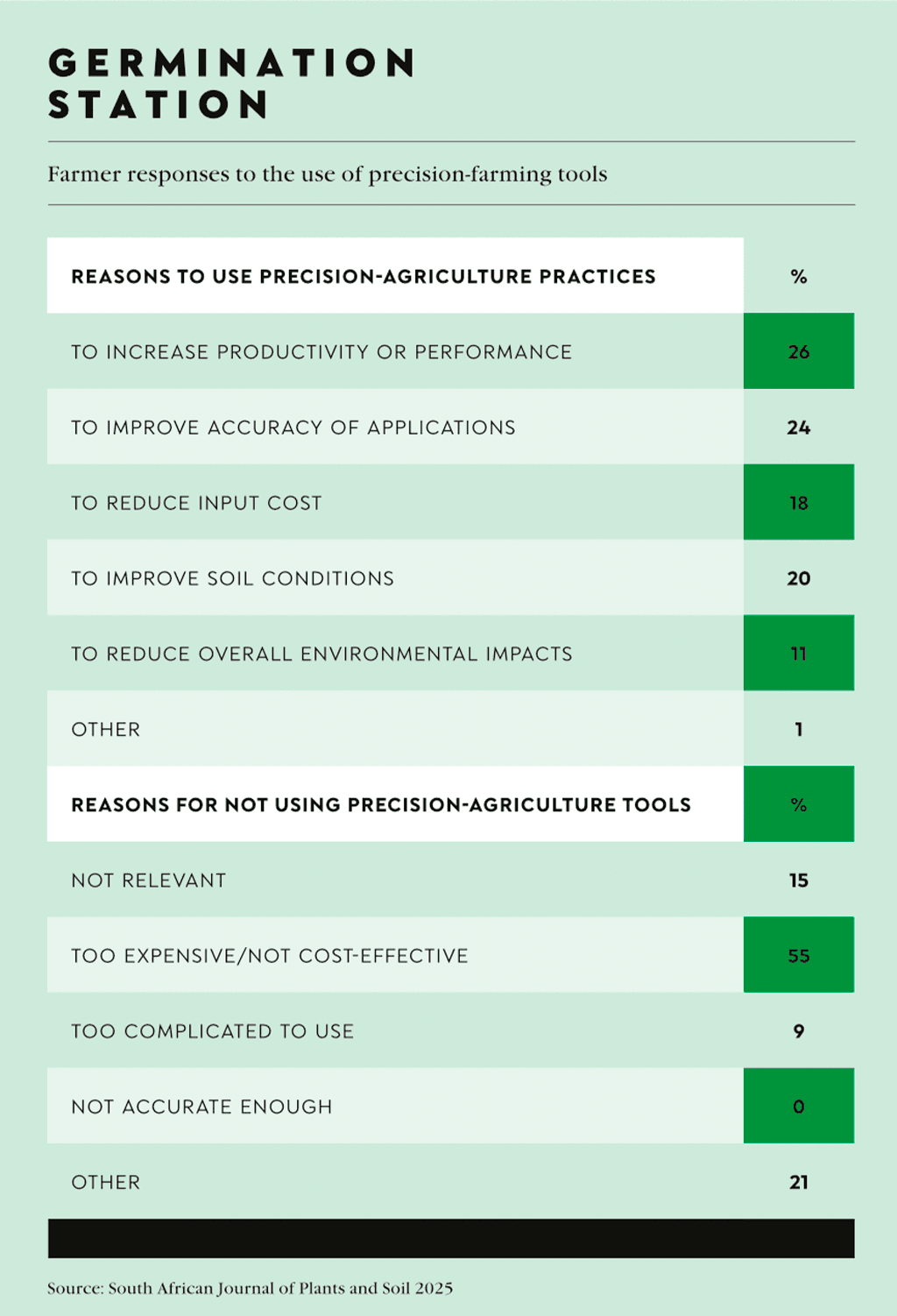
Age appeared to play a role, although the findings are not straightforward. None of the respondents aged 25 to 34 reported zero adoption, which the researchers say may suggest a stronger inclination among younger producers to integrate precision technologies. Barriers to adoption identified by the survey included financial constraints, limited understanding of precision-agriculture applications, insufficient technical support and regional differences in technology adoption. More than half of respondents who had not fully adopted precision agriculture said the technology was too expensive or not cost-effective.
For Van der Laan, the next step is a shift from collecting data to using it to make decisions. ‘I expect three shifts. First, “data-driven” will increasingly mean decisions rather than dashboards. AI and machine learning will turn satellite, drone, weather and machine big data into specific advice, often delivered through a phone.’
The second is a change in how farmers access the technology. ‘Drones and satellite services will increasingly be bought as services rather than owned as equipment. That will make them accessible to far more farmers, including smallholders, as long as regulation keeps pace.’
The third is the development of stronger public data infrastructure. ‘I hope to see stronger national public data infrastructure: weather station networks, soil databases, water and groundwater monitoring and open trial data. These public goods are what allow private tools to work well for everyone.’
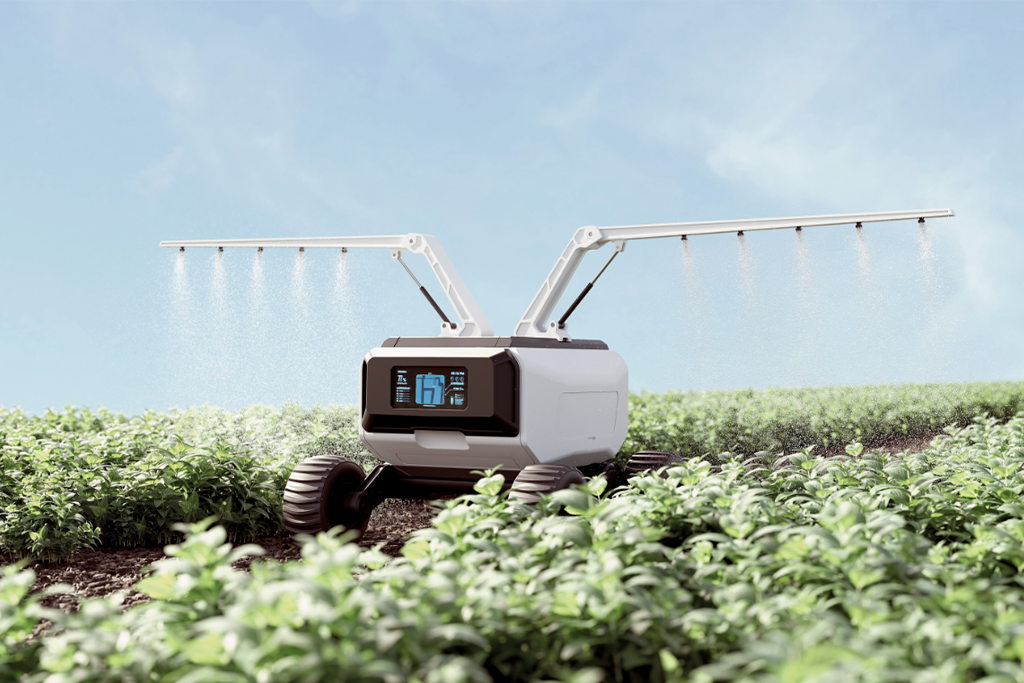
While drones are already changing how crops are monitored and treated, Van der Laan sees another technology potentially making the next leap: autonomous ground robots that move through crop rows.
‘Unlike drones, these machines could operate close to individual plants for extended periods. That would enable highly targeted scouting, weeding, spraying and other interventions with less labour and lower input use.’
The promise of precision farming, then, is not simply greater automation. It is the ability to make increasingly specific decisions about where to put water, fertiliser, chemicals, labour and machinery – and where not to.