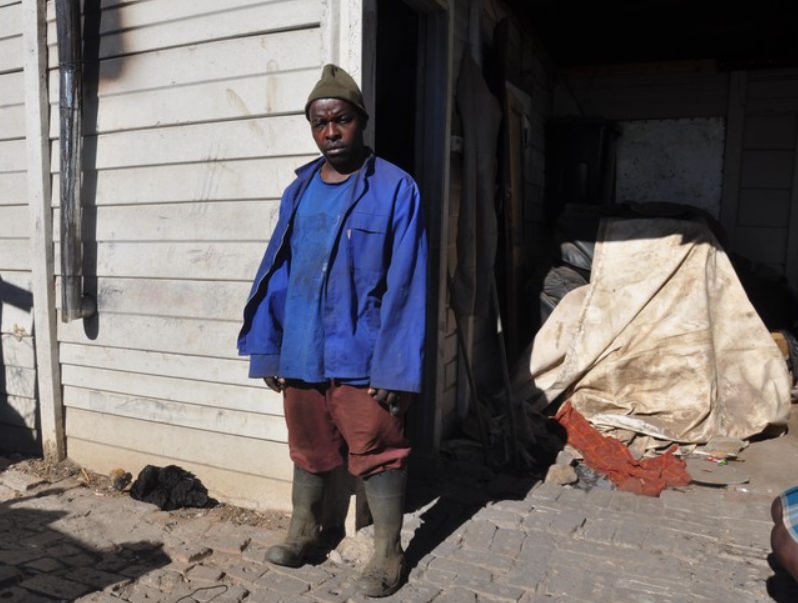
Ernest Mahlangu, a South African Shangaan man, often faces hostility when it is assumed that he is an immigrant. His wife, who is Mozambican, has been in custody since 30 June. Photo: Kimberly Mutandiro
By Kimberly Mutandiro
- Ernest Mahlangu, a Shangaan man, says he was assaulted by a mob during anti-immigration protests on 30 June, who simply assumed he was an undocumented immigrant despite him showing his South African ID.
- Police then detained his Mozambican wife for allegedly contravening the Immigration Act and he has been unable to make contact with her.
- Mahlangu says years of costly and complicated Home Affairs processes have prevented the family from registering their marriage or securing his wife’s legal status. They have also been unable to obtain birth certificates for four of their five children.
As anti-immigration protests spread across the country on 30 June, Ernest Mahlangu was at home with his wife, Esther Sithole, and their five children in Ekuthuleni informal settlement, in KwaThema. There were loud voices outside, and there was banging on the door. Mahlangu opened the door to find a crowd of people carrying long sticks, with police officers standing behind them.
They said he was an “illegal immigrant”. Ernest is South African and Shangaan – a Tsonga-speaking group who live mostly in parts of Mozambique, Zimbabwe and South Africa.
Mahlangu explained to them that he was South African, born in Bushbuckridge, and showed them a copy of his ID.
They then turned to his wife, who is Mozambican. He tried to explain that they were in the process of legalising their marriage and that they had planned to travel to the border that day to renew Sithole’s tourist visa, but to no avail.
“The mob insisted on taking me and my family to the police station. Some people beat me up and cursed, asking why I had an immigrant wife and not a local one,” said Mahlangu.
Mahlangu, his wife and children were bundled into a police van together with other immigrants who had been forced from their homes by the mob.
Mahlangu and his children were released, but his wife was taken into custody.
He took his wife’s passport to the police station and explained their situation, but he says he was brushed off. The KwaThema police told him she was at the Springs station. The Springs police said she was back in KwaThema, where she will appear in court, but he was not informed when.
On the evening of 30 June, Mahlangu’s home storeroom was burgled and his bicycle and tools stolen.
Gauteng police spokesperson Brigadier Brenda Muridili confirmed that Sithole is in custody, pending a court appearance for contravening the Immigration Act.
Mahlangu said on Monday that he was told by officials at the KwaThema Magistrates’ Court that his wife has since been transferred to Sun City prison and is due to appear in court again on 27 July.
Mahlangu said he feels lost without his wife. He is unable to answer his children’s questions about her whereabouts.
Documentation struggles
Mahlangu and his wife have been together for more than 20 years. They have tried without success to register their marriage in South Africa, obtain a spousal visa for her, and apply for their children’s birth certificates.
Home Affairs officials demanded DNA tests proving he is the father. He has been unemployed since 2012 and cannot afford DNA tests, he says. Only one of his children has been able to get a birth certificate.
The process of getting married to a foreigner and obtaining a spousal visa is also arduous and expensive.
“If the process of getting papers for my wife were any easier, we would not be in this mess,” he says.
Vatsonga Machangani (Tsonga-speaking people) like Mahlangu have been targeted by anti-immigration groups, even if they are South African.
“It’s not easy being a Shangaan man. Even though I am a South African citizen, I am being treated as a foreigner,” said Mahlangu.
When GroundUp visited the informal settlements of Highland and Ekuthuleni on Monday, we found houses once occupied by immigrants empty. Street stalls where Mozambican immigrants once operated were abandoned, and immigrant spaza shops in Ekuthuleni have yet to reopen after being looted.
In the Marikana informal settlement extension 3, several shacks previously belonging to immigrants were burnt down.
© 2026 GroundUp. This article is published under the GroundUp Republication Licence Version 1.0. Email [email protected] to request permission to republish.