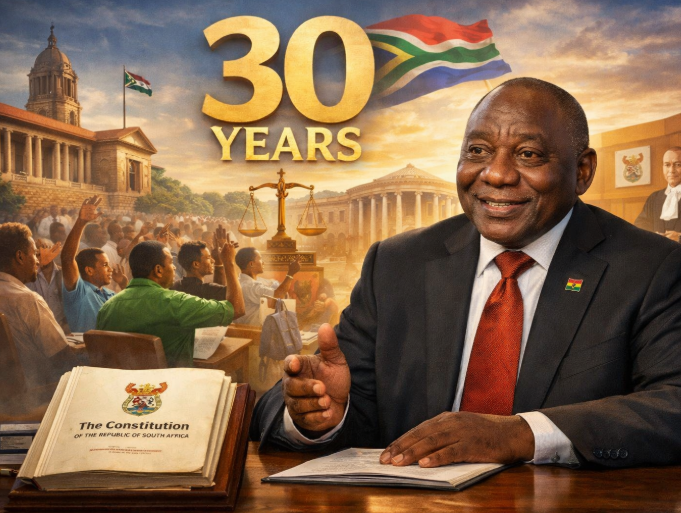
Pretoria – President Cyril Ramaphosa has used his weekly newsletter to reflect on 30 years since South Africa adopted its Constitution, describing it as the foundation of a “robust, participatory and continuously evolving” democracy built on active citizen engagement.
In the letter released on Monday, Ramaphosa said South Africa’s democratic order has been strengthened by a “vibrant public space and deeply engaged citizens” who understand that their voices matter in shaping national decisions.
“We are fortunate to live in a society with a vibrant public space and deeply engaged citizens who know that they have a voice, and more importantly, that their voice matters,” he wrote.
The President said the Constitution continues to anchor freedoms of expression, conscience and media independence, while also ensuring political contestation takes place openly.
He added that South Africa’s courts remain trusted institutions where “no one is above the law and scrutiny and no individual or institution is beyond accountability.”
Dear Fellow South African,
As we mark 30 years this month since the adoption of our country’s constitution, we can reflect with pride on political culture we have built as a nation – a culture that is robust, participatory, continuously evolving and firmly anchored in the… pic.twitter.com/XJ4wLNKkhG
— Cyril Ramaphosa 🇿🇦 (@CyrilRamaphosa) May 25, 2026
Reflecting on the drafting of the Constitution, Ramaphosa recalled what he described as an extensive public consultation process that included community meetings, workplace engagements and radio call-ins.
“We wanted a People’s Constitution where every South African would be able to put his or her own brick towards building the new South Africa,” he said.
He noted that the process generated “hundreds of thousands of pages” of submissions from the public on issues ranging from reproductive rights and taxation to environmental protection, language rights and disability inclusion.
Ramaphosa said this participatory model continues to shape governance today, pointing to public hearings on legislation, policy consultations, environmental decision-making processes and the annual parliamentary budget hearings, which he said rank among the most open globally.
While acknowledging concerns that participatory democracy can slow decision-making, he defended it as essential to maintaining legitimacy.
Making decisions
“For our democracy to retain legitimacy, citizens must be confident that their voices are counted when making decisions that affect them most,” he wrote.
The President also highlighted preparations for the upcoming National Dialogue process, which is expected to include up to 195 pilot engagements between June and August across all nine provinces. These will include ward-based meetings, digital platforms and sectoral discussions aimed at broad public participation.
He called on South Africans to engage actively in the process, saying it should reflect the country’s “racial, cultural, social, economic and geographic diversity.”
“Just as the 1994 generation played a direct role in the production of the birth certificate of the new South Africa, so too does today’s generation carry a responsibility to participate meaningfully in the National Dialogue,” Ramaphosa said.
He concluded by urging citizens, particularly young people, to help shape a renewed national vision that addresses current challenges and future development priorities.
Follow African Insider on Facebook, X and Instagram
For more African news, visit Africaninsider.com
Compiled by Betha Madhomu