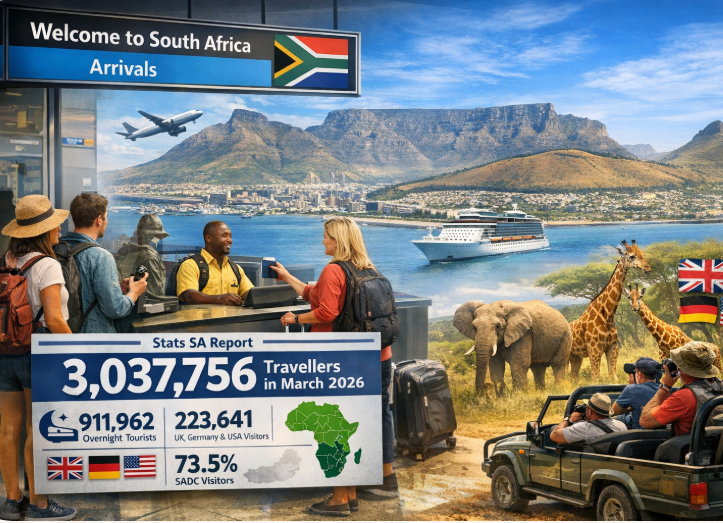
Cape Town – South Africa’s tourism sector continued its upward trajectory in March 2026, with more than three million travellers moving through the country’s ports of entry, according to the latest data from Statistics South Africa (Stats SA).
A total of 3 037 756 travellers — including arrivals, departures and transits — were recorded during the month, highlighting the sector’s growing contribution to economic activity. Of these, 723 364 (23.8%) were South African residents, while 2 314 392 (76.2%) were foreign travellers.
Foreign arrivals totalled 1 171 740 visitors, including 911 962 overnight tourists and 259 778 same-day visitors.
Holiday travel remained the dominant reason for visits, accounting for 97.2% of all tourists.
Stats SA said overseas tourists made up 24.5% (223 641) of all arrivals, with the United Kingdom leading at 45 902 visitors, followed by Germany (39 913) and the United States (31 268).
#WeDoTourism || The occupancy rate for South African hotels was 59,6% in February 2026, up from 51,1% in January 2026.
Read more here: https://t.co/Ecw2Tpj7Hz#StatsSA #KnowYourStatsZA #GovZAUpdates @Tourism_gov_za pic.twitter.com/56BhFN25M6
— Statistics South Africa (Stats SA) (@StatsSA) April 28, 2026
Together, these three markets contributed 52.4% of overseas tourism.
Tourists from the Southern African Development Community (SADC) remained the largest group at 73.5% (670 498), driven mainly by Mozambique (208 306), Zimbabwe (179 403) and Lesotho (108 482), which together accounted for 74% of SADC arrivals.
Road travel remained the most widely used mode of transport, accounting for 65.4% (1 985 575) of all travellers, followed by air travel at 32.9% and sea at 1.8%.
Stats SA also reported month-on-month and year-on-year increases across most categories. South African resident arrivals rose by 17.9% compared with February 2026, while foreign arrivals increased by 8.4% compared with March 2025.
The agency said the data reflects sustained demand for South Africa as a tourism destination, supported by strong regional travel and continued interest from key international markets.