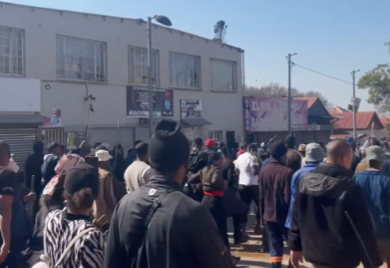
JUNE 30 PROTESTS | Thousands of undocumented Zimbabwean and Malawian migrants are gathered outside the Home Affairs Repatriation Centre in Cape Town, awaiting processing for repatriation. pic.twitter.com/jVpuKlTfXA
— SABC News (@SABCNews) June 30, 2026
“Better to be safe than sorry” – 1,800 Zimbabweans seek repatriation
Immigrant families have been displaced in the Western Cape
By Matthew Hirsch, GroundUp
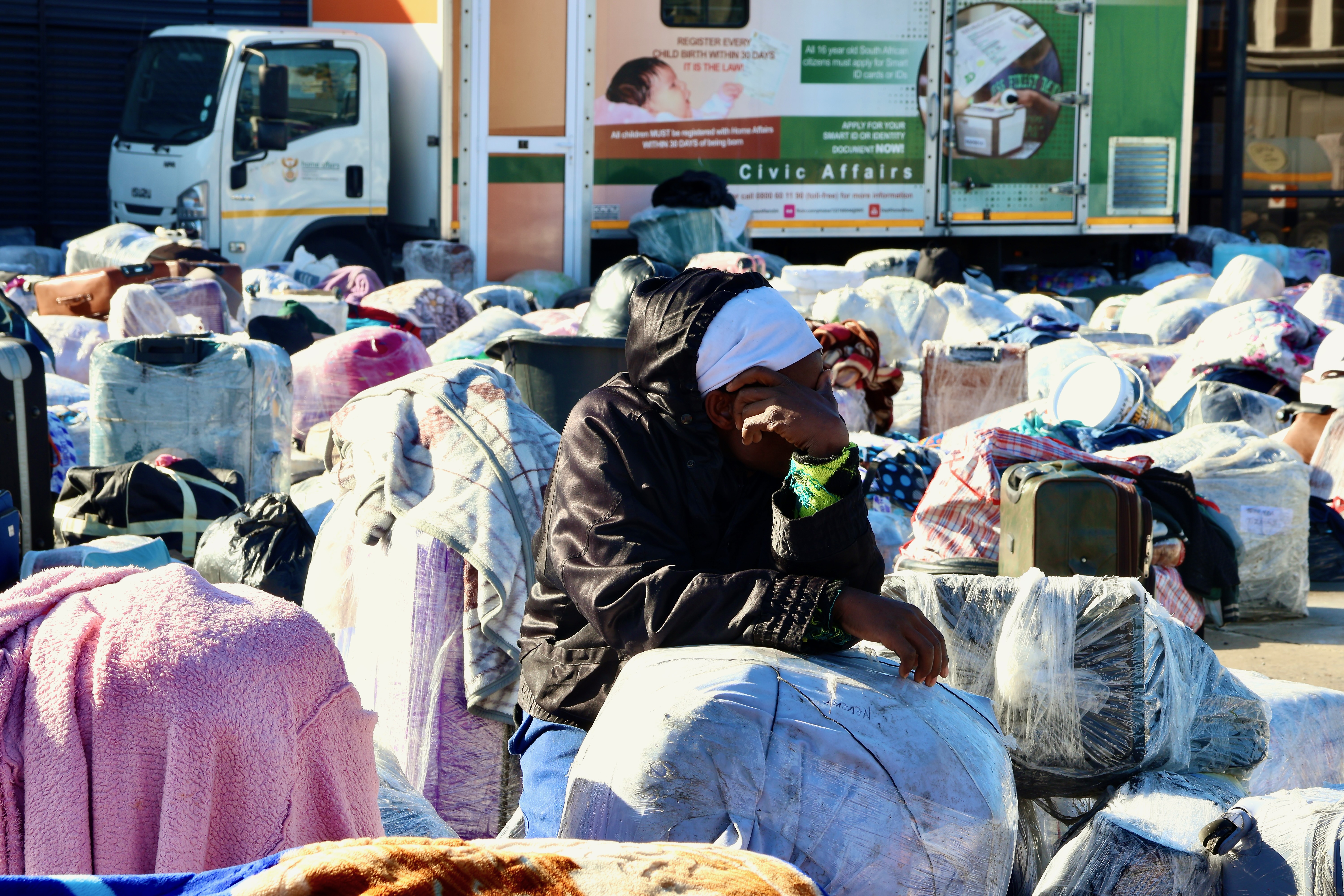
A man sits between hundreds of suitcases wrapped in clingfilm to protect them from the rain. Photos: Matthew Hirsch
- A large group of Zimbabweans are at the refugee reception centre in Cape Town, wishing to be repatriated.
- Women and children spent a cold night inside the centre, while men stayed outside in the rain.
- The group will likely be moved to a repatriation centre in Musina.
About 1,800 displaced Zimbabweans were being processed for repatriation at the Home Affairs Refugee Reception Centre in Epping on Monday.
The group spent Saturday night sleeping rough in the rain near the Zimbabwean Consulate in District Six before they were relocated to the refugee centre on Sunday.
They have fled their homes in rural towns, such as Robertson, amid fears of violence against immigrants.
Women and children had spent Sunday night inside the centre, while men stayed outside. On Monday morning, scores of people were in the street, hanging up their blankets and clothes to dry.
Both SAPS and the metro police were monitoring. Emergency medical officials and disaster risk management officials were on standby.
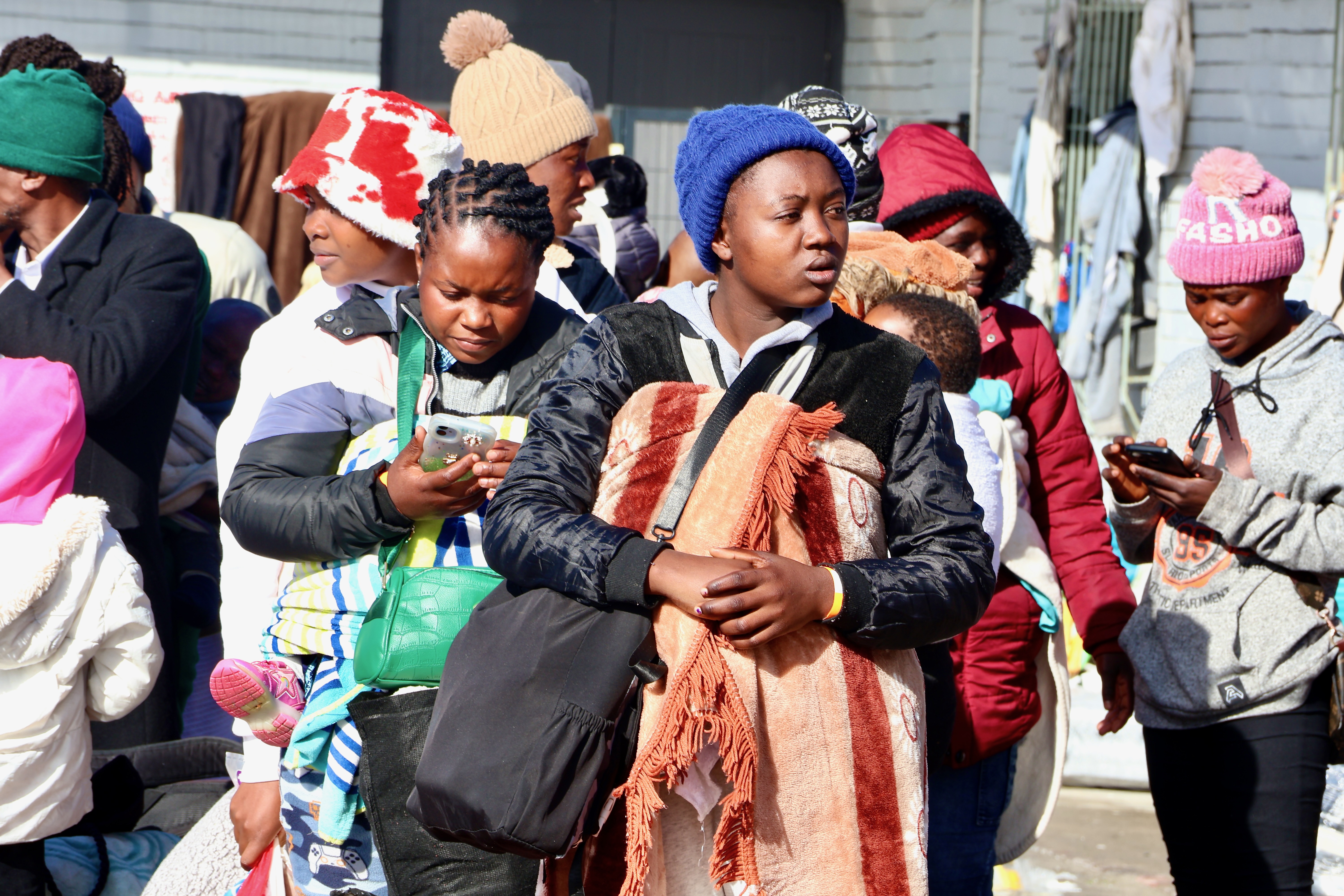
Hundreds of women and children were at the refugee reception centre on Monday.
Spray Vumdi, who lived in Philippi in Cape Town, said he had been in the country for four years.
“Most of us are fearing for our lives. It’s better to be safe than sorry. That’s why we decided to leave the country,” said Vumdi.
“It’s their right to march … but not to attack people. If they were marching peacefully with no threats and attacks, it would be better. If Africans can unite and be one, I think it would be much better. We could build our nation together, rather than fighting one another,” said Vumdi.
“It’s cold. There are no blankets; they were all wet,” he said.
Ndinzwei Marimba was waiting in line to be processed. She said she worked on a farm in Robertson. “We are very scared. Our landlord said we must go home. We have children here. They are very hungry; we don’t have money,” she said.
Ali Sablay, Gift of the Givers project coordinator, said more people, in addition to those being transported from the consulate, had arrived at the refugee centre.
He said that when Gift of the Givers arrived at the centre, “We found thousands of people sleeping in the cold rain last night. All their belongings got soaking wet.”
The organisation is providing hot meals, baby packs, hygiene products and water.
He said Home Affairs brought in extra officials to try to speed up the process.
Sablay said they got permission from Home Affairs to put up tents in the interim to provide shelter.
“Once people are on their buses, we will be giving them a snack pack to at least have a meal and take care of their kids on the long journey home.”
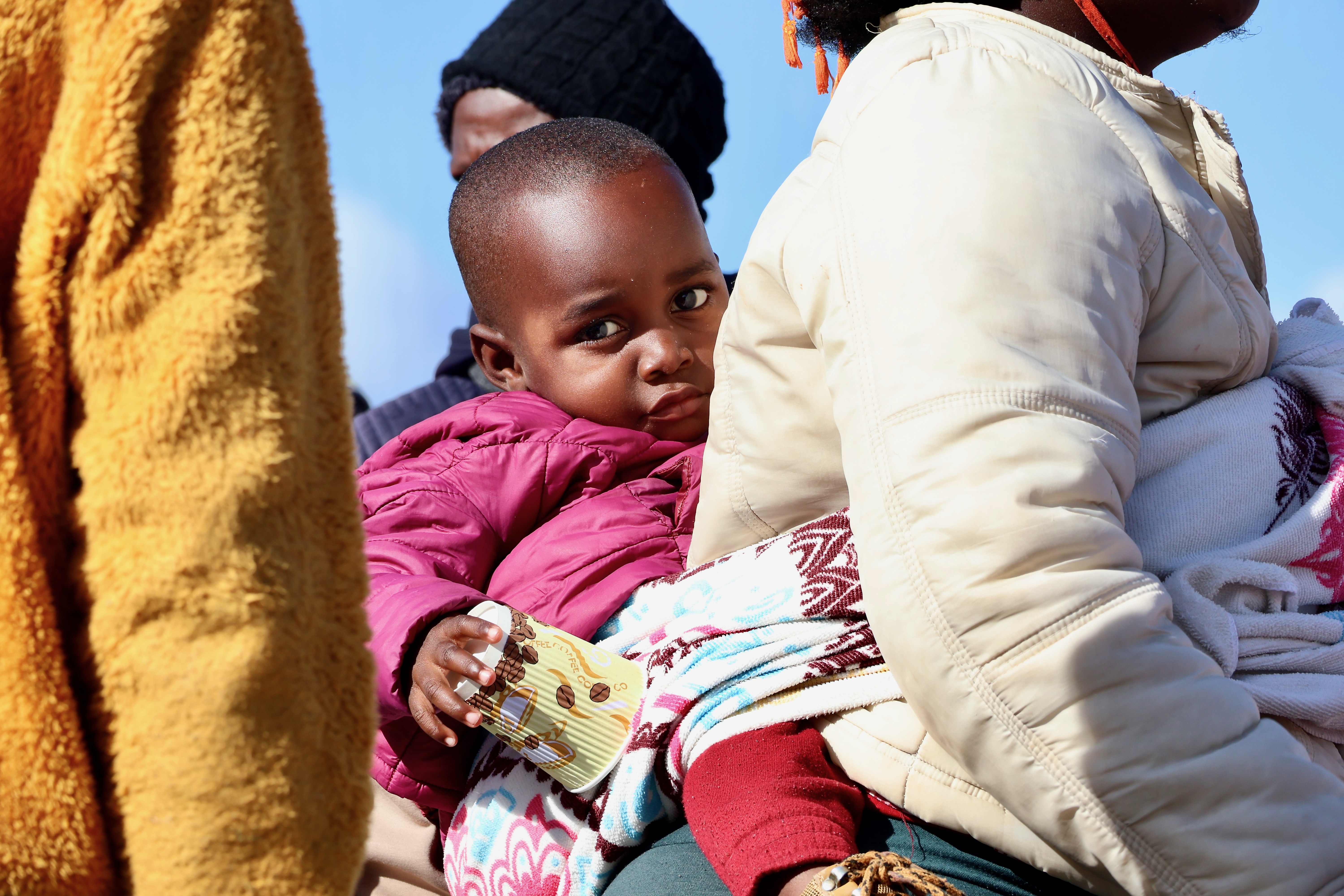
A young child on mother’s back.
Sikawu Makubalo, director of Ecumenical Affairs for the Methodist Church of Southern Africa, said the church had come to assist.
“We have to guard the dignity of all people. We are all Africans. As Africans, we need to make sure that we work for the development of Africa … I don’t know what this will achieve except that Africans will remain vulnerable,” he said.
Home Affairs spokesperson Thulani Mavuso told GroundUp that people would be taken to a repatriation site in Musina once processed before going home. It is unclear how long the repatriation process will take.
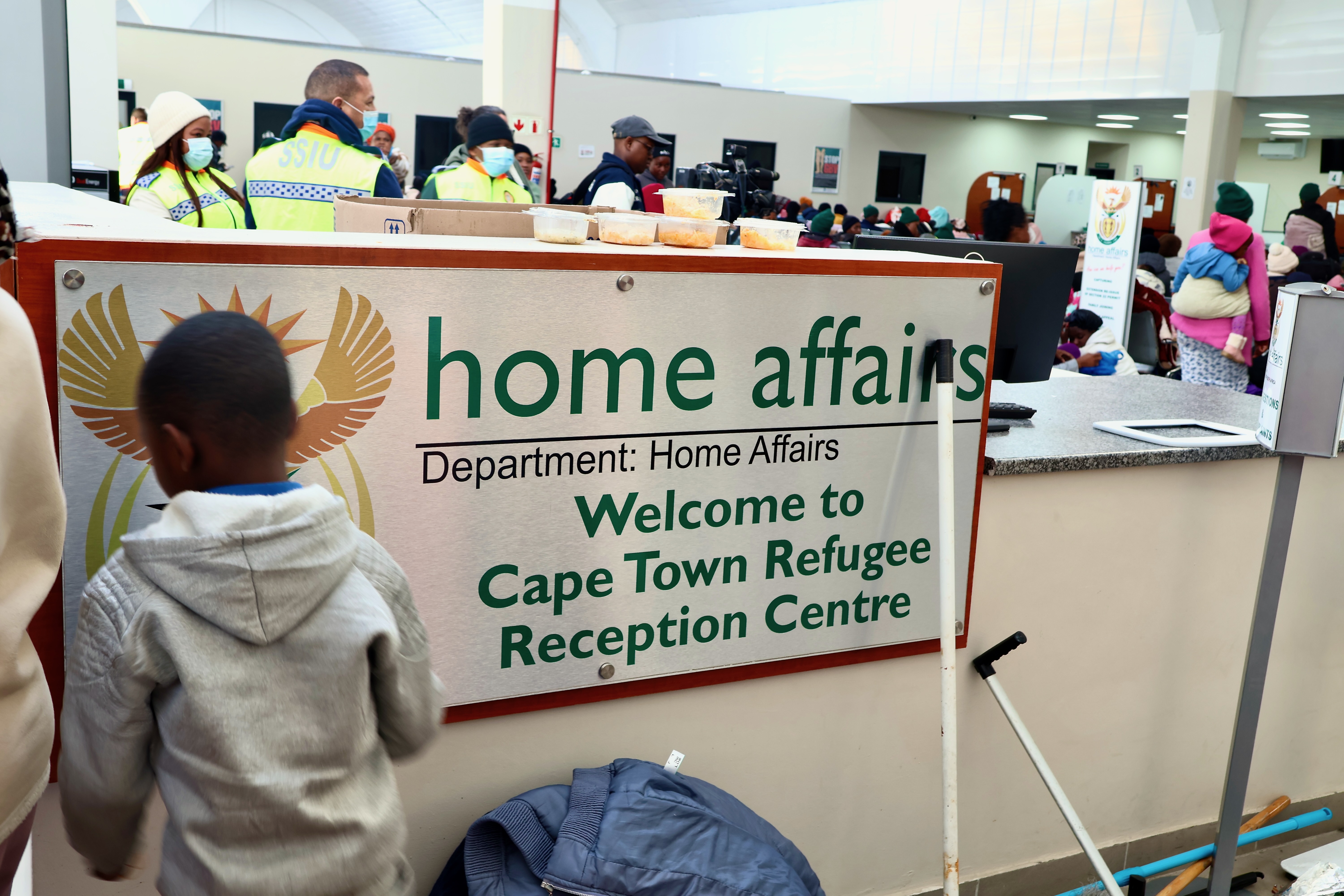
The Cape Town Refugee Reception Centre in Epping was filled to the brink on Monday.
© 2026 GroundUp. This article is published under the GroundUp Republication Licence Version 1.0. Email [email protected] to request permission to republish.
6,000 police officers deployed across Cape Town
Cape Town – At least 6,000 police officers have been deployed across Cape Town and surrounding areas in the Western Cape to maintain safety and security during planned June 30 protests.
The deployment will continue throughout the day and into the night as authorities monitor marches linked to growing tensions around undocumented immigration.
“We are saying to the members (police officers) they must be out there, protect every person in South Africa… and ensure that they are safe… Should there be any need to act, they must act within the law and ensure that they do that with respect for humen rights and human dignity. But also enforce and stamp the authority of the state where necessary,” the police said.
JUNE 30 PROTESTS | About 6,000 police officers have been deployed across Cape Town in the Western Cape to ensure safety and security during today’s marches and into the night. pic.twitter.com/yboR4V28l2
— SABC News (@SABCNews) June 30, 2026
Law enforcement agencies have intensified preparations ahead of the demonstrations, with officers positioned at key areas to prevent violence, criminal activity and disruptions.
Authorities have urged protesters to exercise their constitutional right to demonstrate peacefully while warning that acts of intimidation, vandalism or violence will not be tolerated.
The Western Cape security operation forms part of a broader national response, with police and other law enforcement agencies placed on high alert amid concerns over possible unrest.
[WATCH] It appears to be business as usual in various parts of Cape Town this morning. But later on, anti-illegal immigration activists are set to hold a march in CBD. Malungelo Booi has more. pic.twitter.com/HNBXwNIH2w
— Newzroom Afrika (@Newzroom405) June 30, 2026
The protests are being organised by groups calling for action against undocumented foreign nationals, with similar demonstrations expected in other parts of the country.
Government has repeatedly called for calm, saying concerns around immigration must be addressed through lawful processes and not through violence or attacks on communities.
By Betha Madhomu
Pretoria – The South African National Defence Force (SANDF) says it is prepared to support the South African Police Service (SAPS) should the need arise during nationwide protests planned against undocumented immigration.
The defence force confirmed that it has contingency plans in place ahead of the planned demonstrations, with authorities monitoring developments and preparing for any possible unrest.
The deployment forms part of broader security measures as law enforcement agencies brace for protests organised by groups calling for action against undocumented foreign nationals.
The SANDF said its role would be to assist the police in maintaining law and order, in line with its constitutional mandate, should the situation require additional support.
WATCH | The South African National Defence Force says it is prepared for any eventuality to support the police during tomorrow’s nationwide protests against undocumented immigration. pic.twitter.com/FItXBrGvRB
— SABC News (@SABCNews) June 29, 2026
The planned protests have raised concerns over possible violence and xenophobic attacks, with government urging communities to exercise restraint and ensure that demonstrations remain peaceful.
Police and other security structures have been placed on alert, with officials saying they are taking steps to prevent criminal activity, intimidation and damage to property.
The protests come amid growing public debate around illegal immigration, border control and pressure on public services, while migrant rights groups have warned against targeting foreign nationals.
President Cyril Ramaphosa has called for calm, saying while citizens have a right to protest, this must not lead to violence, discrimination or criminal acts.
By Betha Madhomu
Durban – South African police deployed to head off unrest and protests on Tuesday, the unofficial deadline set by citizen-led groups for undocumented foreign nationals to leave that has already pushed thousands to flee.
Officers were out in force to prevent violence and looting, while hundreds of foreign nationals took refuge in several cities, urgently seeking help to leave.
At least two Mozambicans, an Ethiopian and a Malawian have been killed in anti-immigrant violence over recent weeks and several African governments have organised planes or buses to repatriate their citizens.
“I decided to go to avoid being attacked,” said Malawian Peter Madsoan, 45, among several thousand gathered in the port city of Durban on Monday waiting for a bus to take him home.
“I am a breadwinner back at home in Malawi,” said the builder. “It is better for me to go than to die in South Africa.”
The Border Management Authority MA told AFP on Monday that about 25,000 people had been repatriated in recent weeks.
[WATCH]
The Gauteng Provincial Joint Operational and Intelligence Structure (PROVJOINTS), will be assessing the deployments in Gauteng ahead of the today’s planned protest action. #MorningLive #SABCNews
📍: Mayfair, Johannesburg
🎥: @Chriseldalewis pic.twitter.com/HmYm5Jx0US— SABCNews_MorningLive (@MorningLiveSABC) June 30, 2026
Around 15,000 Malawians had been processed for departure, South African officials said last week, while thousands more from Ghana, Mozambique, Nigeria, Zimbabwe and other countries had already left.
Uganda announced at the weekend an “evacuation plan” to start in the coming days for nearly 750 of its citizens.
As Tuesday’s unauthorised deadline arrived, thousands of people, mostly Malawians and Zimbabweans, also gathered in Cape Town and Johannesburg, waiting for assistance to go home.
Some said their landlords had evicted them or their employers had fired them, fearing fines from officials or attacks by vigilante groups.
Zimbabwean Evelyn Chinooneka, 29, said she and her 10-month-old baby had camped outside the Zimbabwean consulate in Cape Town for days.
“It was raining, all the clothes are wet now. We need our buses to come,” said Chinooneka, who had worked for four years on a farm outside Cape Town before being told to leave.
In Johannesburg, men in Zulu attire and holding shields and sticks paraded through the Soweto township, chanting “Abahambe”, which means “Let them go”.
‘Rolling mass action’
June 30 would launch “a national march to freedom, a rolling mass action” until all undocumented foreign nationals were deported, the leader of the anti-illegal migrant March and March group, Jacinta Ngobese-Zuma, told reporters last week.
“We are not calling for violence… no one will be killed on the 30th of June, and no looting will take place in our name,” she said.
Concerned about a repeat of the unrest that struck five years ago, when around 350 people were killed in days of looting and riots, the government has ordered a massive security deployment and warned against opportunistic crime.
[WATCH]: Law enforcement officials in Gauteng have gathered in Mayfair, as anti illegal immigration groups are set to take to the streets, to protest against police illegal foreigners.
Members of the SAPS, JMPD, Gauteng traffic police, Local traffic police and other departments… pic.twitter.com/eRpHkTD67N
— Kaya News (@KayaNews) June 30, 2026
The July 2021 unrest was sparked by the brief jailing of ex-president Jacob Zuma for refusing to testify to a commission probing corruption.
In the countdown to June 30, President Cyril Ramaphosa announced stepped-up government plans to combat illegal immigration and called on traditional leaders to use their “standing to calm tensions”.
The premier of KwaZulu-Natal province, Thami Ntuli, said: “Whatever our concerns about undocumented migration, however legitimate the frustrations beneath them, we will not allow this province to be set alight a second time, whether by criminality or by xenophobia.”
Migration ‘weaponised’
One of the continent’s wealthiest countries, South Africa is a magnet for migrant labour while grappling with an unemployment rate above 30 percent, high crime and a breakdown in services in many areas.
Previous flare-ups of violence targeting undocumented foreign nationals in South Africa have been deadly, with 62 people killed in riots in 2008.
But this is the first time that governments have simultaneously organised the repatriation of thousands of their nationals.
The country’s law enforcement agencies are leaving nothing to chance ahead of today’s anti-migrant protests. The National Joint Operational and Intelligence Structures has declared its operational plans fully activated. Tune in to #eNCA, channel #DStv403 for more updates on the… pic.twitter.com/wvgVQTA4IW
— eNCA (@eNCA) June 30, 2026
Groups campaigning against illegal immigration accuse foreign nationals of taking jobs, committing crimes and putting pressure on resources.
“The xenophobic groups have got it wrong,” said labour analyst Dale McKinley. “This is a problem of governance, corruption, and mismanagement,” he told AFP.
Coming ahead of local government elections in November, the anti-migrant push has been “politically weaponised”, he said.
Follow African Insider on Facebook, X and Instagram
Picture: Screengrab
For more African news, visit Africaninsider.com
Source: AFP