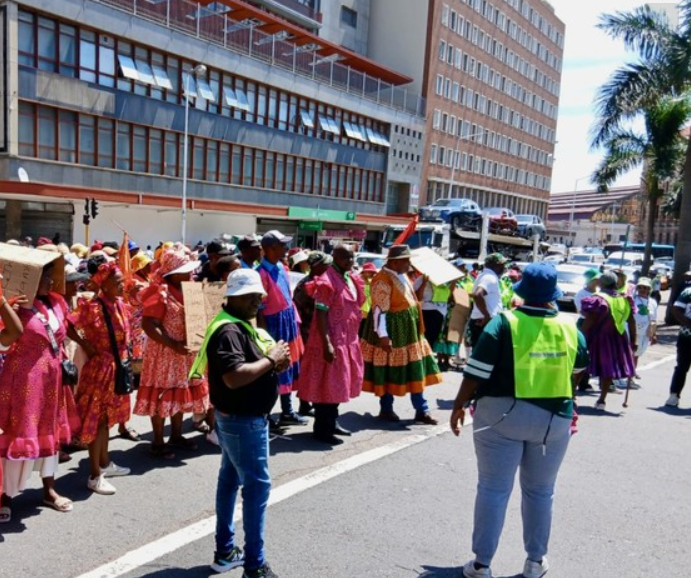
Street vendors marched to the IPID offices in Durban on 5 March to lay a complaint about Metro police conducting “destructive raids”. Photo: Tsoanelo Sefoloko
By Joseph Bracken and Tsoanelo Sefoloko
- More than 80 street vendors are taking eThekwini Municipality to court over permit issues and their planned relocation from the Durban city centre to Centrum Park.
- Vendors also marched to the mayor’s office and to IPID offices in early March, complaining about Metro police conducting “destructive raids”.
- The vendors claim the decisions over their permits and the relocation are based on hostility to foreign nationals working alongside South Africans.
More than 80 street traders are taking the eThekwini Municipality to court over permit issues and the decision to relocate them from Queen, Albert and Victoria streets to Centrum Park. They also say they are being prohibited from selling secondhand clothing.
Centrum Park is a municipality-owned property that has been converted into a trading space for informal traders.
A one-year trading permit costs R560 for a four-square-meter spot and R920 for a table. New permits and renewals are handed out each May, but the 84 vendors, some of whom have been trading for 19 and 20 years with permits, say that the municipality only renewed three people’s permits.
The permits of the other applicants were suspended, terminated, confiscated or left undecided, while some were renewed and subsequently confiscated.
This has left them without a legal way to operate their businesses.
Sinegugu Ngema, a street vendor on Victoria Street, wrote a letter in March 2025 seeking clarity from the municipality after her permit was terminated. She said she was promised a new spot to trade from, but never heard back from the municipality.
On 13 January 2026, Ngema and 83 other vendors filed a notice of motion with the Durban High Court. The motion states that the municipality failed to renew the trading permits of some applicants.
In his founding affidavit, Musema Kweli Kakomere claims that the municipality took issue with the fact that some of the South African permit applicants had immigrants assisting them.
Kakomere says he believes the relocation decision was an attempt to remove foreign nationals, including those legally in the country and who have South African identity numbers, from the city centre and to “isolate us in an area called Centrum Park”.
He further surmises: “I believe that the respondents also condemn the close and cordial relationship which the foreigners and the South Africans share at the stalls on the street”. He quotes an official saying as much in the affidavit.
He also says the relocation area is not safe and is “run by the MK Party who enforces Operation Dudula”, a xenophobic vigilante group. He cites examples of other vendors who have, out of fear, been forced to leave Centrum Park.
Beyond the safety issues, he cites reasons why the location will not be financially viable for the traders.
The vendors want the eThekwini Municipality and the municipal manager to explain why their decisions not to renew permits and to relocate vendors should not be judicially reviewed and set aside.
They say the decisions were never explained, nor were they consulted, and they never consented to the relocation.
The municipality will oppose the motion.
Unfair treatment
Vendors also claim that Metro police officers are using disproportionate force when shutting down their stalls and complain about the confiscation of their clothing wares.
In his affidavit, Kakomere says Metro police have conducted “destructive raids” since June 2025.
On 5 March, a group of vendors marched to the mayor’s office to hand over a memorandum outlining their grievances and demands.
In a memorandum, they called on the municipality to intervene and address the challenges they face, including the alleged harassment by law enforcement officers. Vendors say their wares are unlawfully confiscated, and law enforcement officers demand money.
The day before, on 4 March, about 50 vendors had gathered at King DinuZulu Park in Durban before marching to the provincial offices of the Independent Police Investigative Directorate (IPID).
The march was organised by Alkebu Social Movement, which has filed a notice of intention to join the Durban High Court case.
Provincial IPID deputy director Len John accepted the memorandum and said he will make sure that they meet with the leaders. “We are not the police, but we are investigating the misconduct of the police … We are going to respond after investigating,” said John.
IPID spokesperson Lizzy Suping told GroundUp that with an ongoing investigation, they “cannot provide a timeline”, but IPID had engaged with the complainants.
Thabisile Dlamini, who trades in phinifa dresses, said, “We are not employed and have no alternative sources of income. We rely solely on selling our phinifa. We would be very happy if the municipality could help us by providing a place to sell our goods.”
Bongiwe Ndlovu, a street vendor on Victoria Street, told GroundUp she applied for a space in May 2025 but only received a permit in February this year.
Along the street, there are permanent metal tables bolted to the ground, set up for trading by the municipality. Ndlovu had wanted one of these, but she only received space on the pavement. She is upset because a permanent table right next to her assigned spot has not been allocated.
When GroundUp went to Queen Street last week, we found Metro police busy confiscating goods, mostly clothes and suitcases, from Arsain Kilonda.
Kilonda said he was looking after the stall for a woman who had to attend to another matter. He therefore did not have the permit to show the officers, who confiscated the goods at the stall and issued a R600 fine.
According to municipal spokesperson Gugu Sisilana, vendors may not trade without a valid permit. If officials encounter someone trading without a permit, the standard procedure is to issue a formal warning and instruct them to remove their goods and cease operating.
“Should the individual fail to comply with the directive, enforcement action is initiated. Such action may include the issuing of a fine and the confiscation of goods, as provided for in the applicable bylaws.
“The municipality encourages traders to approach the business support directorate, where they will receive guidance,” said Sisilana.
According to Mzwakhe Masoeu, general secretary of Alkebu, confiscated items are kept at the business support directorate’s pound next to the Durban train station. Vendors must pay their fines at metro police stations or through their banking apps to the metro police account.
He said because the municipality failed to issue permits, “the traders are forced to run away from the law enforcement officers whenever we see them”.
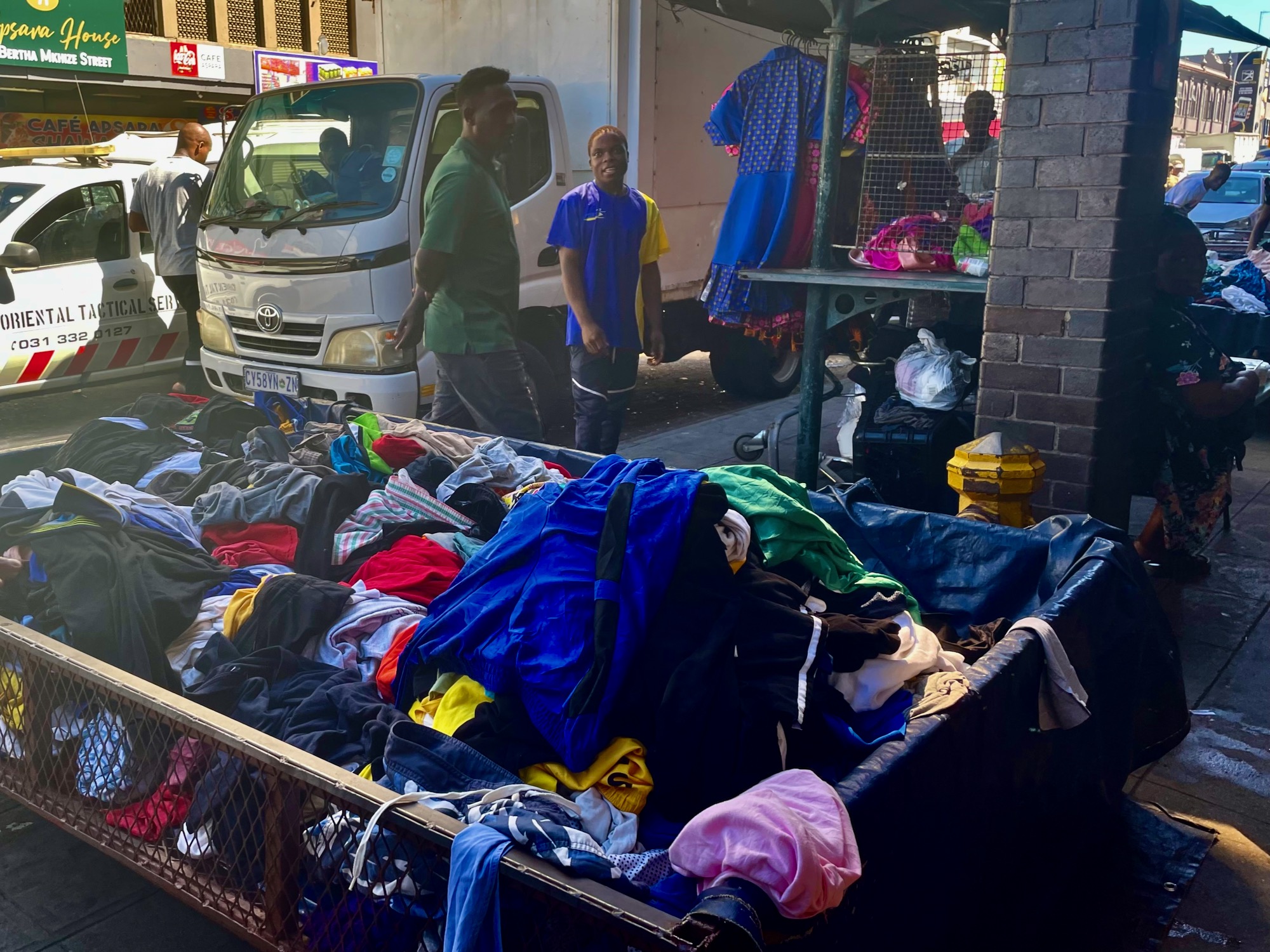
Second hand clothes old on Victoria Street. Photo: Joseph Bracken.
© 2026 GroundUp. This article is licensed under a Creative Commons Attribution-NoDerivatives 4.0 International License.
Follow African Insider on Facebook, X and Instagram
Picture: GroundUp
For more African news, visit Africaninsider.com