In February a hacker known as Rootboy slipped undetected into Standard Bank’s systems, spending (it claimed) ‘just over three weeks’ working through the bank’s SharePoint, OneDrive, Power Apps, Jira, Confluence, Citrix, Remedy and Microsoft and Oracle SQL databases. Rootboy demanded one bitcoin (about ZAR1.2 million) to not leak the data it had stolen, which included client data, passport numbers, driver’s licence numbers, home addresses, employee data and more. The bank appears to have followed the recommended cybercrime playbook and didn’t pay the ransom. Rootboy then published the data.
That’s the nightmare… and artificial intelligence (AI) is making it worse. If cybercrime is a horror movie, AI is the part where the monster gets faster, stronger, smarter and harder to stop.
More than half (55%) of reported cybercrimes across Africa are now enabled by AI. And while traditional cyberthreats (such as ransomware, business email compromise, data breaches or online scams) remain deeply damaging, Interpol’s 2026 African Cyberthreat Assessment Report warns that AI is ‘expanding the reach and sophistication of criminal networks’.
‘Cybercrime has emerged as one of the most significant criminal threats to the region,’ says Neal Jetton, the director of Interpol’s cybercrime unit. ‘AI is automating every stage of a cyberattack from reconnaissance and phishing to extortion and evasion.’
Interpol reports that cybercrime-related losses have more than doubled since 2024, from US$192 million to US$484 million – driven primarily by AI-facilitated scams, credential harvesting and automated social-engineering campaigns.
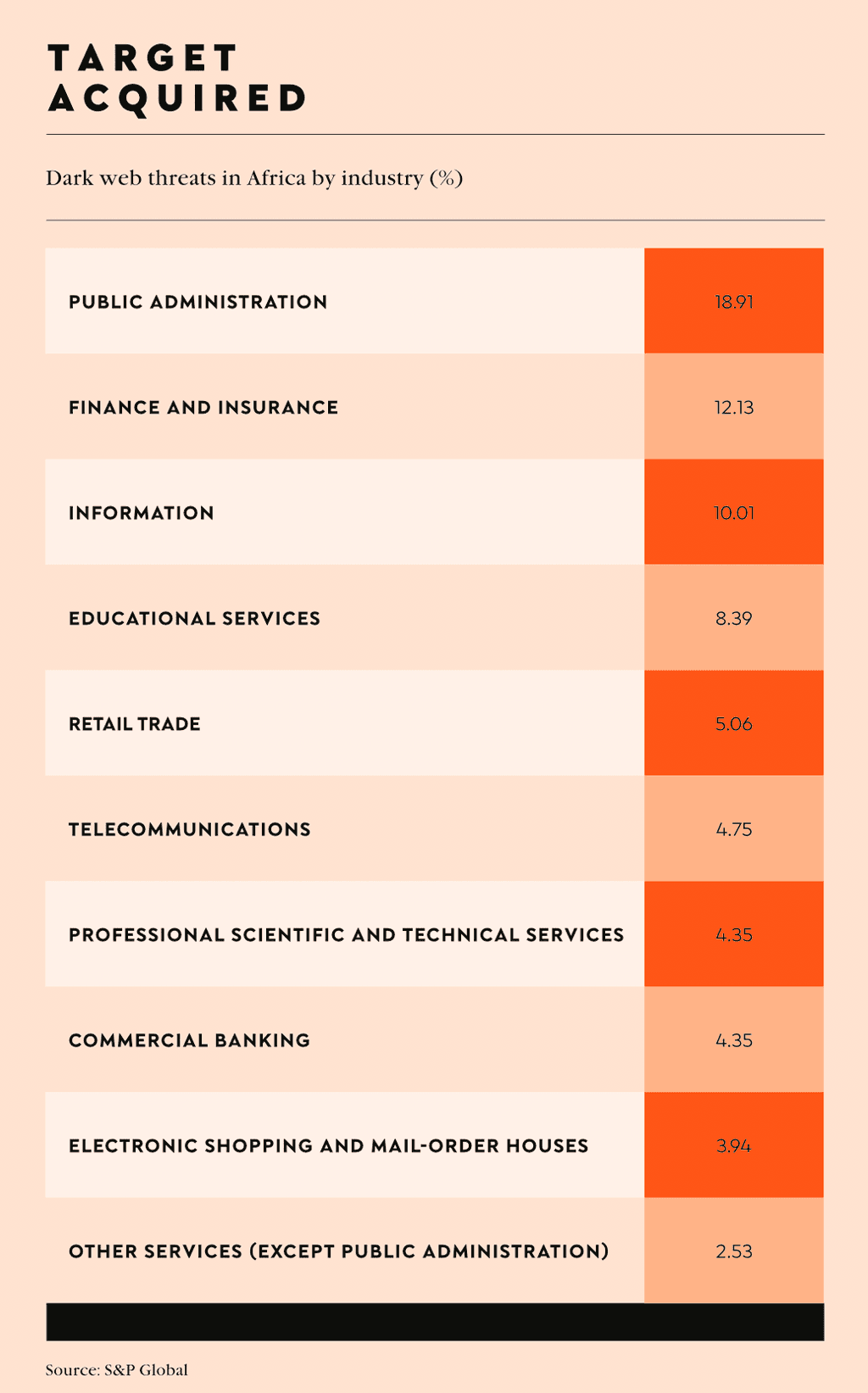
It’s not known whether the Standard Bank hacker used AI to breach the bank’s defences. And in a sense, it doesn’t matter. What matters is that attacks such as these are happening more and more frequently. Land Bank, Bidvest Bank, Hungry Lion, Pam Golding Properties, EasyEquities, Toyota South Africa, the Gauteng provincial government, Avbob, Statistics South Africa… They’ve all been hit by cyberattacks within the past year or so. And those are just the incidents that have been reported.
Kgomotso Lebele, country MD for South Africa at Accenture, says the potential impact of these incidents may grow as AI matures.
‘Recent reports suggest that AI is already being used to support activities such as vulnerability discovery and reconnaissance elements of attack planning. While human oversight remains involved, automation is increasing the speed and scale at which these activities can occur,’ he says.
Avinash Gupta, head of In2IT Technologies’ Centre of Excellence, says the rise of agentic AI is accelerating the contest between defenders and cybercriminals.
‘What makes agentic AI especially concerning is not only its speed, but also its ability to learn from outcomes and refine its actions with minimal delay,’ he says. ‘Cybercriminals no longer need to rely solely on static playbooks or one-off attack attempts. AI-driven systems can test multiple approaches, identify which techniques generate the best results and quickly shift direction when they encounter resistance. This creates a more fluid and unpredictable threat environment, where attacks are not just automated, but increasingly adaptive.’
Adaptive… and autonomous. Traditional cyberattacks often used scripted tools that needed human oversight, which meant they were limited by time, scale and the humans who were running them. Agentic AI removes many of these limits. ‘Autonomous agents can continuously monitor systems, test for vulnerabilities and refine their strategies without waiting for human input,’ says Gupta. ‘This lets attackers probe networks more aggressively and persistently than ever before.’
But if AI is the problem, it’s also the solution. The same tools are available to the organisations trying to keep attackers out, and they’re increasingly being deployed to keep systems secure and data safe.

‘When it comes to breach readiness, South African organisations fare better than many of our global counterparts,’ says Heino Gevers, the senior director of technical support at Mimecast. He points to IBM data that shows South African organisations averaging 227 days to identify and contain data breaches. ‘That’s about a month faster than the global average of 258 days,’ he says. ‘This is partly because 78% of local organisations now deploy AI-infused security tools, which dramatically cuts the time to context,’ says Gevers.
‘Time to context’ is the time it takes for an organisation to figure out what happened, who is affected and how to respond.
‘Instead of teams spending days trawling through disconnected email archives, Teams logs and Slack channels, AI engines can pull this information together in minutes, giving a single pane of glass that shows the scope and impact of an incident,’ says Gevers. ‘Combined with anomaly detection based on years of behavioural and metadata patterns, AI can surface attacks earlier and arm security and leadership teams with the facts they need to brief all stakeholders and customers, not just meeting the 72-hour Popia [Protection of Personal Information Act] requirements.’
Gupta says the defensive side is catching up. ‘Defenders are turning to AI to fight back against AI-driven threats,’ he says. ‘AI-powered monitoring platforms can analyse large amounts of network traffic, user behaviour and system activity to identify unusual patterns that may indicate an attack. These tools can process much more data than human analysts alone and can detect subtle patterns that might go unnoticed.’
Many of these platforms can respond in real time, he adds. ‘Automated systems detect suspicious activity, then isolate compromised devices, block harmful traffic or alert security teams to investigate further. This capacity for quick reaction is critical when dealing with AI-driven attacks, which can escalate rapidly once attackers gain an initial foothold.’
Faster detection helps, but it is better to be secure before an attack begins. That makes preparation more important than ever, says Lebele, who argues that organisations should ensure security is considered at the beginning of digital and AI initiatives, rather than after deployment. ‘Cloud governance, data management, identity controls and application security should form part of planning and implementation processes from the start,’ he says. ‘As AI becomes more embedded across business functions, security can no longer be treated as a separate workstream. It needs to be integrated into decision-making from the outset.’
Then there’s what happens when prevention fails. Speed matters after a breach too, and Gevers notes that global recovery remains slow.
‘When we look at global standards, full recovery remains painfully slow, with 65% of breached organisations still not fully recovered within 100 days,’ he says.
Mimecast’s research shows the median shareholder value loss for a company after experiencing a brand or reputational crisis is 30%. ‘But losses from the same types of crises drop to 4% when there is a response within hours of it occurring, 10% when it’s within days and 14% or more when it takes weeks to address it,’ he says. ‘Leaning into AI can make all the difference.’