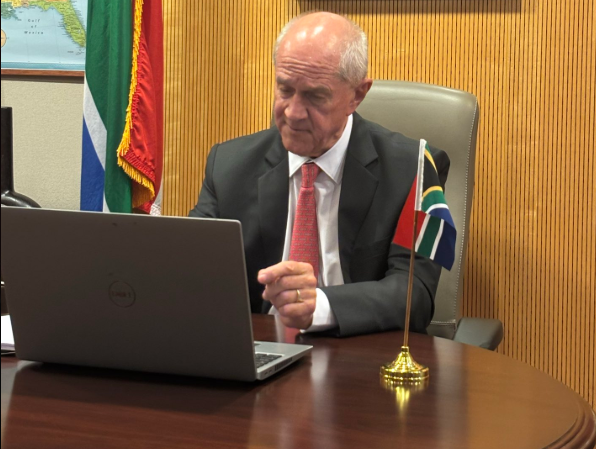
Cape Town – South Africa is unlikely to return to a system of single-party government for the foreseeable future, with coalition politics expected to become a permanent feature of the country’s political landscape, former apartheid-era negotiator and newly appointed ambassador to the United States Roelf Meyer has said.
Speaking to 702/CapeTalk, Meyer said the declining electoral support of the African National Congress (ANC) reflected a broader pattern experienced by liberation movements that governed countries for decades before eventually losing their dominance.
“The outcome, I think, indicates very strongly that we will most likely never see a one-party rule again, a single-party rule again, at least not for a long time,” Meyer said, according to EWN.
He attributed the changing political landscape partly to generational shifts, arguing that many South Africans now voting were not directly involved in the struggle against apartheid and were increasingly judging political parties on their present-day performance.
“The vast majority of South Africans who probably now vote have not been part of the anti-apartheid struggle,” he said.
Political dominance
Meyer compared the ANC’s declining support to India’s Congress Party, which governed the country for nearly four decades following its independence struggle before eventually losing its political dominance.
His comments come as the 2026 local government elections point to further fragmentation of South Africa’s political landscape, with no single party appearing capable of securing outright majorities in several major metropolitan municipalities.
According to Reuters, with approximately 71% of votes counted on Friday, the ANC was leading nationally with 32%, followed by the Democratic Alliance (DA) at 25%.
The figures suggested a potential 14-percentage-point decline in ANC support compared with the 2021 municipal elections, when the party recorded its worst electoral performance since taking power in 1994.
Business Day also reported that the ANC was facing the prospect of losing its outright control of major metropolitan councils, with the DA projected to lead in several metros and smaller parties likely to play decisive roles in coalition negotiations.
Negotiations
Meyer believes political parties must approach these negotiations with a willingness to engage and find common ground, drawing lessons from the negotiations that brought an end to apartheid and established democratic South Africa.
“The starting point is to talk, you know, and they must be serious about it,” he said.
He added: “Talk first, then have proper dialogue and then negotiate the substance.”
Meanwhile, eNCA, reporting on Meyer’s remarks during the launch of his political memoir on 26 October, also highlighted his belief that multi-party government was here to stay.
Meyer argued that coalition government was not necessarily a sign of democratic weakness, saying South Africa’s democratic system remained strong and that voters’ ability to exercise their democratic choices should be protected.
His remarks come at a pivotal moment for the country’s politics, as parties prepare for coalition negotiations following the local government elections, potentially reshaping how major cities and municipalities are governed.
Follow African Insider on Facebook, X and Instagram
Picture: X/@RSAinDC
For more African news, visit Africaninsider.com
Compiled by Betha Madhomu