Pretoria – South Africa is facing an unusual electricity problem: the country now has enough generation capacity to produce surplus electricity, yet thousands of households remain without reliable power because they either cannot afford electricity, lack formal connections or are affected by overloaded local networks.
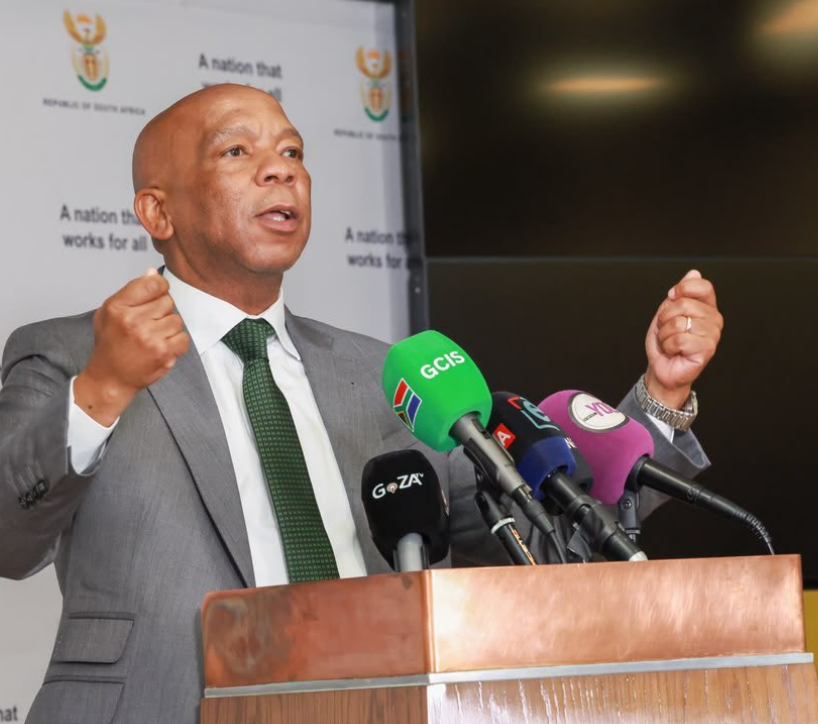
Electricity and Energy Minister Kgosientsho Ramokgopa said the country was generating more electricity than it needed.
“Electricity can be available on the grid, but in many instances, it’s not accessible,” he said.
Ramokgopa was speaking during a media briefing in Hatfield, Pretoria on Wednesday.
He added that some households had no electricity because “they just can’t afford to buy the units.”
The minister said electricity supply and electricity access were two different issues, with affordability increasingly becoming a major barrier for poorer households.
Surplus power meets weak demand
The development marks a significant shift from the electricity crisis that dominated South Africa for more than a decade, when Eskom struggled to generate enough power to meet demand.
South Africa is now prioritising battery storage and gas-to-power projects as part of efforts to strengthen the electricity system.
The government plans to prioritise 9.6GW of battery storage and gas-to-power projects. The technologies are intended to improve grid reliability and provide greater flexibility.
The government’s own announcement confirms that the new electricity procurement programme will include wind, solar, battery energy storage and gas-to-power technologies, while a state-led Power Parks Programme will seek to facilitate the integration of new generation into the national grid.
The programme is intended to provide the market with a long-term procurement pipeline.
But the growing supply of electricity is occurring alongside weak demand.
Eskom is even considering discounted electricity tariffs for cryptocurrency miners and other flexible-load customers as the utility looks for ways to absorb surplus power.
Eskom’s modelling shows it could have 5TWh of surplus electricity by 2028, equivalent to the annual consumption of about 450,000 average households.
“Eskom has proposed a two-year pilot tariff aimed primarily at new, high-load and flexible customers,” the National Energy Regulator of South Africa said.
Poor households still struggling
Despite the improved electricity supply, affordability remains a major obstacle.
In September, Eyewitness News (EWN) reported that Ramokgopa said the government had no shortage of money to provide free basic electricity to poor households, but that municipalities were failing to use available funding efficiently.
“We know that National Treasury provides a budget of about R31 billion per annum to support poor households. So, our view here has to be the efficient use of that allocation, so we don’t have a money problem, we have a problem of efficient allocation,” Ramokgopa said.
The government is also considering expanding the amount of free electricity provided to qualifying indigent households.
The revised electricity pricing policy could increase free basic electricity from the current 50kWh to between 200kWh and 300kWh a month for qualifying households.
Infrastructure remains another problem
Affordability is not the only reason households can remain without power.
Ramokgopa said that load reduction was being driven by illegal connections, informal settlements, overloaded networks and inadequate municipal planning.
He said load reduction had already ended in seven of South Africa’s nine provinces, but warned that the problem would persist without intervention.
“We accept that if you don’t roll out that programme, you are going to continue to have a situation where people don’t have access to electricity,” he said.
The government is therefore attempting to address both sides of the problem — ensuring that additional generation can be absorbed by the grid while improving access for households.
Batteries to absorb excess electricity
Ramokgopa announced that government would procure the full 4,600MW of battery storage allocated under the Integrated Resource Plan 2025, more than double the roughly 2,200MW originally expected to be procured by 2030.
“We don’t wait for the future; the problem is now,” Ramokgopa said.
The strategy is designed to allow excess electricity generated during periods of low demand — particularly from renewable sources — to be stored and released when demand rises.
The government’s Integrated Resource Plan explains that battery systems can charge during periods when surplus electricity is available and discharge the stored power when demand increases.
The official Integrated Resource Plan notes that battery storage can help integrate distributed renewable-energy resources into the electricity system.
For South Africa, the challenge is therefore no longer simply generating enough electricity. The country must now ensure that surplus power can be absorbed by the grid, electricity remains affordable and distribution networks are capable of delivering power to households that need it most.