Johannesburg – South Africans earning R30,000 a month could see almost half of their income consumed by taxes and tax-like household costs once PAYE, VAT, fuel levies and private expenses are taken into account, according to an analysis by BusinessTech.
The publication calculated that a person earning R30,000 a month, or R360,000 a year, pays about R4,750 in PAYE, with UIF and other payroll deductions leaving about R24,773 after payroll taxes.
But once VAT on groceries and electricity, fuel taxes, school fees, medical aid, municipal charges and private security are factored in, only about R15,454 remained.
That translates into an effective burden of 48.49%, although the figure is not a conventional income-tax rate because it includes private household expenses.
Sean Kelly, director at Parity Wealth Managers, told BusinessTech: “Unfortunately, many South Africans feel significantly poorer than their payslips suggest.”
Salary increases
South Africa’s standard VAT rate is 15%, while personal income tax is progressive. According to the South African Revenue Service (SARS), the maximum marginal rate for the 2027 tax year is 45% on taxable income above R1.8786 million.
BusinessTech compared South Africa’s household-cost burden with Germany, where the maximum statutory income-tax rate is 45% for taxable income above €277,825 – equivalent to more than R432,000 a month using the exchange rate in its comparison.
However, PwC’s Germany tax summary notes that Germany’s personal income-tax system is progressive and that the 45% rate applies only to income above the relevant threshold. It therefore should not be treated as directly equivalent to BusinessTech’s 48.49% South African calculation.
The comparison nevertheless highlights the pressure on South African households, where many people pay privately for services such as education, healthcare and security.
Efficient Group chief economist Dawie Roodt argued that these costs can effectively become another layer of financial pressure, while MyTreasury co-founder Michael Kransdorff pointed to private education, healthcare and security as expenses linked to gaps in public-service provision, according to BusinessTech.
Kelly also warned about bracket creep, where salary increases intended to keep pace with inflation can push taxpayers into higher tax brackets without necessarily increasing their real purchasing power.
BusinessTech said the analysis demonstrates the difference between a statutory income-tax rate and the broader financial burden experienced by households after taxes and other compulsory or essential costs are included.
Follow African Insider on Facebook, X and Instagram
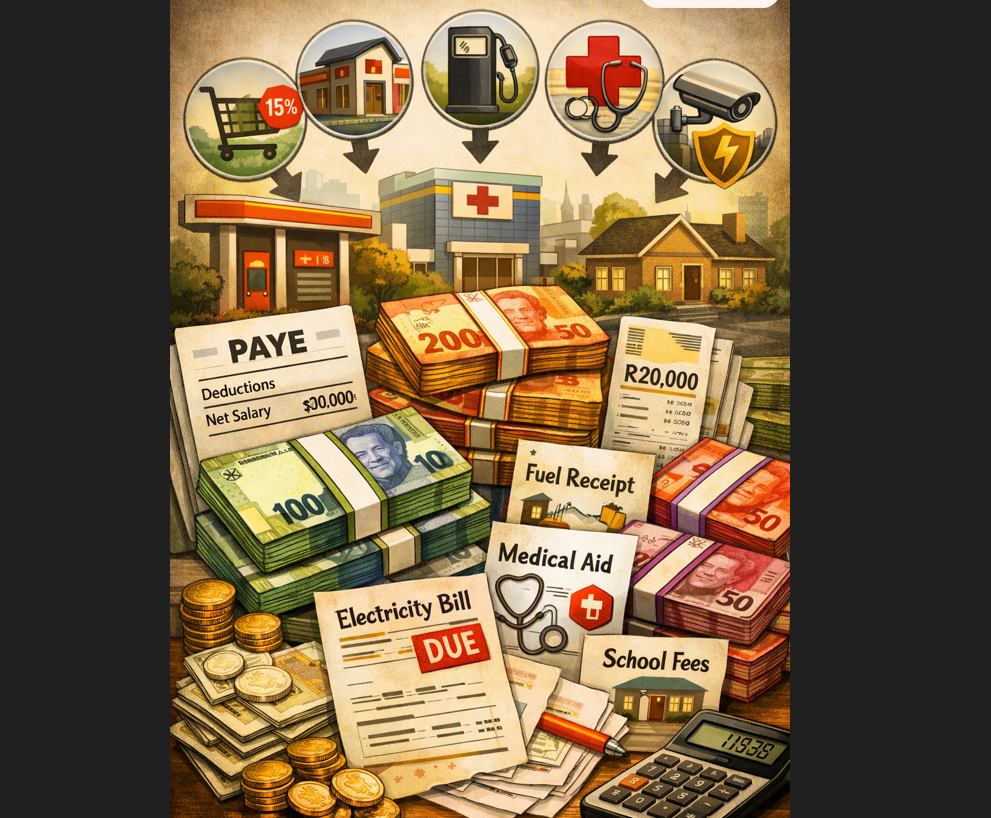
Picture: Copilot
For more African news, visit Africaninsider.com
Compiled by Betha Madhomu