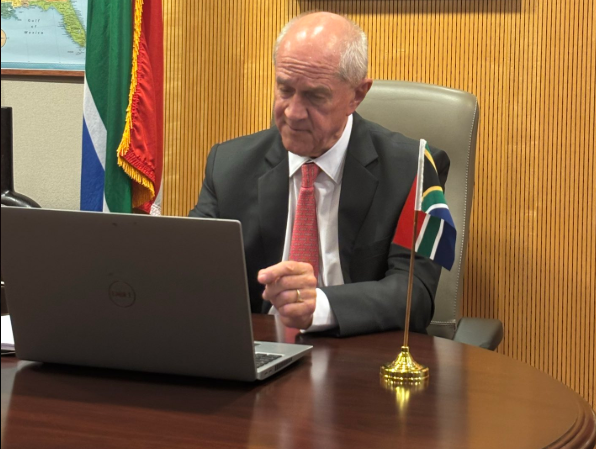
Pretoria – South Africa’s ambassador to the United States, Roelf Meyer, has rejected claims that white farmers are being subjected to political persecution, warning that such assertions could damage relations between Pretoria and Washington.
Meyer made the comments in an interview with eNCA as controversy grows over a planned display of 3,000 white crosses on Washington’s National Mall to highlight farm murders in South Africa.
The White Cross Project, organised by Lex Libertas founder Ernst Roets, is due to take place in Washington on Saturday, September 26. The organisation says the crosses will carry the names of people killed during farm attacks.
Meyer said violent crime in South Africa should be condemned regardless of who the victims are, and rejected the description of farm murders as political persecution.
“With every murder in South Africa, whether it’s farm murders, township murders or gang violence, we must have empathy and sympathy,” Meyer told eNCA.
“But to call it political persecution is very dangerous, because first of all, it’s not true, and secondly, there is no proof.”
The ambassador also warned that international advocacy portraying South Africa as a country where a particular racial group is being persecuted could have consequences for ordinary South Africans.
“If their advocacy leads to punitive measures against South Africa, it will affect all, and the blade might just as well return to them,” he said.
With tensions between SA and the United States over issues including crime, race, land and transformation, attention is turning to how the government communicates the country’s challenges abroad while addressing them at home. SA’s ambassador to the US Roelf Meyer discusses.… pic.twitter.com/xAjHy4k1ld
— Newzroom Afrika (@Newzroom405) September 24, 2026
Lex Libertas says the White Cross Project is intended to draw international attention to farm attacks, property rights and what it describes as incitement of violence in South Africa.
The organisation is also hosting a conference in Washington and plans to use the campaign to lobby for greater international attention to its concerns.
eNCA reported earlier this month that Roets said the crosses would be accompanied by a conference involving American political figures and victims of farm attacks.
The campaign has drawn criticism from other Afrikaner organisations.
Afrikaners for South Africa (AfSA) said the display risks presenting Americans with a distorted picture of South Africa and exploiting the suffering of farm-attack victims for political purposes.
“We unequivocally condemn farm killings and all violence against farming communities,” the organisation said.
According to The Citizen it said victims deserved justice and rural communities needed urgent action, while arguing that the campaign should not be used to advance a particular political agenda.
Meyer also discussed the broader deterioration in relations between South Africa and the US under President Donald Trump’s administration.
He said Pretoria had responded to most of Washington’s concerns and that dialogue remained necessary to repair the relationship.
“The normal thing is, if there’s a disagreement, you sit down,” Meyer said.
“But so far it’s difficult to persuade the American authorities to have a dialogue.”
The ambassador said more than 600 American companies operate in South Africa, highlighting the economic ties between the two countries despite the diplomatic tensions.
His comments come amid renewed disagreement over issues including farm violence, land reform, Black Economic Empowerment and US visa restrictions targeting certain South Africans.
The White Cross Project is taking place against a backdrop of increasingly strained US-South Africa relations.
The Trump administration has repeatedly raised concerns about alleged discrimination against Afrikaners and South Africa’s land policies, while the South African government has rejected claims that white South Africans face state-sponsored persecution.
The US has also announced visa restrictions targeting certain foreign nationals over allegations relating to race-based discrimination, incitement of violence and uncompensated land seizures.
Meyer said his priority remained restoring normal diplomatic relations between the two countries while challenging what he regards as inaccurate portrayals of South Africa abroad.
Follow African Insider on Facebook, X and Instagram
Picture: X/@RSAinDC
For more African news, visit Africaninsider.com
Compiled by Glaan Sibuyi