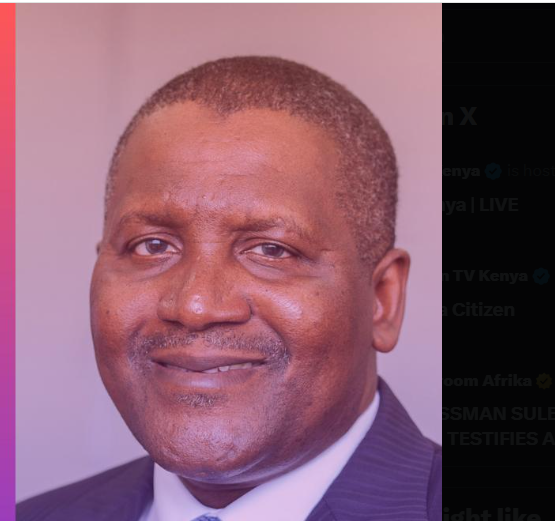
Cape Town – African billionaire Aliko Dangote has revealed that his investment in Nigeria’s textile industry was one of the biggest mistakes of his decades-long business career, saying billions of naira were committed to ventures that ultimately became unsustainable.
Dangote made the disclosure in an interview with Arise News, reflecting on some of the business decisions that shaped his rise as one of Africa’s leading industrialists.
The businessman described the textile investment as a costly lesson from his earlier years in business.
“My biggest business mistake was textiles,” Dangote said.
He said the textile businesses faced intense competition from imported products and insufficient protection for local manufacturers.
“We were swamped by Chinese dumping and Indian dumping. So eventually we had to close down,” Dangote said.
Dangote disclosed that the collapse had a major impact on employment.
Almost 8,000 workers were eventually laid off across the businesses, including 6,920 employees at Nigerian Textile Mills in Ikeja.
The textile ventures included Dangote General Textile Mills in Kano and the acquisition of the foreign shareholder in Nigerian Textile Mill, with Dangote saying he had invested billions of naira in the sector.
The experience appears to have shaped Dangote’s subsequent approach to industrial investment. He has increasingly focused on large-scale manufacturing projects in sectors including cement, fertiliser and petroleum refining.
Importing poverty and exporting jobs
Dangote has also argued that African countries need policies that encourage domestic production rather than dependence on imports.
“If you import, what you are doing is that you are importing poverty and exporting jobs that you are supposed to create out of the country,” he said.
His comments echo remarks he made in a 2015 interview with the Harvard Gazette, in which he discussed the difficulties of building manufacturing businesses in Africa and the collapse of his textile venture amid competition from Chinese and Indian manufacturers.
The latest disclosure comes as Dangote’s business empire expands further into petroleum refining. His $19 billion Dangote Refinery, which began production in 2024, has since reached its full capacity of 650,000 barrels per day, according to the Associated Press.
The refinery has also recently opened its ownership to public investors through a $1.6 billion initial public offering, while Dangote retains an 87% stake, the AP reported.
Dangote’s account of his textile losses highlights a recurring theme in his business career: the risks of investing heavily in African manufacturing while operating in markets affected by imports, infrastructure constraints and changing government policies.
Follow African Insider on Facebook, X and Instagram
Picture: X/@DangoteGroup
For more African news, visit Africaninsider.com
Compiled by Betha Madhomu