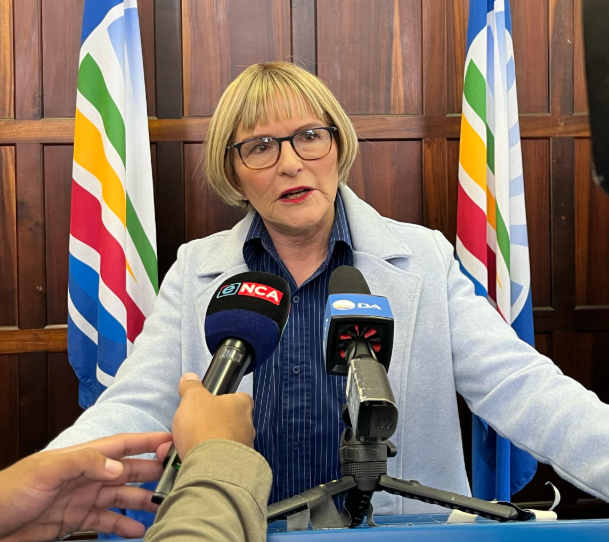
Cape Town – Democratic Alliance (DA) mayoral candidate Helen Zille has accused Johannesburg residents of becoming so accustomed to poor municipal services that they have forgotten what a functioning city should look like.
Speaking in Orange Grove on Wednesday, Zille said residents had become “too resilient”, adapting to deteriorating services rather than demanding improvements from the city.
“I did not know that there is a point where you become too resilient, but when things start collapsing, they do not complain for months. They actually adjust and get used to it, and it becomes the new normal,” she said, according to The Citizen.
Zille said one of the DA’s priorities in the upcoming election would be to convince residents that declining municipal services should not be accepted as normal.
“I need to tell them this is not normal. You have forgotten what normal looks like. Our pledge to you in this election is to bring you back to a new normal that is better than what you now take for granted. That is our promise in this election,” she said.
Zille said she had an “extra and very deep personal motivation” to address what she described as the deterioration of Johannesburg.
She also argued that declining municipal services had damaged residents’ relationship with the city.
“People are not proud of where they live, they no longer love where they live, and the first point of being devoted to a city is being proud of it, to love it, and there is nothing essentially not to love about Joburg,” she said.
ActionSA leader Herman Mashaba, however, offered a contrasting assessment, accusing Zille of presenting herself as the person who could now rescue Johannesburg despite what he described as her role in the city’s political instability.
Mashaba called on Johannesburg voters to hold Zille accountable at the ballot box, accusing her of contributing to instability in a city “that once worked”.
He also revisited the circumstances surrounding his departure from the DA, claiming that Zille had been involved in meetings with senior ANC figures about a possible motion of no confidence against him while she was working at the Institute of Race Relations.
The City of Joburg is where it is today because of Helen Zille, who now preaches that she is the hero Joburg has been waiting for to fix it.
Baagi BaJoburg, Leaders don’t lie to get their way but rather Leaders strive to build in the interests of those who mandate them. On the… https://t.co/dQXqtxkY6B pic.twitter.com/k8hLctaC1B
— Herman Mashaba (@HermanMashaba) August 19, 2026
Mashaba said he raised the matter with then-DA federal leader Musi Maimane and warned that he would leave the party if Zille returned to a leadership position.
According to Mashaba, Zille denied the allegations at the time.
He said he subsequently resigned from the DA after Zille returned to the party and was elected federal chair.
Mashaba also referred to a later SABC interview in which, according to his account, Zille gave a particular reason for Maimane’s departure from the DA.
DA leader Geordin Hill-Lewis said in a statement that the party’s manifesto included plans focused on water, electricity, safer communities, cleaner towns and cities, jobs, infrastructure, professional government and tackling corruption.
Hill-Lewis said the party should be judged by whether it could deliver basic municipal services.
“If I am going to ask you to trust the DA with this city, I believe I have a responsibility to come here personally, stand in front of you, look you in the eye, and tell you what we intend to do with that trust,” he said.
“Our promise is actually very simple: We will get your municipality working.”
Hill-Lewis said the decline of South Africa’s towns and cities should not be accepted as either normal or inevitable.
He pointed to basic services such as reliable water supplies, functioning streetlights, responsive municipal officials and regular refuse collection as the practical measures through which residents experience local government.
“That is how government is supposed to be,” he said.
Hill-Lewis also criticised what he described as “coalition chaos”, arguing that political instability had made it more difficult for municipalities to function effectively.
He acknowledged that coalition governments could be necessary when voters produce no outright majority, but argued that political parties should distinguish between accepting coalitions when required and deliberately creating instability when a stable government could be formed.
The competing claims come as political parties prepare to contest municipal elections, with the DA positioning itself as a party capable of restoring basic services while opponents continue to challenge its record and role in Johannesburg’s political history.
Follow African Insider on Facebook, X and Instagram
Picture: X/@Our_DA
For more African news, visit Africaninsider.com
Compiled by Glaan Sibuyi