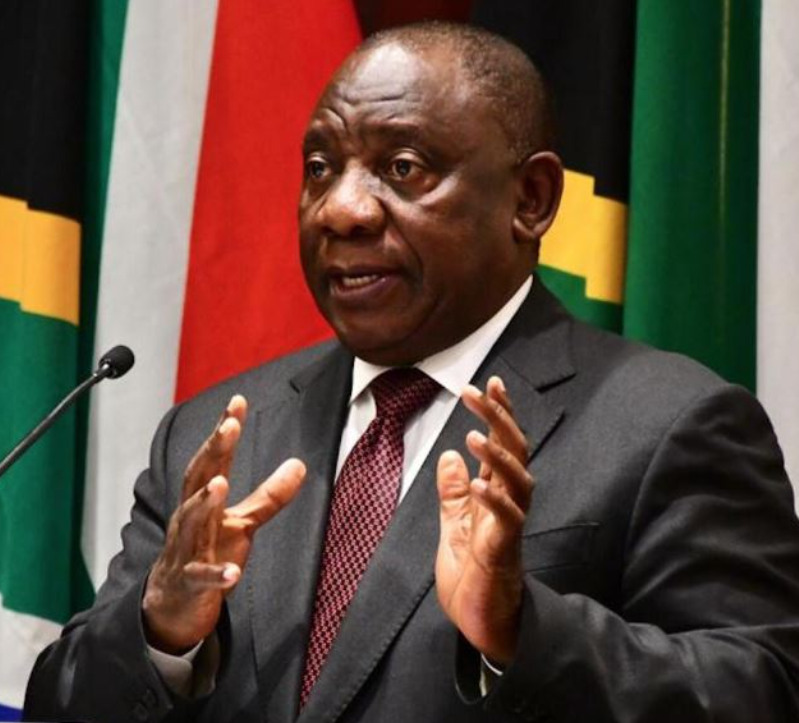
Pretoria – President Cyril Ramaphosa says government is determined to end South Africa’s persistent water crisis through a new National Water Action Plan aimed at restoring reliable water supplies, reforming municipal water management and holding failing service providers accountable.
In his weekly newsletter released on Monday, Ramaphosa acknowledged that unreliable water supply has become a daily reality for many South Africans, saying government is committed to ensuring that every community has access to safe drinking water.
“We released the National Water Action Plan which sets out our government’s determination to ensure that every community in our country has access to a reliable supply of quality drinking water, no matter where they live.”
The president said the plan contains immediate interventions and long-term reforms designed to tackle the root causes of water supply failures in municipalities.
“For too many South Africans, turning on a tap has become an act of uncertainty,” Ramaphosa said.
“In too many cities, towns and rural areas, water disruptions have become a fact of life. Families cannot cook or clean. Children cannot wash. Shops and businesses have to close. We are determined to change that.”
Ramaphosa said implementation would be overseen by the National Water Crisis Committee (WATERCOM), which will regularly monitor progress and hold departments and public entities accountable.
Dear Fellow South African,
Last week, I spoke about our commitment to give effect to the constitutional right of access to water for all South Africans, with particular reference to communities that have remained underserved.
This past week, we released the National Water… pic.twitter.com/TOEODSE3Du
— Cyril Ramaphosa 🇿🇦 (@CyrilRamaphosa) July 27, 2026
Drawing comparisons with government’s efforts to end load shedding, the president said a similar strategy would now be applied to the country’s water challenges.
“Just a few years ago, we faced a similar national crisis in electricity… We are now applying that same approach to water.”
While acknowledging that South Africa is a water-scarce country, Ramaphosa said the immediate problem was not a lack of rainfall or dams but poor municipal management.
“The problem is that municipal water systems are not being properly managed, maintained and financed.”
He said revenue generated from water sales is often diverted to other municipal functions, leaving insufficient funds to repair ageing infrastructure or employ skilled technical staff.
“As a result, on average across the country, close to half of all the water pumped never reaches paying customers. It leaks out of broken pipes, is stolen or is simply never billed for.”
Reforms to municipal financing
To improve accountability, the Water Services Amendment Bill before Parliament will require water service providers to obtain operating licences based on their technical, financial and managerial capacity.
Ramaphosa warned that government would intervene where municipalities fail to provide adequate services.
“Where a municipality is failing, unwilling or unable to provide an acceptable service, government will intervene in accordance with the Constitution and the law to provide the required services to our people.”
The president also announced reforms to municipal financing through the Metropolitan Trading Services Reform Programme, which will require metropolitan municipalities to ring-fence water revenue so it is reinvested into infrastructure, maintenance and operations.
He stressed that partnerships with the private sector would not amount to privatisation.
“Water will remain a public good and the state will continue to protect public ownership, affordability and universal access.”
Ramaphosa also vowed to crack down on corruption linked to the water sector.
Corruption and criminal networks
“We will act firmly against the corruption and criminal networks that are benefiting from irregular water contracts and damage to infrastructure.”
The president highlighted progress already made under the action plan, including 71 completed borehole projects across Mpumalanga, Gauteng, KwaZulu-Natal and the Eastern Cape, benefiting around 30,000 households. A further 80 to 100 boreholes are expected to be drilled this year, with 500 planned over the next two years, extending water access to approximately 250,000 households.
Government is also investing R24 billion annually in municipal water and sanitation infrastructure through about 800 projects nationwide, while several large-scale projects are under way in KwaZulu-Natal, Mpumalanga and Limpopo.
Ramaphosa said all spheres of government had been consulted in developing the plan and expressed confidence that the strategy would resolve the country’s long-standing water challenges.
“Everyone is committed to the successful implementation of the plan and to ending the water crisis in our country once and for all.”