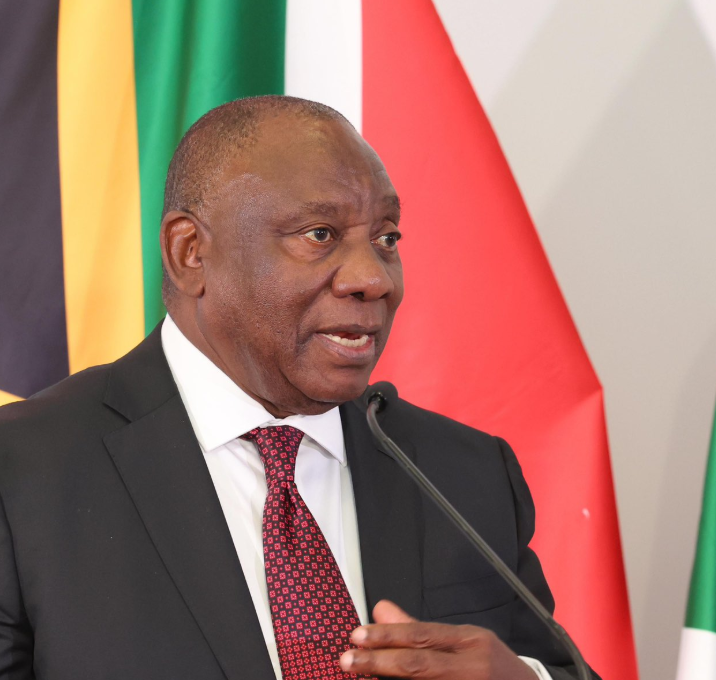
Cape Town – President Cyril Ramaphosa has announced a series of measures to tackle South Africa’s worsening water crisis, including a R156 billion investment in water and sanitation infrastructure over the next three years and tougher action against municipalities that fail to deliver basic services.
In his weekly newsletter on Monday, the President said government had launched the National Water Access Acceleration Programme to fast-track access to safe and reliable water in underserved communities, describing water security as one of government’s most urgent priorities.
The programme, launched in Hammanskraal, Gauteng, forms part of government’s response to the country’s growing water challenges and follows a commitment made in this year’s State of the Nation Address.
“In honour of Madiba’s legacy, we are responding to the need to expand access to safe and reliable water to underserved communities across South Africa. We launched the National Water Access Acceleration Programme through the decentralised water supply schemes,” Ramaphosa said.
The initiative includes the commissioning of the Klipdrift Package Water Treatment Plant and the handover of new boreholes in Hammanskraal, where dozens of people died during a cholera outbreak in 2023 linked to contaminated water. Similar projects are being implemented in parts of Gauteng, KwaZulu-Natal and the Eastern Cape.
Earlier this year, we established the National Water Crisis Committee to coordinate interventions across government. The committee is focused on strengthening municipal water and sanitation services, increasing water infrastructure investment, reforming water sectorinstitutions,… pic.twitter.com/OGOSAAWZyx
— Cyril Ramaphosa 🇿🇦 (@CyrilRamaphosa) July 20, 2026
According to Ramaphosa, the programme is designed to speed up the delivery of water services by using solutions suited to local conditions rather than waiting for large infrastructure projects to be completed.
“The programme is intended to shorten the time between identifying a community’s need and delivering a working water supply,” he said.
The President acknowledged that many municipalities had failed to properly maintain water infrastructure, contributing to water shortages and deteriorating water quality across the country.
“We must acknowledge that in too many municipalities, government has not succeeded with the maintenance of infrastructure, to manage water services properly and to respond with sufficient urgency,” he said.
Ramaphosa said government had established the National Water Crisis Committee earlier this year to coordinate interventions across all spheres of government, with a focus on strengthening municipal water services, increasing infrastructure investment, reforming institutions and tackling corruption in the sector.
He also announced that over the next three years government would allocate R156 billion towards water and sanitation infrastructure as part of its broader public infrastructure investment programme.
Water is life. We all need it to survive.
Water is development; for our communities, for our industries and to grow our economy.
Water is dignity.
https://t.co/PhcvgR7syz— Cyril Ramaphosa 🇿🇦 (@CyrilRamaphosa) July 18, 2026
“Over the next three years, government has allocated R156 billion to water and sanitation infrastructure as part of its broader public infrastructure investment programme,” he said.
Ramaphosa said legislative reforms were also under way, including the establishment of the National Water Resources Infrastructure Agency and proposed amendments to water legislation that would allow municipal managers who fail to manage water infrastructure to be held personally accountable.
“Where municipalities or officials fail to comply with environmental and water-services legislation, government will use the enforcement mechanisms available to it, including directives, criminal proceedings and, where the law permits, personal liability,” he said.
The President said South Africans had grown frustrated with persistent water outages and delays in service delivery, stressing that government remained committed to implementing long-term reforms similar to those used to reduce load shedding.
“Households and businesses experiencing shortages and outages have had enough, and underserved communities across the country still waiting for taps to be installed 32 years into democracy are justifiably tired of waiting,” Ramaphosa said.
He added that government was determined not only to overcome the current crisis but also to ensure future generations enjoy reliable access to water.
“Our ultimate goal is not merely to get over the current crisis, but to fulfil Madiba’s vision of all South Africans enjoying their constitutionally enshrined right to access to water… Water is dignity and therefore central to Mandela’s legacy,” he said.
Follow African Insider on Facebook, X and Instagram
Picture: X/@PresidencyZA
For more African news, visit Africaninsider.com
Compiled by Betha Madhomu