
As the town of Stanford in the Overstrand Municipality continued to grow, its wastewater infrastructure faced mounting pressure.
Through funding, planning support and project preparation, the Development Bank of Southern Africa (DBSA) enabled a critical upgrade that has strengthened sanitation services for more than 6 000 residents while positioning the town for sustainable future growth.
Reliable wastewater infrastructure is essential to healthy, resilient communities. Beyond ensuring safe sanitation, it protects public health, safeguards local ecosystems and creates the enabling conditions for economic activity and future development. When infrastructure capacity falls behind population growth, municipalities face increasing pressure to accommodate expansion while maintaining essential services. This was the challenge confronting the Overstrand Municipality in Stanford, a town situated along the Klein River in the Western Cape’s Overberg region. With sustained growth placing increased demand on local infrastructure, projections indicated that the existing wastewater treatment works, with a treatment capacity of 500 000 litres per day, would soon exceed operational limits.
The DBSA partnered with the Overstrand Municipality to help address this emerging infrastructure challenge. In line with its mandate as a development finance institution, the DBSA’s integrated support across the project lifecycle, including funding, financial structuring, planning assistance and project preparation to enable implementation.
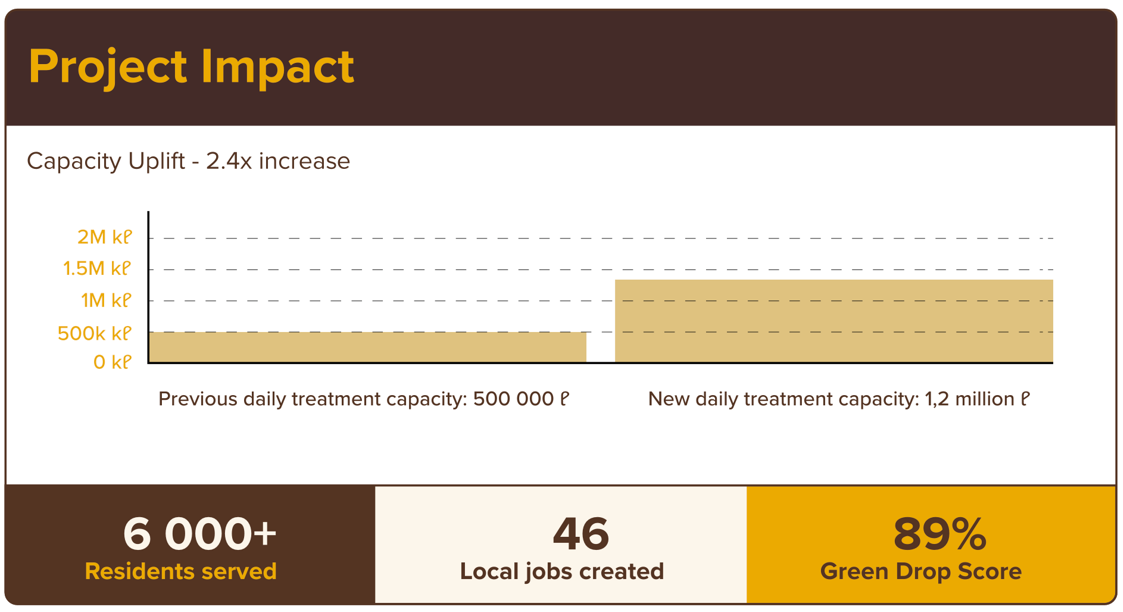
The completed upgrade more than doubled the facility’s treatment capacity to 1,2 million litres per day, ensuring that sanitation services remain fit for purpose as the town continues to expand. More than 6 000 residents now benefit from improved wastewater infrastructure, while additional capacity provides the municipality with greater flexibility to support future residential and economic development. Importantly, the project also contributes to environmental sustainability. By strengthening wastewater treatment capability, the upgrade reduces the risk of pollution to the Klein River, helping to preserve a critical natural resource that supports both local biodiversity and community wellbeing.
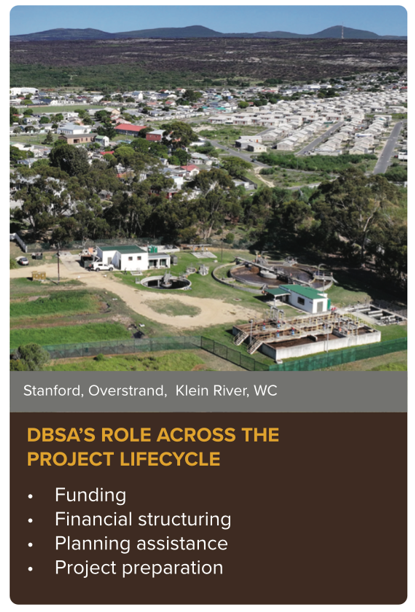
The Stanford Wastewater Treatment Upgrade reflects a broader development model that the DBSA enables across South Africa and the region. Many municipalities, particularly outside major metropolitan areas, face growing infrastructure demands but often lack the financial and technical capacity required to prepare and implement complex projects at scale.
By combining infrastructure financing with technical expertise and implementation support, the DBSA helps municipalities unlock investment, strengthen institutional capability and deliver infrastructure that improves lives.
In Stanford, this approach has translated into tangible developmental impact: infrastructure that supports public health, protects the environment and enables a growing community to thrive.