Pretoria – President Cyril Ramaphosa has acknowledged that illegal immigration is placing growing pressure on South Africa’s public services, economy and security, while announcing a sweeping government crackdown that includes tougher penalties for employers who hire undocumented migrants and the establishment of dedicated immigration courts.
In a national address on Sunday evening, Ramaphosa admitted there had been shortcomings in the management of migration, citing weak enforcement, corruption and loopholes in the immigration system.
“There have been weaknesses in the way migration has been managed. There have been weaknesses in rigorous and focused enforcement. There have been instances of corruption. There have been gaps in our systems that have undermined public confidence,” he said.
The president said undocumented migration places a burden on healthcare, education and other essential services, while also creating opportunities for exploitation in the labour market. He stressed, however, that South Africa’s economic challenges could not be blamed solely on foreign nationals.
As Government our objective is clear.
We want a South Africa where every person who enters the country does so lawfully.
A South Africa where immigration laws are respected and enforced.
A South Africa where businesses compete fairly.
A South Africa where communities feel…
— Cyril Ramaphosa 🇿🇦 (@CyrilRamaphosa) June 7, 2026
Ramaphosa outlined a five-point government strategy to address illegal immigration, beginning with stricter enforcement of immigration and labour laws. He said the Department of Home Affairs, the Border Management Authority, the South African Police Service and other law enforcement agencies would intensify efforts to identify and deport undocumented migrants.
According to the president, the Border Management Authority prevented more than 450,000 illegal border crossings in the past year.
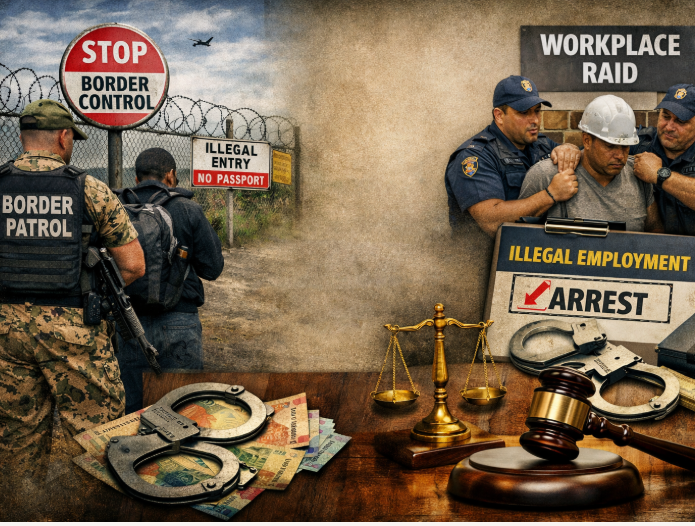
Government will also establish dedicated immigration courts to accelerate deportations and increase workplace inspections targeting businesses suspected of employing undocumented foreign nationals. In addition, the Department of Employment and Labour has started recruiting 10,000 labour inspectors during the current financial year.
Ramaphosa warned that employers who break immigration laws will face tougher consequences.
“We cannot have a situation where employers who, after being charged and found guilty of violating our laws, merely pay a fine and continue employing undocumented foreign nationals whom they exploit,” he said.
Corruption and inefficiencies
The president announced plans to strengthen penalties, including imprisonment, for employers who repeatedly contravene the Immigration Act.
The second pillar of the plan focuses on border security, with increased investment in personnel, infrastructure and technology. Government will also begin relocating refugee reception centres closer to border posts, starting with the Tshwane centre this year, to improve the processing of asylum applications.
The third aspect of the strategy targets corruption and inefficiencies within the Department of Home Affairs. Ramaphosa said officials involved in document fraud, facilitating unlawful entry or other corrupt activities would face dismissal and criminal prosecution.
Government is also developing an Intelligent Population Register containing biometric data for everyone in the country as the foundation for a Digital ID system. The green barcoded ID book will be phased out, while new regulations will be introduced within three months to prevent the misuse of Traffic Registration Numbers as identification documents.
Enforcing immigration
The fourth pillar involves closing legislative loopholes. Ramaphosa said government had finalised the National Labour Migration Policy, which proposes employment quotas for documented foreign nationals and stronger action against employers hiring undocumented workers. Cabinet has also approved the Employment Services Amendment Bill, which would allow sector-specific quotas for foreign employment.
The final component of the strategy focuses on regional cooperation through the Southern African Development Community (SADC), the African Union and bilateral partnerships to address the root causes of migration, including poverty, unemployment and conflict.
Ramaphosa also warned against xenophobia and vigilante action, stressing that only authorised government officials may enforce immigration laws.
“The responsibility for enforcing immigration laws rests with the state and the state alone,” he said.
He added that security agencies had been directed to strengthen coordination ahead of planned protests and a proposed nationwide shutdown on 30 June, warning that government would not allow migration-related tensions to be exploited to destabilise the country.
“We know that South Africans are not xenophobic,” Ramaphosa said, adding that there was “no space for xenophobia, racism, sexism, Afrophobia or any other forms of intolerance in South Africa.”
Follow African Insider on Facebook, X and Instagram
Picture: Copilot
For more African news, visit Africaninsider.com
Compiled by Betha Madhomu