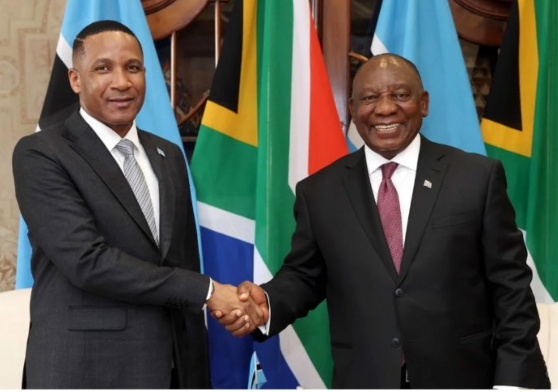
Pretoria – President Cyril Ramaphosa is on Wednesday undertaking a two-day State Visit to Botswana, where he and President Gideon Duma Boko will co-chair the Sixth Session of the South Africa-Botswana Bi-National Commission in Gaborone.
According to the Presidency, the visit aims to strengthen and deepen the “existing bilateral partnership between the two countries”, with officials describing the BNC as “a critical opportunity to reinforce the strategic partnership between South Africa and Botswana”.
The Presidency said the relationship between the two nations remains strong but is “evolving in response to new economic realities and shifting global dynamics”, adding that a Business Forum on the sidelines of the summit will help “strengthen private sector collaboration and facilitate business-to-business exchanges”.
🇿🇦 His Excellency President @CyrilRamaphosa undertakes a State Visit to the Republic of Botswana for the 6th South Africa-Botswana Bi-National Commission at the invitation of 🇧🇼 His Excellency President @duma_boko.
The visit reflects the strong bilateral relations and enduring… pic.twitter.com/lDv1mR1avz
— The Presidency 🇿🇦 (@PresidencyZA) May 20, 2026
South Africa and Botswana’s long-standing ties were described as being “rooted in solidarity during the liberation struggle”, with the partnership continuing to expand across political, economic and cultural sectors.
Bilateral trade between the two countries reached about R82 billion in 2025, while more than 100 South African companies currently operate in Botswana across sectors including mining, banking, retail, logistics and tourism.
The Presidency also said the countries will explore renewable energy cooperation, particularly as Botswana works towards increasing renewable energy usage to 50% by 2030.
The visit comes amid Botswana’s political transition following the election of a new administration in October 2024, with the Presidency saying the State Visit “signals the new government’s intention to consolidate relations with South Africa while maintaining continuity in bilateral engagement”.