Roula Inglesi-Lotz, University of Pretoria
South Africa’s state-owned electricity provider, Eskom, announced in early March 2026 that it would cut off the power to 14 municipalities that collectively owe it more than R110 billion (US$6.5 billion). Energy economist Roula Inglesi-Lotz describes the growing crisis in South Africa’s power system, where many municipalities can’t pay their bulk electricity bills due to poor governance, weak finances, and low payment rates from consumers. She sets out why cutting the supply won’t help Eskom get paid but could harm low income communities.
Why did Eskom decide to cut off 14 municipalities?
Eskom went through many tough years burdened by high debt levels, rising operating costs, declining electricity sales and corruption scandals.
During that time, it required repeated cash injections from the government totalling R230 billion (US$13.7 billion) and increased the cost of electricity numerous times.
Recently, the utility has brought in higher revenues and profits, driven largely by tariff increases, even as electricity sales volumes decline.
But the turnaround has been put at risk by the 14 municipalities which have failed to make arrangements to pay off their debt, or reneged on debt relief plans.
Eskom recently began legal proceedings to disconnect them. Its reason was that without strong action, the debt could triple within five years. This would pose a serious threat to the electricity sector’s stability.
Eskom has previously threatened to disconnect major cities like Johannesburg, but the power utility’s current legal steps are far bigger in scale.
How does the distribution system work?
Large industrial customers such as smelters, along with a few residential areas, receive electricity directly from Eskom.
But the majority of urban households and small businesses – about 60% – are served through municipalities. They distribute electricity to houses and businesses and bill the consumers.
Municipalities add a markup to the electricity before they sell it, to cover their distribution costs and maintenance of local networks. This also generates surplus revenue to fund other services, such as water, sanitation and waste management.
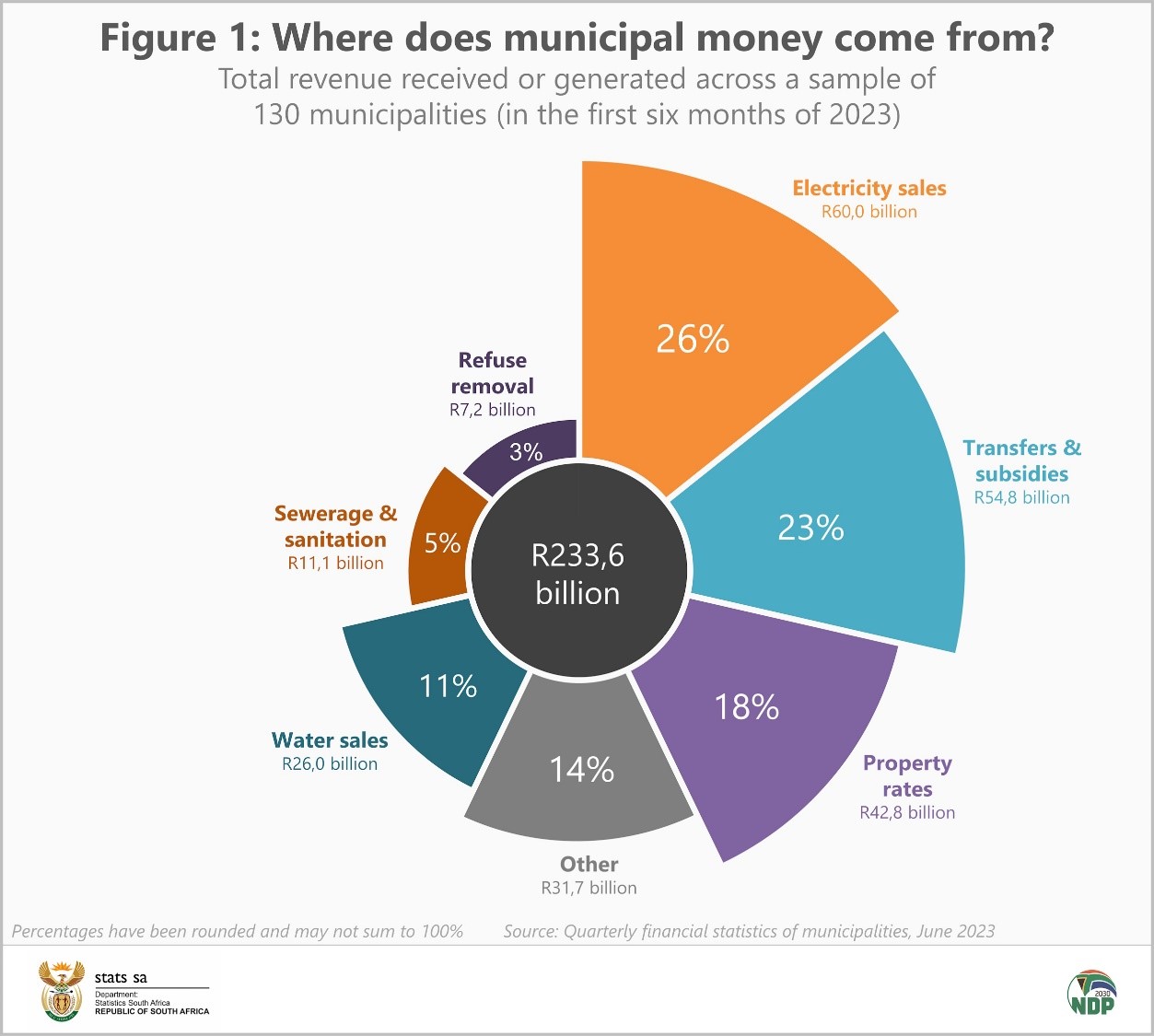
Electricity sales are important to municipalities. They accounted for 26% of total municipal revenue in the first six months of 2023.
So if Eskom disconnects municipalities, it destabilises a revenue system that supports broader service delivery.
At the same time, municipalities struggle to collect electricity payments in times of high unemployment (31.4% in the fourth quarter of 2025) and poverty (36.8 million were living on less than US$8.30 per day in 2025). Eskom cutting off power may make the situation worse.
It could reduce municipalities’ ability to recover electricity payments from households by making it harder for people to earn income and pay their bills, or by making people switch to other sources. And it could also damage the trust of residents.
How did the situation reach this point?
Debts have built up partly because of increasing electricity prices. Since 2015, average tariffs have increased by roughly 10% per year, outpacing inflation.
Eskom charged municipalities 74 cents per kilowatt hour of electricity in 2015/16. This more than doubled to around 184 cents per kilowatt hour in 2024/25. These price hikes came during the time of severe power outages (load shedding). This prompted many higher income households to leave the grid and switch to alternative, mainly solar, energy sources. This in turn meant that electricity payments to municipalities declined.
How electricity prices are set in the country is as follows: every year, Eskom calculates how much it will cost to generate, transmit and distribute electricity. It then submits the proposed increases to the National Energy Regulator of South Africa. The regulator reviews the request, holds public consultations and decides on the price hike. In 2026, electricity tariffs are to be increased by 8.76% for Eskom direct customers, while municipalities face bulk price increases of about 9%.
These higher prices are passed on to households. As electricity becomes more expensive, people start paying less and illegal connections increase. This makes it harder for municipalities to pay Eskom because they aren’t collecting enough revenue. This is not, however, the only reason municipalities struggle to pay Eskom: weak billing systems, ageing infrastructure, and governance challenges make the situation worse.
Who will suffer the most?
I liken the current Eskom problem to the popular African proverb: “When elephants fight, it is the grass that suffers”. In South Africa’s electricity sector, the elephants are Eskom, municipalities, and the regulatory and financial systems that bind them. And of course, the grass is the households, particularly low-income families.
Electricity flows through municipalities to millions of households in South Africa. Cutting power to municipalities does not discipline local government institutions and make them more likely to pay for bulk electricity. It disrupts entire communities.
How can communities be protected?
Eskom must strengthen measures to make sure it gets paid for the electricity it supplies. It could bill users directly, or take over some functions from municipalities, improving billing and revenue collection.
Municipalities should improve financial governance through accurate billing systems. People won’t pay their electricity bill if it is wrong. This often happens because of outdated metering systems, incomplete customer databases, and a lack of capacity in municipal administration systems.
Municipalities also need to fix ageing electricity infrastructure and transmission problems. They should recover lost revenue that happens through illegal connections and meter tampering.
To avoid getting into more debt, municipalities must keep electricity revenues in a separate account where they can only be used to pay Eskom.
Local government also needs to build a culture of payment for electricity.
A common policy suggestion is that municipalities should simply procure their own electricity from independent power producers. But this is complicated in practice.
To do this, municipalities would have to go through lengthy and uncertain approval processes. They’d also need to attract private investment to fund the move away from Eskom. In many cases, smaller municipalities lack the creditworthiness to do this and have higher poverty levels than metropolitan (city) municipalities.
What the indebted municipalities need is support from national government. This doesn’t necessarily have to be another financial bailout. It could mean simpler regulations and more administrative capacity.
As the pressure builds between Eskom and municipalities, households bear the consequences.
Roula Inglesi-Lotz, Professor of Economics, University of Pretoria
This article is republished from The Conversation under a Creative Commons license. Read the original article.
Follow African Insider on Facebook, X and Instagram
Picture: X/@Eskom_SA
For more African news, visit Africaninsider.com
Source: The Conversation