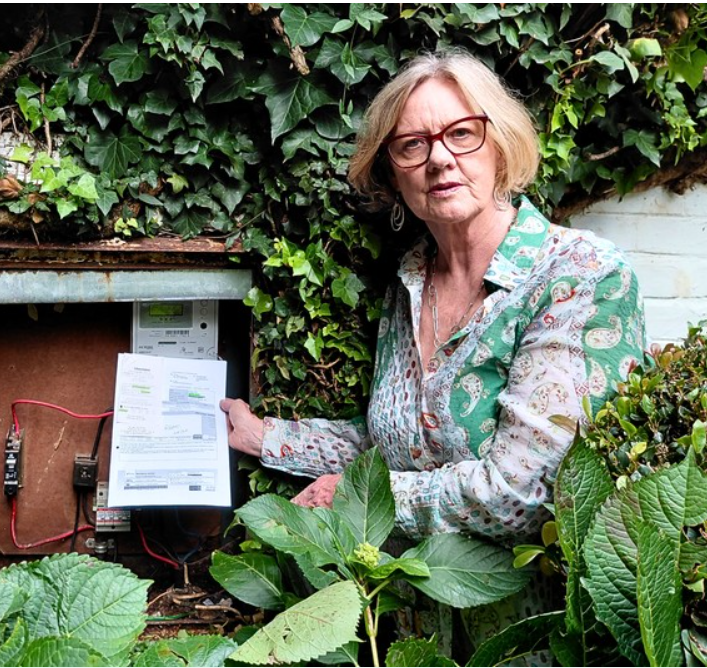
Elizabeth Edwards, from Parkwood, was slapped with a R60,000 electricity bill after City Power took over electricity billing from City of Johannesburg. Photo: Seth Thorne
By Seth Thorne and Kimberly Mutandiro
- In July 2025, City Power took over electricity billing from the City of Johannesburg in an effort to increase revenue collection.
- While this has led to some improvements, many residents have complained about sky-high bills, incorrect meter numbers, and being charged for estimated usage rather than actual meter readings.
- City Power says credits of R136-million have been issued to customers who were overcharged.
Parkwood resident Elizabeth Edwards installed solar panels and switched to Egoli gas to reduce her reliance on the grid. But to her surprise, her electricity bill from City Power and the City of Johannesburg soared to more than R60,000.
This happened shortly after City Power replaced her electricity meter, saying it was faulty. Between June and July, her bill went up by almost R21,000, even though her actual usage went down because of switching to solar and gas. The bill continued to rise in the coming months.
The electricity usage on her account was based on estimates not actual readings. These estimates have since been reversed, and the account was adjusted to reflect actual meter readings, City Power spokesperson Isaac Mangena told GroundUp. But Edwards says she is left owing more than R20,000, which she continues to challenge.
Her case is not unique. Across Johannesburg, residents say they are battling high, unexplained or erroneous electricity bills. In some cases, electricity has been disconnected, even while their accounts remain under formal dispute.
In Randburg, another resident’s electricity has been disconnected several times. In 2022, her meter was replaced by City Power, but it was never properly registered. In recent months, she was slapped with a R93,000 bill. City Power took a correct meter reading in December, but the resident was still left with a R52,000 bill, which she disputes.
Mangena told GroundUp that a verification reading has been requested.
Julia Fish, head of the civic organisation JoburgCAN, says Johannesburg’s municipal billing system has been unstable for more than a decade. In July 2025, City Power officially took over electricity billing. This has led to some improvements, says Fish.
“Many long-estimated bills [have been] resolved,” she says, and she has found City Power’s billing team “very responsive” in correcting cases that had remained unresolved for years.
But the transition has not been smooth, and JoburgCAN saw an increase in complaints as the change came into effect.
In January, the municipal e-billing system went offline for nearly two weeks.
Disconnections have also become more unpredictable because that responsibility still lies with the municipality rather than the utility, says Fish.
The transition has also contributed to “an increase in aggressive debt collection”, she said, such as when the City proceeds with disconnections even when accounts are disputed or subject to court orders.
“The issue now is the multiple siloed entities handling metering, revenue and disconnections,” she says.
Systems for residents to log disputes fail to connect cases with officials who can resolve them. Although municipal bylaws state that residents who lodge disputes should not be charged interest or penalties, “this also happens regardless, further inflating bills”, she says.
What is needed, says Fish, is a “complete migration of the entire billing function for the system to operate better”.
She advises residents disputing bills to continue paying their previous monthly average and to log their dispute each month using the original reference number.
If a disconnection team arrives, residents should calmly present the dispute reference and contact the municipal call centre if electricity is cut. No reconnection fee is charged for unlawful disconnections.
Long-troubled billing system
Mangena said taking over electricity billing was an important step toward fixing Johannesburg’s long-troubled billing system and to collect revenue.
The power utility’s financial crisis has been primarily driven by the gap between the electricity it buys from Eskom and the revenue it actually collects. This has led to a reported R20-billion in the red and a monthly deficit of roughly R2-billion in late 2025.
Mangena said the change allows City Power to take direct control of metering, tariff alignment and account reconciliation, improving oversight and responsiveness to customer queries.
The transition has exposed “a number of historical discrepancies that had accumulated over several years”, including incorrectly programmed meters, tariff misclassifications, unbilled accounts and technical inconsistencies.
To address these issues, City Power launched a city-wide meter audit in July 2025 to verify that every electricity meter is correctly linked to a customer account.
The audit uncovered widespread issues, including prepaid meters providing electricity without payment, under-billing caused by meter tampering, customers placed on incorrect tariffs, and accounts that were not billed for electricity consumption at all.
As City Power rectified this, some residents reported duplicate charges and back-billing for electricity consumption going back years. There were also instances of over-billing and long-standing customer disputes, said Mangena.
According to Mangena, credits totalling R136-million have been issued to 86 customers whose accounts were overcharged, while 162 long-running legal disputes have been resolved. Another 116 remain outstanding.
City Power encourages residents to submit their monthly meter readings via the e-Joburg platform to reduce estimated billing.
Since taking over billing responsibilities, City Power says it has processed 2,888 accounts and generated about R1.1-billion in additional revenue by correcting under-billing and previously unbilled accounts.
Mangena insists the increase in revenue is not due to overcharging residents.
City Power is also upgrading its billing system to allow real-time detection of anomalies and training staff to respond more quickly to customer queries, he said.
© 2026 GroundUp. This article is licensed under a Creative Commons Attribution-NoDerivatives 4.0 International License.
Follow African Insider on Facebook, X and Instagram
Picture: GroundUp
For more African news, visit Africaninsider.com