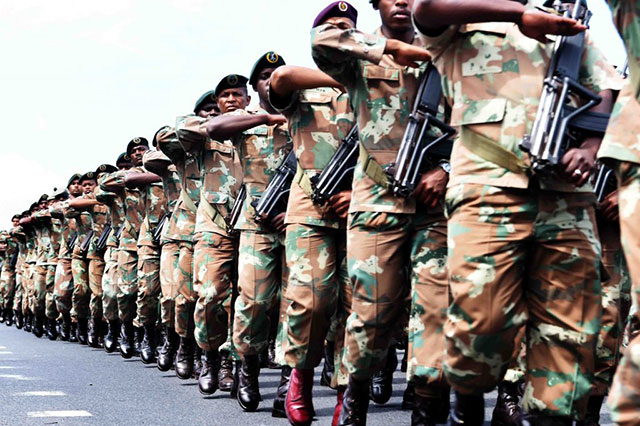
Cape Town – President Cyril Ramaphosa says the South African National Defence Force (SANDF) is working to keep South Africans “safe and secure” as it takes on an expanded role in fighting violent crime and supporting disaster relief efforts.
Dear Fellow South African,
On Saturday, we held Armed Forces Day in Thohoyandou in Limpopo, an annual event that honours the men and women of the South African National Defence Force (SANDF) and the important role they play in our country and on our continent.
— Cyril Ramaphosa 🇿🇦 (@CyrilRamaphosa) February 23, 2026
“Given our history, where the apartheid state sent the army into townships to violently suppress opposition, it is important that we do not deploy the SANDF inside the country to deal with domestic threats without good reason,” he said.
“This recent deployment has become necessary due to a surge in violent organised crime that threatens the safety of our people and the authority of the state.”
Ramaphosa emphasised that soldiers would operate under police command and within strict parameters.
“That is why the SANDF will be deployed in support of the SAPS, operating under police command, with clear rules of engagement and for specific time-limited objectives,” he said.
The SANDF may assist in high-risk operations, cordon-and-search missions and securing critical infrastructure, allowing police officers to focus on investigations and prosecutions. The deployment will also complement strengthened anti-gang units and illegal mining task teams working alongside the National Prosecuting Authority.
Rural development
Beyond crime-fighting, Ramaphosa highlighted the military’s humanitarian and development work. During recent floods in parts of Limpopo and Mpumalanga, SANDF members supported evacuations, repaired damaged infrastructure and erected temporary structures.
Through Project Owethu, launched in Limpopo to coincide with Armed Forces Day, the SANDF provided healthcare services to more than 50,000 people in underserved communities. The force has also contributed to rural development through the Welisizwe Rural Bridges programme and conducted border operations to curb people smuggling and illegal crossings.
Ramaphosa recalled the “unprecedented mobilisation” of the SANDF during the COVID-19 pandemic, when soldiers enforced disaster regulations, safeguarded borders and set up field hospitals.
He acknowledged that the defence force has been operating under significant financial constraints in recent years but said government is working to strengthen its readiness as public finances stabilise.
Decisive break
“We are working to close funding gaps and strengthen the readiness of our armed forces,” he said.
Applications have also opened for the 2027 intake of the Military Skills Development System, which offers young people training in the army, air force, navy and military health service.
“When the SANDF was formed in 1994 it marked a decisive break from the use of the defence force to perpetuate apartheid oppression,” Ramaphosa said. “Today our armed forces are loyal to our democratic Constitution, are subject to civilian oversight and reflect the diversity of our nation.”
“As we work together to overcome the challenges facing our armed forces, let us not lose sight of their immense contribution to building a democratic nation in which all our people are safe and secure.”
Follow African Insider on Facebook, X and Instagram
Picture: X/@SAgovnews
For more African news, visit Africaninsider.com
Compiled by Betha Madhomu