About 80% of the students funded by the National Student Financial Aid (NSFAS) scheme between 2019 and 2024 were first years.
In 2024, of the 917,092 students funded, 780,125 were first years.
This means only about 130,000 of the approximately 620,000 first-year students who received funding in 2023 continued to receive funding for their studies the next year.
There are several reasons for this.
Many students drop out after their first year, sometimes for personal reasons or because they did not qualify for further studies. NSFAS requires students to pass their university courses with a 60% grade to continue receiving funding. TVET students need to pass a certain number of subjects to proceed with funding.
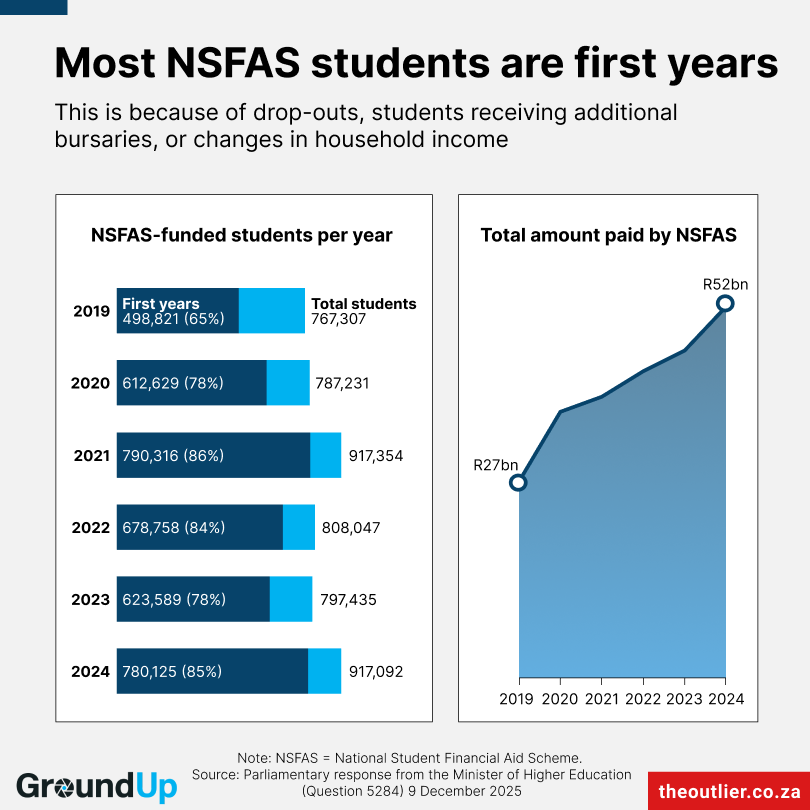
Chart by The Outlier. Text by GroundUp Staff.
Some students may receive bursaries for the rest of their studies, which disqualifies them from receiving further funding. Others may not pass the eligibility criteria for the following years, due to increases in household income.
Unfortunately we don’t have data on the percentage breakdown between the different reasons for not receiving funding after the first-year.
NSFAS paid out R52-billion in funding in 2024, up from R27-billion in 2019.
It provides financial aid to students at public universities and TVET colleges. Students need to be SASSA grant recipients or prove a household income of less than R350,000 per year. NSFAS funding covers tuition, accommodation, a living allowance, books, and transport.
Chart produced by The Outlier in partnership with GroundUp
© 2026 GroundUp. This article is licensed under a Creative Commons Attribution-NoDerivatives 4.0 International License.
Follow African Insider on Facebook, X and Instagram
Picture: Unsplash
For more African news, visit Africaninsider.com