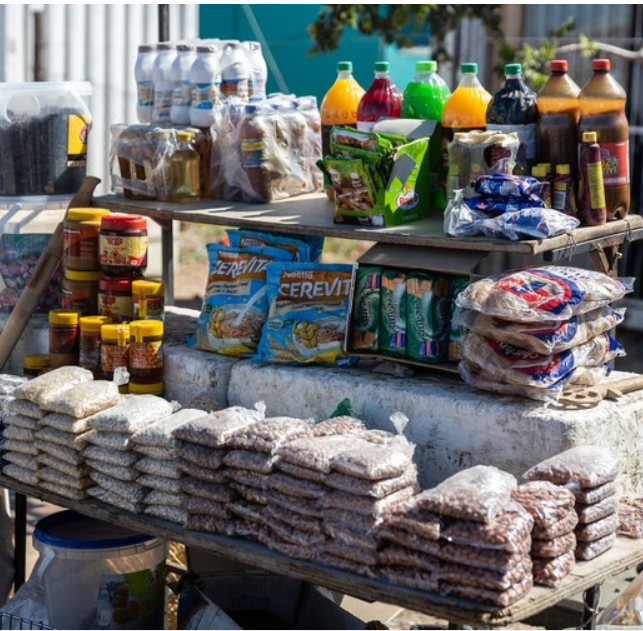
Informal traders are expected to comply with “impossible” rules, argues the author. Archive photo: Ashraf Hendricks
By David Jeffery
On the side of a busy street in Khayelitsha, Simon (not his real name) runs an unexpectedly criminal enterprise: a black-market barbershop. He does not launder money, nor sell drugs. But he works from a shipping container on public land and without an informal trading licence, a clear violation of municipal by-laws. Though no one has been jailed for this offence, Simon strangely still risks imprisonment.
Simon is one of more than 7.5 million people employed in the informal economy—not far behind the 9.8 million formal workers in South Africa.
While many are engaged as casual labourers or domestic staff, more than 2.2 million work in informal businesses. Of these, about 850,000 are employees. For perspective, this means that informal businesses employ nearly twice as many people as our entire mining sector — including gold, coal, and platinum.
Even so, the sector provides far fewer jobs than expected for an economy of our size. A recent study by researchers from the University of Cape Town and Harvard University found that our informal sector is about half the size of what you would expect for the size of our economy. The number of formal sector jobs, on the other hand, are only slightly below par.
Half of our informal sector is missing. This changes how we understand our record-breaking unemployment rate. First, unemployment in South Africa is not really a problem of formal employment. We do not have too few formal jobs (at least, not by much); it is our informal sector that is so abnormally small. Second, if our informal sector was larger — as large as it should be for our economy —unemployment would be lower. Much lower, according to the researchers: maybe even as low as 7-9%.
Why is our informal sector so small? One reason is history: for much of apartheid, Black South Africans were not allowed to run most types of businesses in most cities. We lack multi-generational businesses. Another reason is crime, both the added expense business owners must face of security and the risk they run of losing stock and equipment overnight.
But two other reasons stand out, highlighted by business owners themselves: no access to finance, and no support from the government.
There are, in fact, many government programmes to support small and informal business.
For example, the Spaza Shop Fund offers spaza shops owners R100,000: R40,000 as a grant, R50,000 as a loan, and R10,000 for training. This is a fortune for most South African spaza entrepreneurs who, on average, start their businesses with between R1,000 and R5,000. Yet the take-up of programmes like this is low. As of last year, the Spaza Shop Fund had received fewer than 3,000 applications, and, of those, only 294 had been successfully processed.
As it turns out, using the Fund is surprisingly hard. In 2023, working with a local ward councillor in a rural municipality, I tried to register two spaza shop owners with the fund.
Their businesses first needed to be registered with the Companies and Intellectual Property Commission (CIPC) and SARS — these are cumbersome processes, but luckily a business incubator at a nearby university could help with this.
The next piece of the puzzle was a permit from the municipality. In this town, that permit requires site visits from no fewer than five institutions: the fire department, the police, the ward committee, a health and safety inspector, and municipal town planners.
Cramped in a municipal office, I asked an official how long the process normally takes. He didn’t know; he couldn’t remember the last time anyone tried to apply. Maybe months, or even years?
He was worried, as clearly the spaza shop owners needed the funds. He offered to issue the permit if we could arrange a letter from the ward councillor verifying that these were real businesses. This we could do, and the businesses were eventually funded. This official’s intervention was not corrupt — he did not benefit from this workaround at all. Like many municipal staff, he just wanted to support local businesses, and he was uneasy with the rules getting in the way.
Similar permit requirements, needing lengthy approvals from multiple departments, are standard for many — maybe all — municipalities in South Africa. Local businesses are ruled by a sprawling maze of regulations, many of which make it impossible to run a small business legally.
If you want to run a business from your home, you will almost certainly need to apply for consent from the municipality. Perplexed by Cape Town’s dense bylaws, I visited a municipal planning office. What if I lived in Khayelitsha and wanted to, say, sell stuff from my lounge? Fine, though you can’t have any bedrooms opening onto the “shop” area—a limitation that excludes almost all RDP houses.
What if I wanted to cut hair, or repair tyres, in my garage? Probably fine, but you’ll need to submit an application with a revised floor plan. Even if nothing new is being built, the labels on the floor plan need to be updated. And, for that, you’ll need to hire a professional to help you revise the plan and make the application.
You’ll also need to have your title deed. If you don’t have the deed (like many South Africans), we can’t help you.
Businesses like Simon’s — the barber — are not run from home and so fall under a different set of rules. In most of Cape Town, informal entrepreneurs need to find an official (and vacant) trading bay, apply online to the City of Cape Town, and then attend an interview. Khayelitsha is different, however. According to the municipal staff, the whole township is a “free trade” zone, which means that you can trade on land owned by the City of Cape Town provided you have an informal traders’ licence.
The application is simple if you meet certain conditions. You cannot have a job; informal trade is only for the unemployed. You must run your business from a structure that can be easily demolished, like a stand or a gazebo. You cannot use a shipping container or a caravan — nothing that the municipality would need a vehicle to remove.
For Simon, and many other entrepreneurs I’ve spoken to, these structural requirements are unworkable. Without shipping containers, their equipment is stolen regularly.
But in any case, Simon could not get a licence. Hairdressers may be popular and widespread, but they are one of the informal businesses to which the municipality will not issue a licence. The staff in the municipal office — who, again, were clear in their passion to help small businesses — were not sure why.
This is enforced informality: precariousness is baked into six-month permits and flimsy structures. Yet so many businesses exist despite these rules, and municipalities know this. To Simon’s left is a tailor. To his right, a second-hand appliance store. Further down, a mechanic and more hairdressers. None have a trading license; all violate bylaws. However, the official rules are rarely enforced. On the one hand, the municipality cannot police every house and every street. More importantly, though: if they did, these businesses would collapse, unemployment would skyrocket, and communities would need to travel much further to buy what they need.
The rules are impossible. But they are rarely changed, even while departments lament that “red tape” and stilted bureaucracies inhibit businesses. Ultimately, these regulations are like a sjambok hanging on the wall; municipalities want to reserve the right to reach for it. As we have seen in both Cape Town and Johannesburg, municipalities’ tolerance of informal traders can flip overnight, especially ahead of an international event. The streets are quickly “cleared”, demolishing hundreds of businesses — and jobs — within hours.
Cape Town’s requirement that informal traders’ structures must be easy to remove is ruthlessly practical.
It is not meant to be like this. To cut employment down to 6%, the National Development Plan (NDP) aims for two-million new informal sector jobs by 2030 —more than in the public sector, construction, manufacturing, mining, or agriculture. Businesses like Simon’s carry the weight of our economic future. But the government finds itself in a bind.
To turbocharge the informal sector, the state needs to pump money into small businesses. The Department of Small Business Development’s (DSBD) Khula Credit Guarantee Scheme, South Africa’s flagship fund for these businesses, disburses the equivalent of about 0.005% of GDP. That must climb massively; similar funds in countries like South Korea spend closer to 4% of their GDP — roughly 800 times more, in relative scale. And yet, there is no point in more money, if the current budgets are not being spent.
Hoping to simplify business regulations across municipalities, the DSBD has recently resurrected the Business Licensing Bill. The aspiration is essential, but the Bill in its current form sidesteps the bottlenecks.
For one, it leaves municipal bylaws untouched; indeed, it affirms that these must be adhered to. But even more consequentially, it requires all businesses to formally apply for a licence — and thus announce to the municipality that they are not following the rules. At present, municipalities can look the other way. The Business Licensing Bill would make that much harder.
Ultimately, the problem is not that requirements happen to be too complex. It is that those requirements are rooted in a mindset about what jobs matter and how municipalities should work. Following municipal “clean ups” of informal traders, posts often circulate on social media comparing pictures of the same street: one (“before”) filled with informal traders, the other (“after”) empty except for cars. The “after” is clearly preferred by those who put up the posts.
But it is only in the “before” picture that people have jobs, and people can shop without travelling to supermarkets or malls. The “after” is a fantasy: a city of cars, office jobs, and malls; of straight lines and paperwork, where everything aligns neatly with crisp regulations. The alternative is not more informality or laissez-faire. But it is a different starting point, where a busy street is not the rubble to be cleared, but what we build on.
Views expressed are not necessarily those of GroundUp.
© 2026 GroundUp. This article is licensed under a Creative Commons Attribution-NoDerivatives 4.0 International License.
Follow African Insider on Facebook, X and Instagram
Picture: GroundUp
For more African news, visit Africaninsider.com