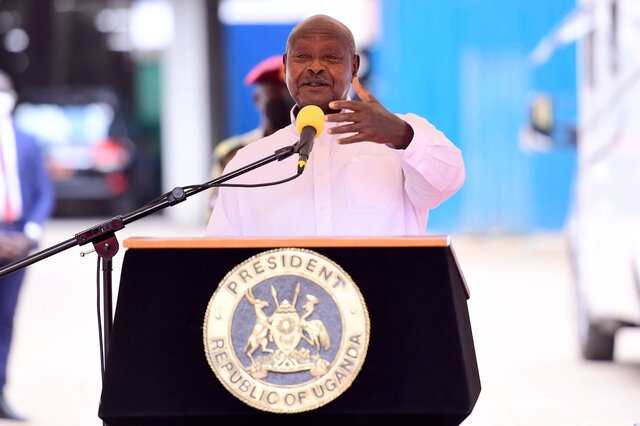
Kampala – Polls closed in Uganda on Thursday after a chaotic day of voting that took place under an internet blackout and with long delays caused by technical breakdowns as President Yoweri Museveni seeks to extend his 40 years in power.
Official results were due within 48 hours.
Wine accused the government of “massive ballot-stuffing” and arresting some of his party officials under cover of the internet blackout imposed by the government this week.
In many polling stations around the country, voting was delayed by several hours as ballot boxes were slow to arrive and biometric machines — used to verify voters’ identity — were malfunctioning, which some blamed on the internet blockage.
Uganda cuts internet off
UCC orders internet blackout ahead of Thursday’s polls
Uganda also bans sale and registration of new sim cardsNo outbound data roaming to one network area countries
Thembo: Block all non-essential public internet traffic#CitizenExplainer pic.twitter.com/lUVB77IDE4— Citizen TV Kenya (@citizentvkenya) January 13, 2026
“We are holding elections in the dark,” Wine said after casting his vote.
“This is done in order to facilitate the intended rigging of the regime,” he said. “We would encourage the people of Uganda to resist.”
But voting passed off peacefully. A spokesperson for the Ugandan Red Cross, which deployed across the country ahead of polls, told AFP they had heard “no substantive” reports of violence.
There was a heavy police and army presence throughout the day, with authorities determined to prevent the anti-government protests seen in neighbouring Kenya and Tanzania in recent months.
Museveni acknowledged even he had trouble with the voting machines and promised to investigate.
“I put my right… thumbprint. The machine did not accept it. I put my left, it did not accept it,” he told journalists, adding that the machine finally accepted a scan of his face, allowing him to vote.
Peace and security
As with Wine’s 2021 campaign, hundreds of his supporters were arrested in the run-up to the vote. He wore a flak jacket at rallies, describing the election as a “war” and Museveni as a “military dictator”.
Human Rights Watch has denounced this week’s suspension of 10 NGOs, including election monitors.
The government said the internet shutdown was needed to prevent the spread of “misinformation” and “incitement to violence”, but the United Nations called it “deeply worrying”.
The other major opposition figure, Kizza Besigye, who ran four times against Museveni, was abducted in Kenya in 2024 and brought back to a military court in Uganda for a treason trial that is ongoing.
DEVELOPING: Vote counting continues in Uganda after an election delayed by failures of biometric voter verification kits.
Bobi Wine says the internet was cut “to facilitate the intended rigging.” But President Yoweri Museveni claims that the opposition rigged the last election pic.twitter.com/mkcAuUAVzk
— Larry Madowo (@LarryMadowo) January 15, 2026
Many Ugandans still praise Museveni as the man who ended the country’s post-independence chaos and oversaw rapid economic growth, even if much was lost to a relentless string of massive corruption scandals.
“Peace and security in the country is very good. The party is well-organised,” said Angee Abraham Lincoln, 42, a Museveni supporter waiting to cast his vote in Kampala.
Western countries have often given Museveni leeway after he swallowed their demands for neoliberal reforms in the 1980s and made himself a useful partner in the US-led “war on terror” in the 2000s, especially through troop contributions to Somalia.
The president said his vote, when it was finally cast, was for anyone “who believes in Uganda… who believes in Africa.”
Follow African Insider on Facebook, X and Instagram
Picture: X/@KagutaMuseveni
For more African news, visit Africaninsider.com
Source: AFP